A recent comprehensive study has rigorously benchmarked the performance and capabilities of three dominant forces in data analysis—Structured Query Language (SQL), the Python-based Pandas library, and a leading artificial intelligence agent, Claude—across a spectrum of interview-style data challenges. Conducted using real-world questions sourced from StrataScratch, the comparison meticulously evaluated these tools across eight critical dimensions: speed, accuracy, explainability, debugging, scalability, flexibility, hallucination risk, and production readiness. The findings illuminate the distinct strengths and evolving roles of each technology in the modern data landscape, providing crucial insights for data professionals and organizations navigating increasingly complex analytical demands.
Methodology: A Rigorous Framework for Comparison
To ensure a fair and robust evaluation, the study employed a standardized methodology. Three interview questions, spanning Easy, Medium, and Hard difficulty levels, were selected from StrataScratch’s extensive bank, a platform renowned for preparing data scientists for technical interviews at top companies. This selection ensured that the challenges represented common analytical scenarios encountered in professional settings, from simple data retrieval to complex aggregations and window functions across multiple tables.
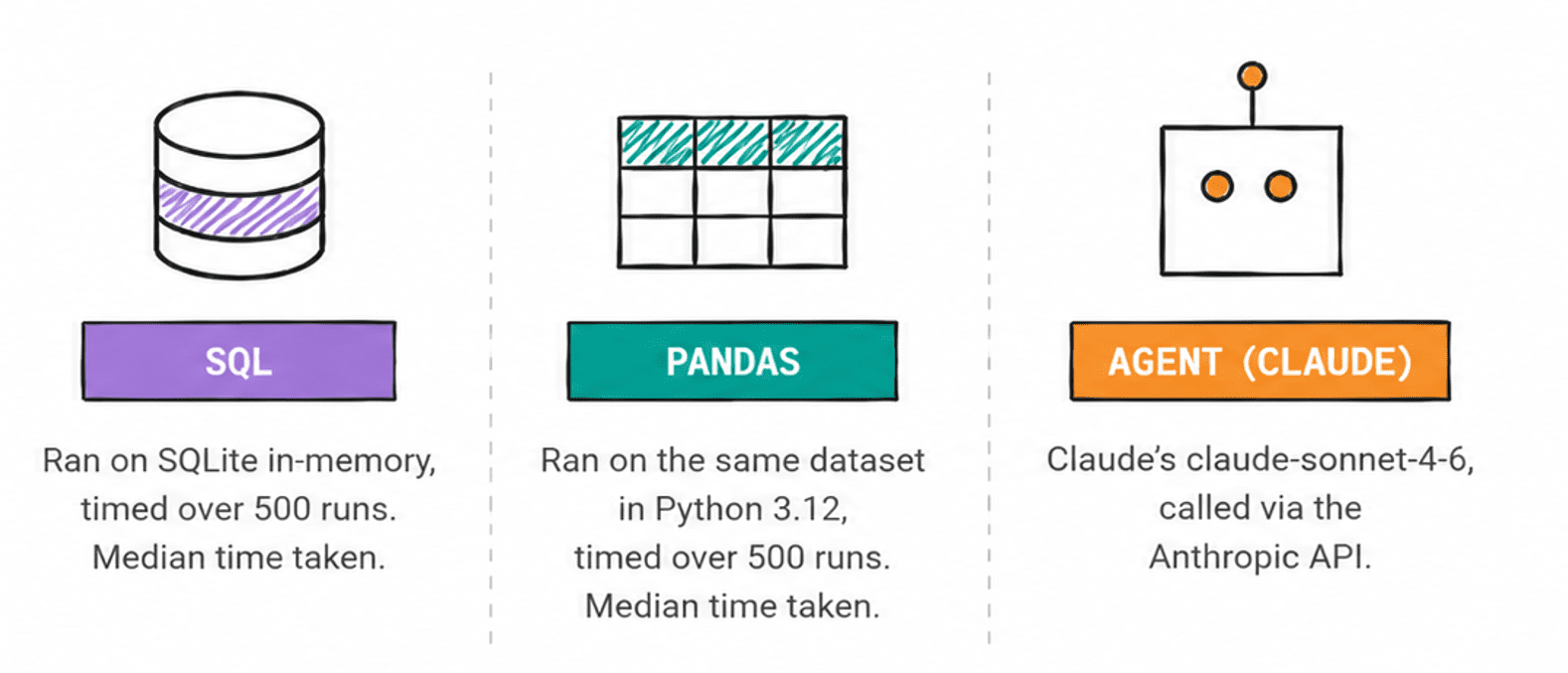
The execution environment was meticulously controlled. SQL queries were run on an in-memory SQLite database, a lightweight yet performant relational database system. Pandas operations were executed within Python 3.12, utilizing the standard library for data manipulation. For the AI agent, Anthropic’s claude-sonnet-4-6 model was invoked via its official API, representing a state-of-the-art large language model (LLM) capable of generating code from natural language prompts.
Performance metrics, specifically execution times, were captured as the median over 500 runs for both SQL and Pandas, a statistical approach designed to minimize transient system fluctuations and provide a stable measure of performance. For the AI agent, response times were measured from the moment the API request was sent until the first token of the generated output was received, reflecting the inherent inference latency of LLMs.
A crucial aspect of the AI agent’s evaluation was the use of "schema-grounded" user prompts. Each question included explicit details about table names, column names, and a few sample rows, alongside a consistent system prompt. This approach aimed to mitigate the risk of "hallucination," a known challenge with LLMs where models generate factually incorrect or irrelevant information, particularly in the absence of sufficient context. The generated agent answers were taken verbatim, providing an unvarnished view of its capabilities.
Case Study 1: Simple Retrieval – Unanimous Accuracy, Divergent Speeds
The initial challenge, an "Easy" question sourced from a Meta interview scenario, tasked participants with identifying distinct user IDs who had performed at least one scroll_up event from a single table, facebook_web_log. This problem tests basic filtering and uniqueness operations.
The facebook_web_log table contained user_id, timestamp, and action columns. Sample data included entries like (0, '2019-04-25 13:30:15', 'page_load') and (0, '2019-04-25 13:30:45', 'scroll_up').
Both SQL and Pandas provided straightforward and highly efficient solutions. The SQL query, SELECT DISTINCT user_id FROM facebook_web_log WHERE action = 'scroll_up';, executed in a mere 0.002 ms. Pandas, using facebook_web_log[facebook_web_log['action'] == 'scroll_up'].drop_duplicates(subset='user_id')[['user_id']], completed the task in 0.40 ms.
The Claude agent, presented with a prompt detailing the table schema and question, generated an identical SQL query to the human-written solution. However, its generation time was approximately 2 seconds. All three methods correctly identified the distinct user IDs.
This simple retrieval task underscored SQL’s unparalleled speed for direct data querying and Pandas’ efficiency for in-memory operations. The AI agent, while perfectly accurate, introduced a significant latency overhead due to the computational demands of large language model inference. Analysts noted that for such straightforward queries, the primary risk with AI agents, even with schema grounding, could be minor variations in column naming (e.g., event_type instead of action), which could lead to empty results without an explicit error. This highlights the ongoing need for human oversight, even on seemingly trivial tasks.
Case Study 2: Multi-Step Aggregation – The Criticality of Schema Grounding
The "Medium" difficulty question, related to product feature completion, presented a more intricate challenge. It required calculating the average completion percentage for each product feature across all users. A user’s completion was defined as their maximum step reached divided by the total steps for that feature, multiplied by 100. Crucially, users who had never interacted with a feature were to be counted as 0% complete. This necessitated joining data from two tables: facebook_product_features (containing feature_id and n_steps) and facebook_product_features_realizations (with feature_id, user_id, step_reached, and timestamp).
The SQL solution (0.007 ms) employed Common Table Expressions (CTEs) to first determine the maximum step reached per user per feature, then joined this with the feature definitions, using LEFT OUTER JOIN and COALESCE to correctly account for users with 0% completion. The Pandas solution (2.05 ms) followed a similar logical flow, using groupby().max(), pd.merge(how='outer'), and fillna(0) to handle the non-starters.
The AI agent’s prompt for this question was notably more verbose, explicitly stating: "Users who never started count as 0% completion." This specific instruction proved to be "load-bearing," meaning its inclusion was critical for generating the correct logic. The Claude agent produced a SQL query that correctly incorporated a LEFT JOIN and COALESCE function, mirroring the human-written SQL’s approach to handling zero-completion users. Its generation time was around 3 seconds. All three solutions yielded identical, correct average completion percentages for each feature.
This case study vividly demonstrated the profound impact of precise prompt engineering on AI agent accuracy. Without the explicit instruction to count non-starters as 0% complete, the agent might have defaulted to an INNER JOIN, silently excluding users who never began a feature. This would lead to an inflated and incorrect average, yet the output would appear perfectly structured and plausible. This "silent failure" mode is a significant concern for AI-driven analytics, underscoring the need for domain expertise to validate results, even when the generated code looks syntactically sound. Industry analysts suggest that this highlights a key limitation: while AI can generate code, it lacks the inherent business context to anticipate edge cases unless explicitly provided.

Case Study 3: Multiple Tables and Window Logic – Sophistication in Code Generation
The "Hard" difficulty question involved consolidating energy consumption data from three regional Meta data centers (fb_eu_energy, fb_na_energy, fb_asia_energy), each with recorded_date and consumption columns. The task required combining these tables, summing consumption by date, and then deriving two new columns: a cumulative running total of energy consumption and that total expressed as a percentage of the grand total, rounded to a whole number. This problem tests advanced SQL concepts like UNION ALL for combining tables, GROUP BY for aggregation, and window functions for cumulative sums.
The SQL solution (0.010 ms) skillfully used UNION ALL to merge the tables, then GROUP BY to aggregate daily consumption. Crucially, it employed window functions (SUM() OVER (ORDER BY recorded_date)) for the cumulative total and a scalar subquery (SELECT SUM(total_energy) FROM energy_by_date) to calculate the grand total for the percentage calculation. The Pandas solution (1.84 ms) paralleled this logic using pd.concat, groupby().sum(), cumsum(), and dividing by sum() for the grand total.
The AI agent’s prompt provided a clear breakdown of the required output columns and their definitions. Claude generated a highly efficient and correct SQL solution in approximately 4 seconds. Notably, for the percentage calculation, instead of a scalar subquery, the agent utilized SUM(daily_total) OVER (), a window function without an ORDER BY clause, which calculates the sum over the entire partition (effectively the grand total). This demonstrated an alternative, equally valid and often more performant, approach within SQL. The output table, containing recorded_date, cumulative_total_energy, and percentage_of_total_energy, was identical across all three methods.
This "Hard" question showcased the AI agent’s ability to generate sophisticated SQL, including complex window functions, and even propose elegant alternatives to human-written solutions. This capability suggests that AI agents can not only understand complex analytical requirements but also leverage diverse coding patterns to achieve the desired outcome. However, the consistent latency of AI inference remained a factor, distinguishing its role from the near-instantaneous execution of compiled SQL or optimized Pandas operations.
Comparative Analysis: A Deep Dive into Key Dimensions
The detailed comparison across these three questions provided a clear picture of the strengths and weaknesses of SQL, Pandas, and AI agents.
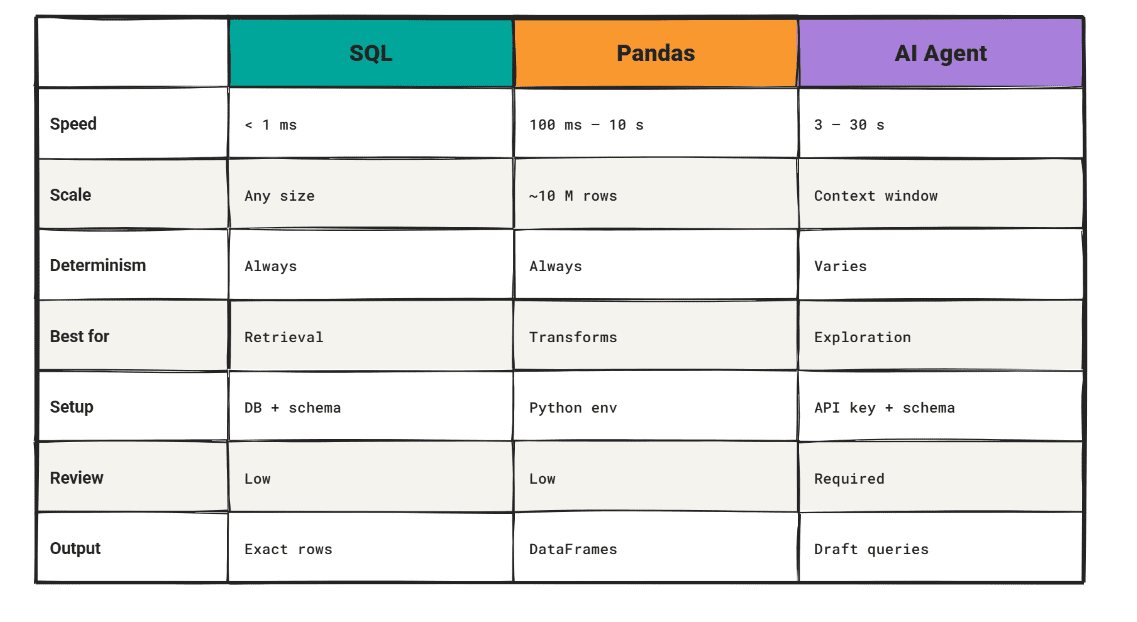
Speed: SQL consistently emerged as the fastest, executing operations in the sub-millisecond range (0.002-0.010 ms) due to its highly optimized nature within database engines. Pandas, while slower than SQL, was still very fast for in-memory operations (0.4-2.1 ms). The AI agent, however, introduced a significant latency bottleneck of 2-4 seconds for code generation before any execution could even begin. At warehouse scale, where data volumes routinely exceed tens or hundreds of millions of rows, the gap in execution time post-generation might narrow for SQL as it leverages database engine optimizations, while Pandas would typically hit memory ceilings, necessitating distributed computing frameworks like Apache Spark or Polars.
Accuracy and Hallucination Risk: SQL and Pandas are deterministic tools; identical code on identical data will always produce identical results. AI agents, being probabilistic models, exhibited variability. While Claude achieved 100% accuracy in this study with schema-grounded prompts, each API call often produced syntactically different but logically equivalent SQL. The risk of hallucination (generating incorrect but plausible code or explanations) dramatically increases when prompts lack detailed schema information, leading to silent failures that are difficult to detect without prior knowledge of the expected output.
Explainability and Debugging: A well-structured SQL query is often self-documenting, and errors are typically traceable to specific clauses or join conditions. Pandas code, while requiring Python fluency, allows for step-by-step inspection of the DataFrame, facilitating debugging. AI agents, conversely, provide explanations in natural language, followed by the generated code. Debugging an error in AI-generated code means not only understanding the code but also inferring the model’s "reasoning chain," which can be a more opaque process than debugging human-written code. This adds a layer of complexity for data professionals tasked with validating and maintaining AI-generated solutions.
Scalability: SQL, by design, scales effectively within robust database management systems, handling terabytes of data with optimized indexing and query plans. Pandas, being an in-memory library, scales well up to datasets that fit into RAM (typically around 10 million rows on standard workstations); beyond that, it requires distributed processing tools. AI agents, at present, generate code for other systems to execute, so their scalability is dependent on the execution engine they target (e.g., a SQL database). The challenge for AI agents lies in generating optimal, scalable code for extremely large and complex datasets without human intervention.
Flexibility: Pandas excels in scenarios requiring custom data transformations, string parsing, and iterative feature engineering within a Python environment. SQL is the lingua franca for set-based logic and relational operations, though it can become verbose for highly procedural tasks. AI agents offer unparalleled flexibility in translating diverse plain-English requests into executable code, democratizing data access for users less familiar with programming languages. However, their consistency can vary with the complexity or ambiguity of the schema and the prompt.
Production Readiness: SQL is the most mature and proven technology for production analytics, supported by decades of robust tooling, testing frameworks, and established best practices. Pandas, while dependable, typically requires comprehensive unit tests and careful resource management when deployed in production pipelines. AI agents are currently best suited for low-stakes queries, ad-hoc exploration, or environments where human review and validation of the generated output are mandatory before deployment. The variability in generated code, even if logically equivalent, adds a layer of complexity for version control, code reviews, and maintaining consistent production environments.
Broader Implications for Data Professionals and the Industry
The emergence of AI agents like Claude marks a significant inflection point in data analysis. While they introduce latency and necessitate careful prompt engineering, their ability to translate natural language into complex, correct code is transformative.
Democratization of Data Access: AI agents have the potential to significantly lower the barrier to entry for data analysis. Business users, analysts, and even non-technical stakeholders could, in theory, pose questions in plain English and receive executable code or direct answers, reducing reliance on specialized data teams for every query. This could accelerate insights and foster a more data-driven culture across organizations.
Evolving Role of Data Professionals: Rather than replacing data scientists and analysts, AI agents are likely to reshape their roles. Professionals will increasingly shift from solely writing code to designing robust data architectures, refining prompts for AI agents, validating AI-generated code and outputs, and focusing on higher-level problem-solving and strategic interpretation of data. The emphasis will move towards "AI-assisted analytics" where human expertise guides and verifies AI capabilities.
Hybrid Workflows: The study strongly suggests a future of hybrid workflows. For high-performance, mission-critical operations, SQL will likely remain indispensable. For iterative, custom transformations and detailed data wrangling, Pandas will continue to be a go-to. AI agents will find their niche in rapid prototyping, ad-hoc queries, initial code drafts, and for users who are less fluent in traditional coding languages. The seamless integration of these tools will be key.
Training and Education: The findings underscore the enduring importance of foundational skills in SQL and data literacy. Data professionals will need to understand the underlying principles of data manipulation to effectively prompt AI agents and, more importantly, to critically evaluate and debug their outputs. Education in prompt engineering and understanding LLM limitations will become as crucial as traditional programming skills.
Ethical Considerations and Governance: The "silent failure" observed in the Medium difficulty question highlights the ethical imperative for robust governance around AI-generated analytics. Organizations must establish clear protocols for validating AI outputs, particularly in sensitive domains, to prevent erroneous decisions based on hallucinated or subtly incorrect data. Data privacy and security implications of feeding sensitive schemas into third-party AI models also warrant careful consideration.
Conclusion: Complementary Tools in an Evolving Landscape
The rigorous comparison of SQL, Pandas, and Claude demonstrates that each tool possesses distinct advantages, making them complementary rather than mutually exclusive. SQL remains the gold standard for high-performance, deterministic data retrieval and manipulation within relational databases. Pandas provides a flexible and powerful environment for in-memory data wrangling and custom transformations within the Python ecosystem. AI agents, while introducing latency and requiring careful prompt engineering, showcase an impressive capability to generate complex, correct code from natural language, potentially democratizing data analysis.
The study unequivocally found that the AI agent, Claude, when provided with a comprehensive, schema-grounded prompt, could generate accurate and even creatively optimized SQL solutions for problems ranging from simple to hard. This ability, such as utilizing SUM() OVER() instead of a scalar subquery for the cumulative percentage, underscores its potential for innovative code generation. However, the inherent variability of LLM outputs and the critical dependence on prompt quality necessitate a "human-in-the-loop" approach for validation and debugging, especially in production environments.
As data volumes continue to explode and analytical demands grow, the future of data analysis will likely involve a synergistic integration of these tools. Data professionals will leverage the speed and reliability of SQL and Pandas for established workflows, while harnessing the intuitive power of AI agents for rapid exploration, code generation, and enabling broader access to data insights, always with a critical eye and rigorous validation. The ongoing evolution of AI models, coupled with advancements in prompt engineering and integration strategies, promises an exciting and dynamic future for the field of data science.