The field of quantum mechanics, once a domain of theoretical debate and philosophical inquiry, has increasingly become a theater of high-stakes engineering and technological innovation. At the heart of this transition is quantum entanglement, a phenomenon where particles become so inextricably linked that the state of one cannot be described independently of the others, regardless of the distance separating them. While the concept famously troubled Albert Einstein, who referred to it as "spooky action at a distance," modern physicists view it as the fundamental currency of the next technological revolution. A collaborative research team from Kyoto University and Hiroshima University has recently achieved a milestone in this field by successfully performing the first entangled measurement of a three-photon W state, a complex configuration of entanglement that had remained elusive for over a quarter of a century.
This breakthrough addresses a critical bottleneck in quantum information science: the ability to efficiently identify and verify the specific state of entangled particles. As quantum systems scale in complexity, the methods used to observe them must become more sophisticated. The success of the Kyoto and Hiroshima team signals a shift toward more scalable and robust quantum architectures, potentially accelerating the development of quantum computers, secure communication networks, and quantum teleportation protocols.
The Evolution of Quantum Measurement: Beyond Tomography
To understand the significance of this achievement, one must first consider the limitations of existing measurement techniques. In the classical world, measuring a system is straightforward; one can observe the properties of individual components to understand the whole. In the quantum world, however, the act of measurement is fraught with complexity.
The standard method for characterizing a quantum state is known as quantum state tomography. This process involves performing a vast number of measurements on many identically prepared copies of a quantum system to reconstruct its state. While effective for small systems, tomography suffers from what researchers call the "curse of dimensionality." As the number of photons or qubits in an entangled system increases, the number of measurements required grows exponentially. For a system involving many entangled photons, the time and resources needed for tomography become prohibitive, creating a serious obstacle for real-time quantum applications.
An alternative and far more efficient approach is the "entangled measurement." Unlike tomography, which estimates a state through statistical repetition, an entangled measurement can identify a specific entangled state in a single shot. By projecting the incoming particles onto a basis of entangled states, researchers can determine the nature of the correlation immediately. While scientists successfully demonstrated this for the Greenberger-Horne-Zeilinger (GHZ) state—a type of entanglement where all particles are perfectly correlated—the W state remained a formidable challenge.
Distinguishing the W State: Robustness and Complexity
In the landscape of multipartite entanglement, the W state and the GHZ state represent two distinct "classes" of entanglement. The GHZ state is often described as "fragile"; if one particle in a GHZ trio is measured or lost to the environment, the entanglement between the remaining particles is completely destroyed. In contrast, the W state is remarkably robust. If one particle is lost from a W state, the remaining particles retain a high degree of entanglement.
This robustness makes the W state highly desirable for practical quantum technologies, particularly in quantum networks where photon loss is a common occurrence. However, the very mathematical structure that makes the W state robust also makes it difficult to measure using traditional photonic circuits. Until the recent work by the Japanese team, no experimental method had been proven capable of performing a single-shot entangled measurement for W states.
"More than 25 years after the initial proposal concerning the entangled measurement for GHZ states, we have finally obtained the entangled measurement for the W state as well, with genuine experimental demonstration for 3-photon W states," stated Shigeki Takeuchi, the corresponding author of the study and a lead researcher at Kyoto University.
The Breakthrough: Cyclic Shift Symmetry
The research team overcame the measurement hurdle by identifying and exploiting a specific mathematical property of W states known as cyclic shift symmetry. In a three-photon W state, the particles are arranged such that a "shift" in their positions (e.g., photon 1 moves to 2, 2 to 3, and 3 to 1) leaves the overall state essentially unchanged in its structure, though it may acquire a specific phase.
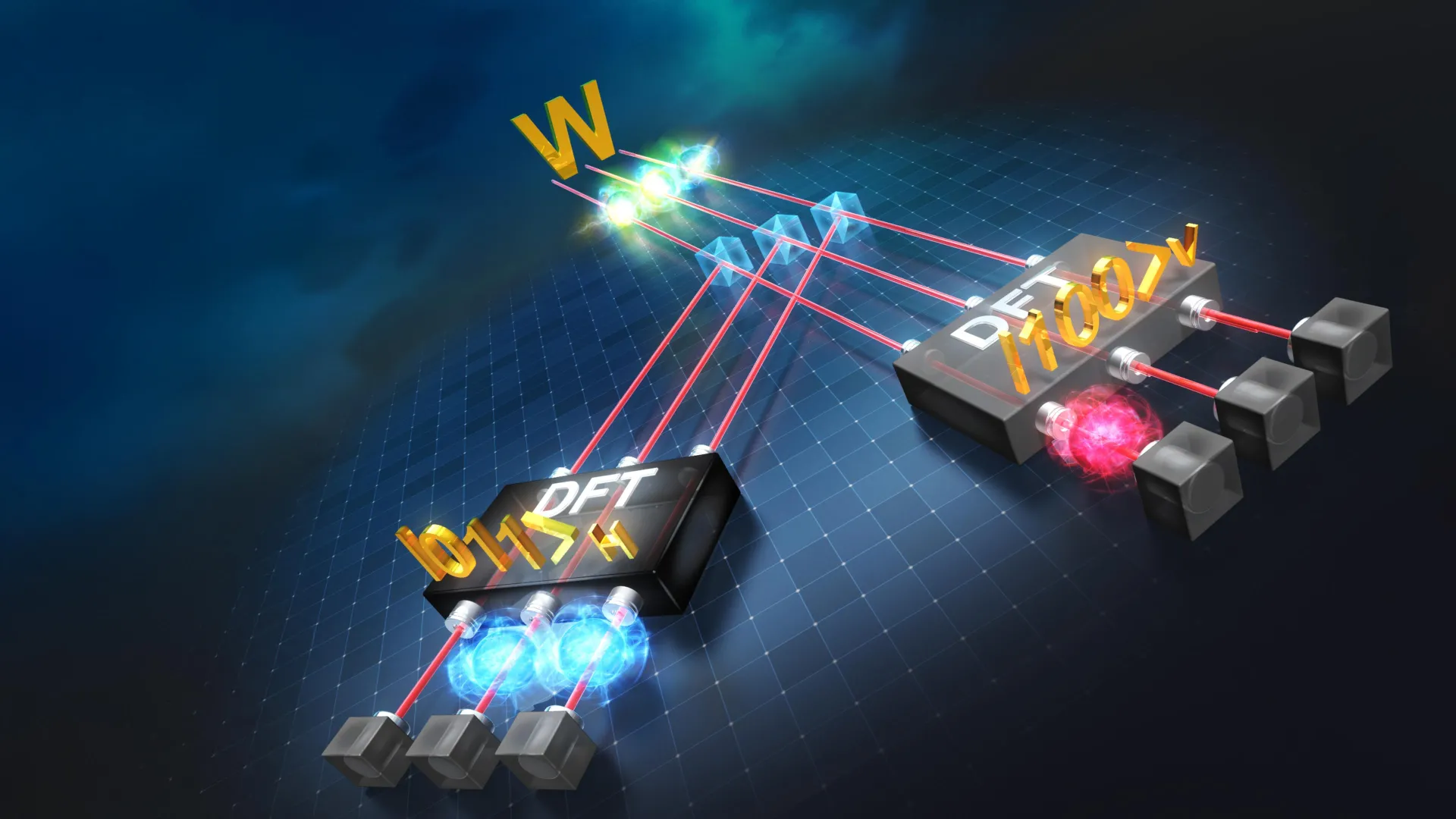
Using this symmetry, the researchers designed a specialized photonic quantum circuit. This circuit performs what is known as a Quantum Fourier Transform (QFT) specifically tailored for W states. By passing the photons through a series of beam splitters and phase shifters, the circuit "unpacks" the hidden correlations of the W state and maps them onto a measurable signal. This allows the device to distinguish between different types of three-photon W states based on which detectors are triggered.
Experimental Setup and Stability
The experimental demonstration involved the generation of three single photons, which were then injected into a highly stable optical quantum circuit. One of the primary technical hurdles in quantum optics is maintaining the phase stability of the light paths. Even a microscopic vibration or temperature change can shift the phase of a photon, destroying the delicate quantum interference required for the measurement.
The Kyoto and Hiroshima team developed a circuit that remained stable for extended periods without the need for active electronic feedback or constant manual adjustment. This "passive stability" is a crucial requirement for future quantum infrastructure. If quantum measurements are to be integrated into commercial networks or satellite communications, the hardware must be able to operate reliably in environments outside of a strictly controlled laboratory setting.
To evaluate the success of the device, the team measured the "fidelity" of the entangled measurement. In this context, fidelity represents the probability that the device correctly identifies the input state. The results confirmed that the circuit could successfully distinguish non-classical correlations among the three incoming photons with high accuracy, providing a functional blueprint for W-state detection.
A Timeline of Parallel Advancements (2025–2026)
The achievement by the Kyoto and Hiroshima team does not exist in a vacuum; it is part of a broader acceleration in quantum photonics. The timeline of 2025 and 2026 has seen several key milestones that complement the W-state breakthrough:
- Late 2025: Researchers achieved all-photonic quantum teleportation using photons generated from distinct quantum dots. This experiment, conducted across a hybrid urban network, proved that quantum information could be transferred between different types of hardware over real-world distances.
- Early 2026: A separate team reported the development of an integrated photonic chip capable of generating and manipulating "multipartite cluster states." These states are the backbone of measurement-based quantum computing, where the computation is performed by measuring entangled particles rather than using traditional logic gates.
- Mid-2026: In a significant move toward the "Quantum Internet," engineers in New York tested a three-node quantum network using existing fiber-optic cables. By utilizing "entanglement swapping," they successfully linked disparate quantum nodes, demonstrating that existing infrastructure could support quantum traffic.
These developments highlight the growing need for the Kyoto team’s measurement technique. As networks become more complex, the ability to verify W states—which are more resilient to the losses inherent in fiber-optic cables—will be essential for routing and error correction.
Analysis of Implications: Quantum Teleportation and Computing
The ability to perform entangled measurements on W states has profound implications for several branches of quantum technology.
1. Multi-Party Quantum Teleportation:
Quantum teleportation allows the transfer of a quantum state from one location to another without moving the physical particle. Most current protocols focus on bipartite (two-party) teleportation. The measurement of W states enables "multi-party" teleportation, where a single sender can distribute information to multiple receivers simultaneously, or where multiple inputs are combined into a single quantum output.
2. Measurement-Based Quantum Computing (MBQC):
In MBQC, a large entangled state (a cluster state) is prepared at the start. The actual computation is then "driven" by performing a sequence of measurements on the particles. The ability to identify and measure complex entangled states like the W state expands the toolkit available for MBQC, potentially leading to more efficient algorithms and better error-correction codes.
3. Quantum Communication Protocols:
In secure communication, W states can be used for "Quantum Secret Sharing," where a message is split among several parties such that no single person (or small group) can read it without the cooperation of the others. The robustness of the W state ensures that even if one communication channel is noisy or interrupted, the secret remains recoverable.
Future Directions: Scaling and Integration
The Kyoto University and Hiroshima University team is already looking toward the next phase of their research. While the current demonstration used three photons, the theoretical framework based on cyclic shift symmetry is applicable to W states with any number of photons. The researchers plan to scale the system to four or more photons, which would exponentially increase the information-carrying capacity of the system.
Furthermore, the team is working on "on-chip" integration. By shrinking the large-scale optical setups onto silicon or lithium niobate chips, they hope to make entangled measurements faster, smaller, and more practical for mass production.
"In order to accelerate the research and development of quantum technologies, it is crucial to deepen our understanding of basic concepts to come up with innovative ideas," Takeuchi emphasized.
As the world edges closer to the realization of a global quantum network, the ability to accurately and efficiently "read" the language of entanglement will be the defining factor of success. The demonstration of the W-state measurement marks a definitive step away from the "spooky" mysteries of the past and toward a future where quantum correlations are a standard tool of the information age.