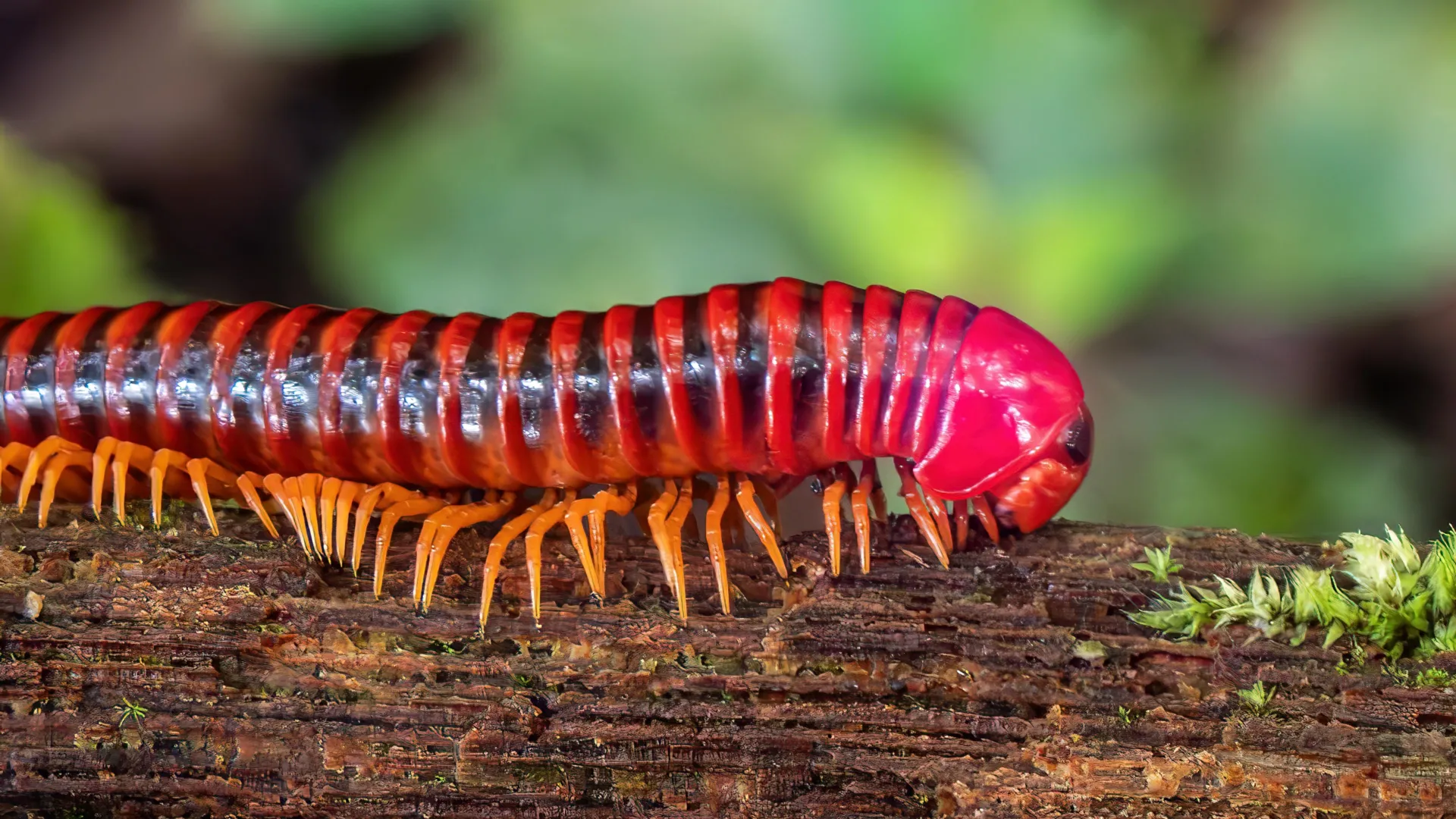
For hundreds of millions of years before dinosaurs roamed the Earth and long before vertebrates dared to venture onto land, millipedes were already a dominant force, silently shaping the planet’s nascent terrestrial ecosystems. These humble, segmented decomposers, often overlooked in the grand narrative of life’s evolution, have now taken center stage thanks to a landmark international study led by Virginia Tech researchers. The comprehensive work, published in the prestigious journal Current Biology, provides the first complete evolutionary history of all living millipede orders, effectively filling a critical void in our understanding of these ancient creatures and their profound impact on preparing Earth for complex life.
The study pushes back the estimated origins of millipedes to nearly 460 million years ago, a staggering antiquity that predates the oldest millipede fossils ever discovered by an estimated 35 million years. This revised timeline places millipedes as some of the earliest pioneers of terrestrial life, predating the arrival of vertebrates on land by over 80 million years. "Millipedes beat vertebrates onto land by more than 80 million years," stated Dr. Paul Marek, the study’s lead investigator and an associate professor in Virginia Tech’s Department of Entomology within the College of Agriculture and Life Sciences. "They really set the stage for later life on land, including humans and vertebrates."
Solving a Century-Old Millipede Enigma
A significant hurdle in understanding millipede evolution for over a century involved two exceptionally rare and enigmatic groups: Siphoniulida and Siphonocryptida. Their elusive nature and the scarcity of fresh specimens had rendered them largely inaccessible to genetic analysis, leaving their precise placement within the broader millipede family tree a persistent mystery. These two groups represented the "white whales" of millipede research, their evolutionary secrets guarded by their reclusive lifestyles.
One of these groups comprises minute millipedes, measuring less than a centimeter in length, which spend their entire lives concealed beneath the soil. The other group is known to inhabit only a handful of geographically isolated locations, making their discovery and study exceptionally challenging. The quest to finally capture and analyze these elusive lineages led researchers on an ambitious expedition to remote corners of the globe.
The intrepid team journeyed to the lush biodiverse region of Los Tuxtlas in Mexico and the windswept Canary Islands of Spain. Their arduous efforts were rewarded with the collection of Siphoniulus neotropicus from Mexico and Hirudicryptus canariensis from the Canary Islands – two species whose genetic material had never before been incorporated into evolutionary studies.
Luisa "Fernanda" Vasquez-Valverde, a Ph.D. candidate in Marek’s lab and the paper’s first author, described the intense fieldwork. "It took 10 people over a week just to find this one tiny 10-millimeter adult," she recounted. "Finding them in the field was hard because we were just seeing this little white nematode. We didn’t know for sure it was a millipede until we looked under the microscope." This anecdote underscores the dedication and meticulous observation required to uncover these hidden components of Earth’s biodiversity.
A New Dawn for Millipede Phylogeny
With the critical genetic samples in hand, the researchers embarked on a massive undertaking. They meticulously sequenced DNA from these two elusive groups and then conducted a comprehensive comparative analysis. This involved examining hundreds of genes across a diverse array of 82 living millipede species. To provide a robust temporal framework, the study also integrated data from 29 meticulously preserved millipede fossils, spanning millions of years of evolutionary history.
The sheer volume of data generated by this project was immense, resulting in terabytes of genetic information. The reconstruction of these complex evolutionary relationships, stretching back nearly half a billion years, was made possible through the substantial computational power provided by Virginia Tech’s Advanced Research Computing resources. This technological backbone was crucial in processing and analyzing the vast datasets required to build a reliable phylogenetic tree.
The results of this painstaking research have fundamentally reshaped our understanding of millipede taxonomy. The study revealed that Siphonocryptida, previously considered a distinct millipede order, actually represents a lineage nested within an existing, well-established group. This finding significantly simplifies the millipede classification. Siphoniulida, on the other hand, was finally and definitively placed alongside its closest evolutionary relatives, resolving a long-standing taxonomic puzzle.
Millipedes: Architects of an Ancient, Barren Earth
The revised evolutionary timeline derived from this study paints a vivid picture of an Earth vastly different from the one we inhabit today. The estimated origin of millipedes around 460 million years ago places them among the vanguard of life colonizing the terrestrial realm. At this epoch, the Earth’s surface was a stark and largely lifeless expanse.
"There were no vertebrates, no trees, no leaves, no flowering plants, no plants with seeds," Dr. Marek emphasized, highlighting the primordial conditions millipedes encountered. In this nascent terrestrial environment, millipedes acted as crucial ecosystem engineers. Their primary role was that of decomposers, diligently feeding on decaying organic matter – primarily primitive mosses, decomposed microbial mats, and other organic detritus that formed the rudimentary ground cover.
By breaking down this organic material, millipedes played an indispensable role in nutrient cycling. This process was vital for transforming the barren land into a substrate capable of supporting future plant life, thus paving the way for the subsequent evolution of more complex terrestrial ecosystems. Without these early decomposers, the accumulation of organic matter might have inhibited the development of plant life, profoundly altering the trajectory of life on Earth.
The Dawn of Millipede Chemical Warfare
Beyond their foundational role in terrestrialization, the newly constructed evolutionary tree has also shed light on the origins of one of the millipedes’ most remarkable and enduring adaptations: their sophisticated chemical defense mechanisms. Many millipede species possess glands that can secrete a variety of noxious compounds, serving as a potent deterrent against predators.
The study’s analysis suggests that these chemical defenses first emerged approximately 260 million years ago. This provides the clearest empirical evidence to date for the evolutionary timeline of this crucial survival strategy. "They made the first chemical weapons," Dr. Marek remarked, underscoring the pioneering nature of this adaptation. "They’re little chemical factories." The development of these chemical arsenals would have been a significant evolutionary advantage, allowing millipedes to thrive in an environment populated by newly evolving predators.
Unsung Heroes of Ecosystem Health
Even today, millipedes continue to perform their vital ecological functions as some of the world’s most significant detritivores. Their tireless work in breaking down dead plant material is fundamental to nutrient recycling, soil aeration, and the overall health and stability of ecosystems globally.
Despite their ecological importance, millipedes remain surprisingly understudied and often unknown to the general public. "It’s really kind of puzzling that they have such an important function in the ecosystem, and yet they’re so poorly known," Dr. Marek commented.
The sheer diversity of millipedes is also astonishing, with over 14,000 species formally described worldwide. However, researchers estimate that tens of thousands more species remain undiscovered, hidden in diverse habitats from the dense tropical forests to the urban landscapes. Dr. Marek and his students have themselves contributed to this ongoing discovery, identifying new species in unexpected locations, including the campus of Virginia Tech in Blacksburg and even the metropolitan area of Los Angeles.
For emerging scientists like Luisa Vasquez-Valverde, this vast potential for discovery is a primary driving force. "There is all this potential for discovery," she expressed with enthusiasm. "It keeps me wondering what else we’re going to find." This sense of exploration and the thrill of uncovering unknown facets of biodiversity fuel the continued research into these ancient and vital creatures.
The groundbreaking research was made possible through the generous funding of the National Science Foundation. The collaborative effort involved a diverse team of scientists from prestigious institutions including the Field Museum of Natural History, Hampden-Sydney College, Universidad de La Laguna, Virginia Tech’s School of Plant and Environmental Sciences, the Australian National Insect Collection, West Virginia University, and Universidad Autonoma del Estado de Hidalgo, highlighting the global significance and reach of this endeavor.