

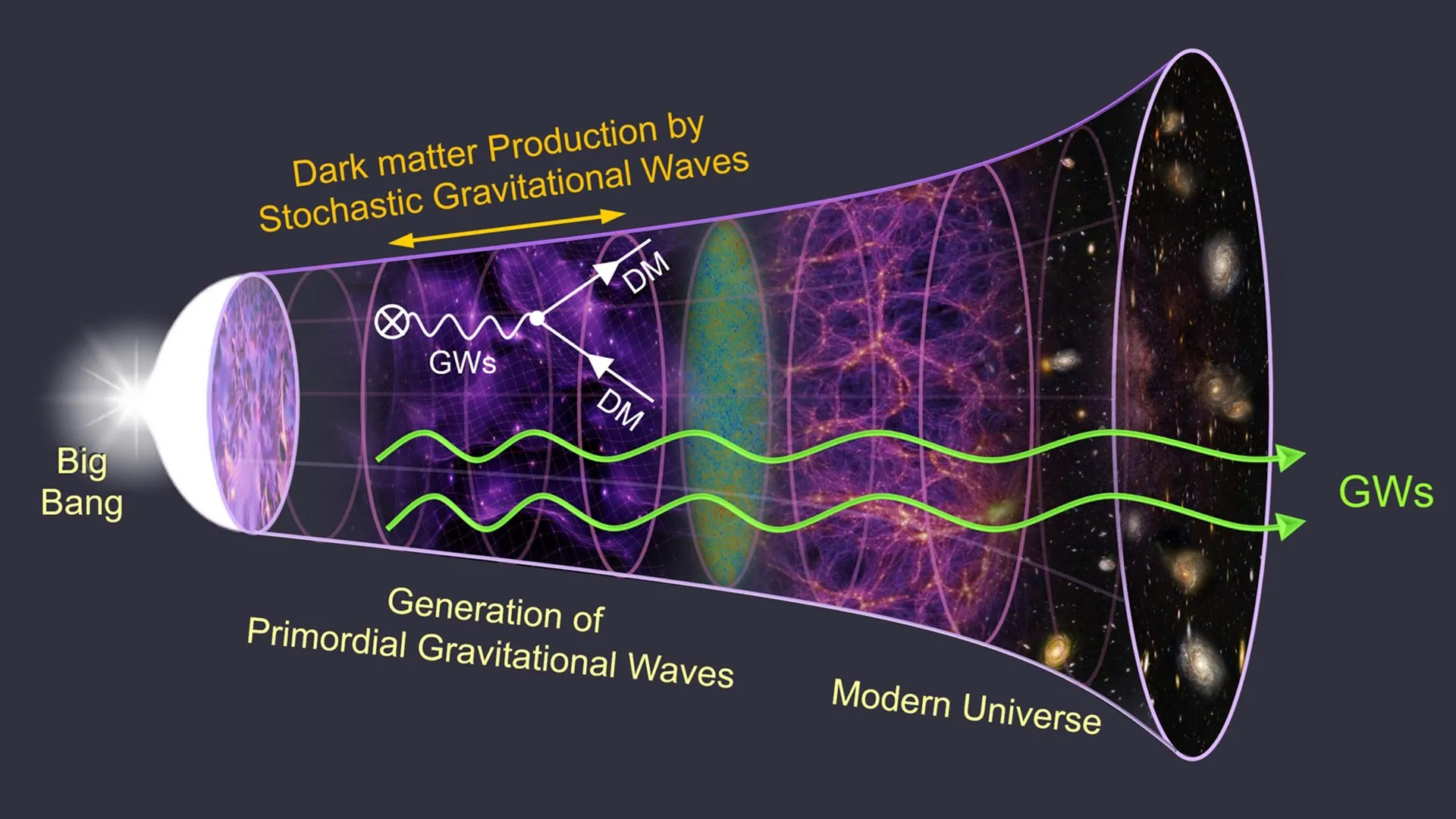
The fundamental nature of the universe remains one of the most significant enigmas in modern science, particularly regarding the elusive substance known as dark matter. A groundbreaking study led by Professor Joachim Kopp of Johannes Gutenberg University Mainz (JGU) and the PRISMA++ Cluster of Excellence, in collaboration with Dr. Azadeh Maleknejad from Swansea University, has proposed a transformative theory that could redefine our understanding of cosmic origins. Published in the prestigious journal Physical Review Letters, the research introduces a sophisticated theoretical framework suggesting that stochastic gravitational waves—ripples in the fabric of spacetime—may have been the primary catalyst for the creation of dark matter during the universe’s infancy. This study moves beyond traditional particle physics models, offering a mechanism where the energy inherent in the early universe’s gravitational background was converted into the particles that now dictate the structure of the cosmos.
The Dark Matter Problem: A Search for the Missing Mass
To understand the significance of this new research, one must first consider the current state of cosmology. For decades, astronomers and physicists have grappled with a glaring discrepancy: the visible matter we observe—stars, planets, gas clouds, and galaxies—accounts for a mere four percent of the total energy density of the universe. The remaining 96 percent is composed of dark energy (approximately 73 percent) and dark matter (approximately 23 percent).
Dark matter does not emit, absorb, or reflect light, making it invisible to traditional telescopes. Its existence is inferred through its gravitational effects on visible matter. For instance, galaxies rotate at speeds that should cause them to fly apart if only visible matter were present; the presence of an unseen "halo" of dark matter provides the necessary gravitational glue to hold them together. Despite its ubiquity, decades of experimental efforts using underground detectors, such as the LUX-ZEPLIN (LZ) and XENONnT experiments, have yet to produce a direct detection of a dark matter particle. This lack of empirical evidence has led theorists to explore alternatives to the long-standing "Weakly Interacting Massive Particle" (WIMP) hypothesis, paving the way for the gravitational wave theory proposed by Kopp and Maleknejad.
Understanding Stochastic Gravitational Waves
Gravitational waves were first predicted by Albert Einstein in 1916 as part of his General Theory of Relativity. They are essentially oscillations in spacetime caused by the acceleration of massive objects. While the Laser Interferometer Gravitational-Wave Observatory (LIGO) and Virgo detectors have successfully captured high-intensity waves from cataclysmic events like black hole mergers, the study by JGU and Swansea University focuses on a different phenomenon: stochastic gravitational waves.
Unlike the discrete signals from colliding black holes, stochastic gravitational waves represent a continuous, random background "hum" that fills the universe. These waves are thought to be remnants of the extreme conditions following the Big Bang. They can be generated by a variety of primordial processes, including cosmic inflation, phase transitions as the early universe cooled, or the turbulence of primordial magnetic fields. Because these waves are incredibly weak and permeate all of space, they have been difficult to isolate, but they carry vital information about the first moments of existence.
The Mechanism: From Spacetime Ripples to Fermions
The core of the new research lies in the mathematical demonstration of how these stochastic waves could interact with quantum fields to produce particles. The researchers suggest that the high-energy environment of the early universe allowed for a process where gravitational wave energy was converted into fermions.
Fermions are a category of subatomic particles that follow the Pauli exclusion principle and include electrons, quarks, and neutrinos. In the model proposed by Kopp and Maleknejad, these fermions were initially produced in a massless or near-massless state. As the universe expanded and cooled, these particles underwent a secondary process—potentially involving a mechanism similar to the Higgs field—where they acquired mass. Once mass was acquired, these particles became the stable, non-luminous matter that we now identify as dark matter.
"In this article, we investigate the possibility of gravitational waves—which are believed to have been ubiquitous in the early universe—being partially converted into dark matter particles," Professor Joachim Kopp explained. This conceptual shift is significant because it treats gravity not just as a force that dark matter exerts, but as the very source from which dark matter emerged.
A Chronology of the Early Universe and Particle Formation
The timeline proposed by the researchers fits into the established cosmological model while adding specific milestones for dark matter production:
- The Inflationary Epoch (approx. 10^-36 to 10^-32 seconds post-Big Bang): The universe undergoes rapid expansion. This period generates a background of primordial gravitational waves.
- The Stochastic Wave Era: As the universe continues to expand, various phase transitions and magnetic fluctuations contribute to the stochastic gravitational wave background, creating a high-density environment of spacetime ripples.
- Fermion Production: The interaction between these intense gravitational waves and the vacuum of space triggers the creation of massless fermions. This is a purely gravitational production method, independent of the thermal history of the universe.
- Mass Acquisition: As the temperature of the universe drops further, these fermions interact with scalar fields, gaining mass and effectively "freezing out" to become dark matter.
- Structure Formation: Over billions of years, these dark matter particles clump together, creating the gravitational wells that allow visible matter to form galaxies and clusters.
Supporting Data and Theoretical Implications
The research published in Physical Review Letters is based on rigorous analytical estimates and quantum field theory calculations. By modeling the coupling between gravity and fermionic fields in a curved spacetime, the team was able to show that the energy density of the resulting dark matter matches the observed density required by current cosmological data.
One of the most compelling aspects of this theory is that it addresses the "WIMP Miracle" fatigue in the scientific community. For years, scientists expected dark matter to be a particle that interacts via the weak nuclear force. However, the failure of the Large Hadron Collider (LHC) to find such particles has left a vacuum in the field. The Kopp-Maleknejad model provides a "gravity-only" or "gravity-dominant" origin story that does not require dark matter to have any interactions with the Standard Model of particle physics other than through gravity, which would explain why it has been so difficult to detect in traditional laboratory settings.
Official Responses and Scientific Context
The scientific community has reacted to the study with cautious optimism, noting that it opens a new "window" into the early universe. Professor Kopp has emphasized that while the analytical framework is robust, the next phase of the project involves high-complexity numerical simulations.
"The next step in developing this line of research is to go beyond our analytical estimates and conduct numerical calculations to improve the accuracy of our predictions," said Kopp. He also noted that this research could have far-reaching implications for other mysteries in physics, such as the matter-antimatter asymmetry. Currently, science cannot fully explain why the universe is dominated by matter rather than having equal parts matter and antimatter, which would have resulted in total annihilation. Kopp suggests that the same gravitational wave mechanisms that created dark matter might also have influenced the production of particles over antiparticles.
Dr. Maleknejad’s contribution from Swansea University highlights the interdisciplinary nature of the work, combining expertise in high-energy physics and theoretical cosmology. The collaboration underscores the importance of the PRISMA++ Cluster of Excellence in Mainz, which is dedicated to exploring the fundamental forces and particles that constitute our world.
Broader Impact and Future Observation
The implications of this theory extend to future space missions and observational technology. If dark matter was indeed produced by stochastic gravitational waves, then the characteristics of the dark matter we see today are intrinsically linked to the properties of the early universe’s gravitational background.
Future detectors, such as the Laser Interferometer Space Antenna (LISA)—a joint mission between ESA and NASA scheduled for the mid-2030s—may be able to detect the stochastic gravitational wave background with greater precision. Furthermore, pulsar timing arrays, which monitor the timing of signals from distant stars to detect spacetime distortions, could provide data that validates or refines the calculations presented in this study.
If confirmed, this theory would solve one of the most persistent puzzles in physics. It would transition dark matter from a "ghostly" unknown to a predictable byproduct of the universe’s initial expansion. By linking the largest structures in the cosmos (galaxies) to the smallest fluctuations in spacetime (gravitational waves), the research by Kopp and Maleknejad provides a unified narrative for the history of matter itself.
As the scientific community awaits numerical verification, the study stands as a significant milestone in theoretical physics, shifting the focus from searching for dark matter via traditional particle collisions to searching for its origins in the very fabric of the early cosmos. The discovery suggests that we are not merely living in a universe filled with dark matter, but in a universe that was literally sculpted into existence by the ripples of the Big Bang.













Leave a Reply