In an era dominated by artificial intelligence tools that promise ever-increasing capabilities and seamless, feature-rich integrations, a new player has emerged that deliberately defies this trend. Pi, a coding agent developed by Mario Zechner and subsequently acquired by Earendil Inc., distinguishes itself by embracing a philosophy of radical minimalism, eschewing many of the built-in functionalities that its competitors champion. This approach, which prioritizes core functionality and extensibility over a comprehensive, out-of-the-box feature set, presents a compelling alternative for developers seeking greater control and transparency in their AI-assisted workflows.
The current landscape of AI coding agents is characterized by a fierce competition to offer "more capability, less setup." Tools like Claude Code, for instance, boast sophisticated features such as sub-agent management, a dedicated plan mode for complex tasks, and intricate permission flows designed to streamline development. Cursor takes this integration a step further by wrapping an entire Integrated Development Environment (IDE) around its underlying AI model, promising an all-encompassing experience. The prevailing narrative is one of convenience and comprehensive automation. Pi, however, challenges this narrative head-on. Its official documentation conspicuously lists what it refuses to build in: no Multi-Agent Communication Protocol (MCP) support, no sub-agent orchestration, no plan mode, no intrusive permission pop-ups, no integrated to-do lists, and no background bash execution. This deliberate abstention from common features makes Pi a unique proposition, prompting a closer examination of its design principles and practical implications.
Genesis and Strategic Evolution: Mario Zechner’s Vision and Earendil Inc.’s Acquisition
The inception of Pi can be traced back to Mario Zechner, a respected figure in the software development community, particularly renowned for his foundational work on libGDX, a popular Java game development framework. Zechner’s profound understanding of software architecture and developer needs informed his critical perspective on mainstream AI coding harnesses. In November 2025, he published a lengthy and unusually candid essay, articulating his motivations for building Pi. His core argument was structural: existing coding agents often inject hidden context into their operations, exhibit unpredictable behavior changes between releases, and offer limited visibility into the precise information the underlying model receives. This opacity, Zechner argued, undermines developer control and trust. His solution was to build the antithesis of this trend: a compact, transparent core loop surrounded by clearly defined extension points, rather than a monolithic, feature-complete product with a rigid mode of operation.
Zechner’s vision quickly resonated within the developer community, attracting significant attention and momentum. A pivotal moment occurred in January 2026 when Armin Ronacher, the esteemed creator of widely used Python frameworks Flask and Jinja2, publicly endorsed Pi. In a technical essay, Ronacher hailed Pi as the "minimal agent worth building around," a powerful affirmation from a highly influential voice in the open-source world. This endorsement significantly amplified Pi’s profile, signaling its potential to become a foundational tool in the evolving AI landscape.
Roughly two months later, in March 2026, Ronacher’s company, Earendil Inc., formally acquired the Pi project. This strategic move brought Zechner into Earendil as a major stakeholder and coincided with the launch of Lefos, a companion cloud platform designed to complement Pi’s capabilities. The acquisition was accompanied by a formal governance document, RFC 0015, which outlined a clear commitment to maintaining Pi’s core under an MIT license. Crucially, this document also reserved space for paid, "Fair Source" layers and hosted services built atop the free core. This open-core structure, common in infrastructure software, provides a sustainable business model for Earendil while ensuring the core remains accessible and open-source. For developers considering building workflows around Pi, understanding this upfront is essential, as it defines the boundaries between free, community-driven development and commercial offerings.
The project’s burgeoning popularity is evident in its rapid ascent on GitHub. As of this writing, Pi’s GitHub repository has garnered over 70,000 stars and continues to climb. This significant number for a tool that markets itself primarily on its deliberate limitations underscores a growing appetite within the developer community for transparent, controllable, and extensible AI assistants. Confirming the current release against its official news page, a fresh installation reported pi --version as 0.80.3, ensuring consistency and reliability for users.
The Lean Core: Understanding Pi’s Deliberate Omissions and Their Rationale
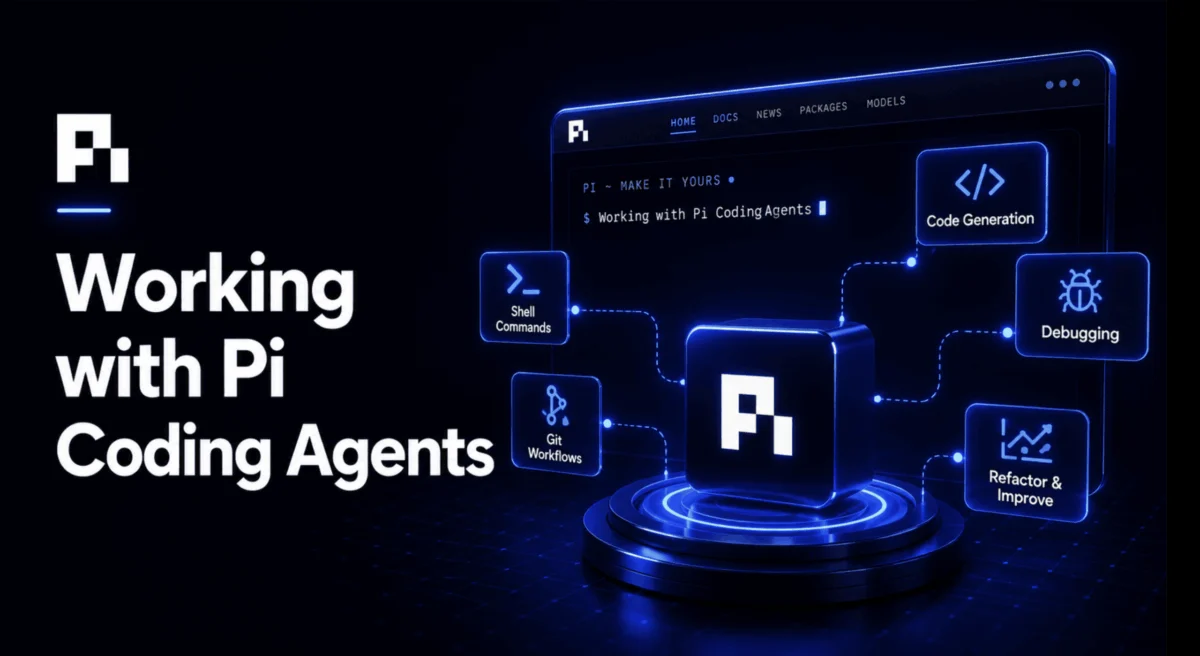
At the heart of Pi’s minimalist design lies its remarkably constrained built-in toolset, comprising just four fundamental operations: read, write, edit, and bash. This is not merely a starting point for future expansion but, by design, the entirety of its core functionality. A direct query to the installed binary, pi --help, confirms this, describing itself as an "AI coding assistant with read, bash, edit, write tools." This stark simplicity stands in sharp contrast to the feature-rich environments offered by competing agents.
Everything beyond these four tools—which other agents might ship natively—Pi categorizes as an extension, something users are expected to add as needed. Its documentation explicitly details these omissions: no native MCP support, no sub-agent orchestration, no plan mode for sequential task breakdown, no permission confirmation pop-ups for potentially risky actions, no integrated to-do tracking, and no background bash execution.
The rationale behind these deliberate omissions is multi-faceted, encompassing both philosophical and pragmatic considerations, particularly regarding token costs. Reports on comparable coding agents often indicate that their default system prompts can consume anywhere from 7,000 to 10,000 tokens before a user even inputs a query. This substantial token cost recurs with every single API call throughout the session, accumulating rapidly and impacting both performance and operational expenses. In contrast, Pi’s system prompt is engineered to run under 1,000 tokens. The only additional context it injects beyond this minimal prompt comes from user-defined AGENTS.md files—a global one for all sessions and a project-specific one, both fully visible and editable by the developer.
The core hypothesis underpinning this design is that modern frontier models, having been extensively reinforcement-learning-trained on a vast array of agentic tasks, already possess an inherent understanding of what a coding agent is supposed to do. By minimizing the system prompt, Pi’s developers posit that more of the model’s precious context budget is freed up for the actual problem-solving and coding tasks, rather than being consumed by elaborate instructions on how to behave or manage complex internal states. Whether this bet pays off in terms of efficiency and effectiveness depends heavily on the specific use case and the user’s willingness to embrace Pi’s extensible paradigm.
Practical Application: Installation, Workflow, and Advanced Session Management
Engaging with Pi begins with a straightforward installation process. It is distributed as an npm package under Earendil’s scope, making it accessible to a broad developer base familiar with Node.js tooling. The recommended installation command, npm install -g --ignore-scripts @earendil-works/pi-coding-agent, explicitly suggests the --ignore-scripts flag, reflecting Pi’s commitment to security and transparency by preventing arbitrary script execution during installation. Alternatively, macOS and Linux users can opt for a standalone installer script via curl.
During a practical test, executing the npm install command in a clean environment completed in approximately eleven seconds, downloading 131 packages and successfully placing a working pi binary on the system path. Immediately verifying the installation with pi --version returned 0.80.3, confirming a successful and operational setup.
Authentication within Pi offers two primary pathways. For providers that support it, initiating a /login command within a Pi session triggers an OAuth flow, facilitating subscription-based access. For other providers or for direct API key management, users can set their API key as an environment variable before launching Pi (e.g., export ANTHROPIC_API_KEY=sk-ant-your-key-here). Project-specific keys can also be managed using pi config set.
Once authenticated, starting a Pi session is as simple as navigating to the desired project directory and typing pi. This action drops the user into Pi’s terminal interface, with its four built-in tools live and any AGENTS.md file present in the directory loaded as project-specific context. The interface is designed for efficiency: the /model command allows for seamless switching between different AI model providers mid-session (e.g., /model sonnet, /model gpt-5, or even a local Ollama model). For frequent model switching, Ctrl+P cycles through pre-configured favorites without requiring the full command.

Pi’s documentation confirms its extensive support for over 15 major AI model providers, a critical feature for developers seeking flexibility and avoiding vendor lock-in. This includes industry giants like Anthropic, OpenAI, Google, Azure, AWS Bedrock, Mistral, Groq, Cerebras, xAI, Hugging Face, OpenRouter, and Ollama for fully local models. This comprehensive provider list, which the CLI itself references when no key is configured, underscores Pi’s role as a truly universal harness, capable of leveraging the strengths of various large language models.
A particularly noteworthy detail for teams undertaking complex, iterative development is Pi’s unique approach to session management. Unlike most chat-style agent interfaces that treat interactions as linear logs, Pi stores sessions as trees. The /tree command enables users to navigate back to any earlier point in a conversation, branch off with a new line of inquiry, and preserve every branch within a single session file rather than overwriting previous attempts. This genuinely different mental model facilitates exploratory coding, allowing developers to experiment with multiple approaches to a problem without losing valuable context or progress, ultimately enhancing productivity and iterative refinement.
The Power of Extension: Customizing Pi for Specific Needs
Pi’s minimalism truly comes into its own when developers leverage its robust extension API. Since the core intentionally omits features like built-in permission confirmations for potentially destructive bash commands (e.g., rm -rf or a forced git push), users are empowered—and expected—to build these functionalities themselves using TypeScript extensions. This paradigm shifts the responsibility and flexibility for safety rails and custom tooling directly to the developer, allowing for a security model tailored to specific threat models rather than a one-size-fits-all approach.
Consider a practical example: a permission-gate.ts extension. This snippet, designed to be loaded into Pi, demonstrates how to implement both a security layer and a custom utility tool.
// permission-gate.ts
import type  ExtensionAPI  from "@earendil-works/pi-coding-agent";
import  Type  from "typebox";

export default function (pi: ExtensionAPI)
  // Permission gate: confirm before pi runs anything that looks destructive
  pi.on("tool_call", async (event, ctx) =>
    if (event.toolName === "bash" && typeof event.input.command === "string") bgits+pushs+--forceb/;
      if (risky.test(event.input.command))
        const ok = await ctx.ui.confirm(
          "Risky command",
          `Allow: $event.input.command`
        );
        if (!ok)
          return  block: true, reason: "Blocked by permission gate extension" ;


  );

  // A small custom tool the model can call directly
  pi.registerTool(
    name: "count_words",
    label: "Count Words",
    description: "Counts words in a block of text.",
    promptSnippet: "Count words in a string",
    parameters: Type.Object(
      text: Type.String( description: "Text to count words in" ),
    ),
    async execute(toolCallId, params)
      const count = params.text.trim().split(/s+/).filter(Boolean).length;
      return
        content: [ type: "text", text: `$count words` ],
        details:  count ,
      ;
    ,
  );

  pi.registerCommand("gate-status",
    description: "Show that the permission gate extension is active",
    handler: async (_args, ctx) =>
      ctx.ui.notify("Permission gate extension is active.", "info");
    ,
  );
This extension serves multiple purposes. The pi.on("tool_call", ...) hook intercepts every tool call the agent attempts before execution. A regular expression (/brms+-rfb|bsudob|bgits+pushs+--forceb/) identifies genuinely dangerous bash commands. If a match occurs, ctx.ui.confirm pauses execution and prompts the user for explicit approval in the terminal. Returning block: true, reason: ... prevents the command from running, forcing the model to acknowledge the block and adjust its strategy rather than silently retrying. This mechanism ensures that critical operations are subject to human oversight, directly addressing a common security concern with AI agents.
Separately, pi.registerTool adds a new, independent utility tool called count_words. The model can invoke this tool whenever it determines word counting is useful, with its input parameters defined using a TypeBox schema. This schema allows Pi to validate inputs before the execute function runs, ensuring data integrity. Finally, pi.registerCommand provides a simple /gate-status slash command, offering a quick way to confirm the extension has loaded successfully.
Testing this extension involves saving the file and loading it explicitly with the -e flag: pi -e ./permission-gate.ts --list-models anthropic. This command, when run against a real installed Pi binary, successfully loaded the extension, parsed the TypeScript, and registered both the event hook and the custom tool without errors. In a live interactive session with a configured API key, prompting the agent to execute a command like rm -rf ./tmp would trigger the confirmation prompt, demonstrating the permission gate’s effectiveness. This pattern, where permission handling is deliberately external to the core, aligns perfectly with Pi’s philosophy of allowing users to tailor security to their specific needs.
Beyond simple gates and custom tools, Pi’s extension API supports a much broader range of functionalities. Developers can intercept messages before every turn, replace the default context compaction mechanisms that automatically manage session length, integrate retrieval-augmented memory systems, or add entirely new slash commands. The permission gate, while genuinely useful, represents just a small fraction of the extensive customization surface Pi offers, allowing users to build virtually anything the built-in feature set intentionally omits.
The Trade-offs of Minimalism: Where Pi Excels and Where It Demands More
Pi’s radical commitment to minimalism yields distinct advantages but also imposes specific demands on its users. Understanding these trade-offs is crucial for determining its suitability for different development environments and workflows.
Where Pi Excels:
- Context Control and Transparency: Pi’s lean core and minimal system prompt empower developers with unprecedented control over what context enters their model’s processing. This transparency directly addresses Zechner’s initial critique of opaque mainstream agents, fostering greater trust and predictability in AI-assisted development. Users can explicitly see and modify the
AGENTS.mdfiles that provide contextual instructions, ensuring no hidden directives influence the model’s behavior. - Lower Operational Costs: The significantly reduced token consumption of Pi’s system prompt translates directly into lower API costs, particularly for users with high-volume or long-running sessions. In a world where AI API calls are metered by tokens, this efficiency can lead to substantial savings. Moreover, a smaller prompt leaves more of the model’s context window available for actual problem-solving, potentially leading to more focused and effective responses.
- Unparalleled Flexibility and Customization: The robust extension API allows developers to tailor Pi precisely to their needs. Instead of waiting for a vendor to ship a specific feature, teams can build it themselves, integrating custom safety rails, domain-specific tools, or unique workflow orchestrations. This "build what’s missing" philosophy empowers developers to create a truly bespoke AI assistant. The ease with which the permission gate extension was created and loaded—under thirty lines of TypeScript—is a testament to the API’s effectiveness.
- Multi-Provider Agnosticism: Pi’s extensive support for over 15 AI model providers offers unparalleled flexibility, enabling developers to switch between different large language models (LLMs) based on performance, cost, or specific task requirements. This feature mitigates vendor lock-in and allows teams to leverage the best-of-breed models for various stages of their workflow.
- Innovative Session Management: The tree-based session logging with the
/treecommand provides a genuinely different and superior mental model for complex problem-solving. It allows for non-linear exploration, parallel experimentation, and easy backtracking, enhancing the iterative nature of software development and debugging.
Where It Demands More (The Costs of Minimalism):
- Increased Development Effort for Missing Features: The most significant cost of minimalism is that features Pi deliberately omits—such as sub-agent coordination for large tasks, a structured plan-review step, or comprehensive, out-of-the-box permission gates—must be built by the user. While Pi can assist in generating these extensions, it still represents work that a more opinionated, feature-complete tool would have provided by default.
- Not Ideal for Unattended Operations Without Customization: Independent reviews have highlighted this limitation bluntly. A reviewer evaluating Pi against Claude Code for unattended, overnight agent runs, for example, concluded that while they admired Pi, its lack of built-in safety rails made it unsuitable for such workflows without significant custom development. The responsibility for ensuring safe, unsupervised execution falls squarely on the user.
- Thinner Documentation and Community Support: Compared to established, mainstream tools, Pi’s documentation, while solid for core features, can be thinner for edge cases. Community support is primarily centered around a single company (Earendil Inc.), a Discord server, and a GitHub issue tracker. This means that encountering an unusual problem might require delving into the source code for answers, rather than relying on years of accumulated Stack Overflow discussions or extensive third-party tutorials.
- Implications of the Open-Core Model: While Pi’s core remains MIT-licensed, Earendil Inc.’s Fair Source layers and the Lefos hosted platform represent commercial offerings. The company’s revenue needs will inevitably influence which features are developed and which layer they reside in over time. While this is a common and legitimate business model in infrastructure software, it requires long-term consideration for teams planning deep dependencies on Pi, as it shapes the future availability and cost of advanced functionalities.
Conclusion: A New Direction for AI-Assisted Development
Pi stands as a provocative and highly influential entrant in the rapidly evolving domain of AI coding agents. Its most compelling attribute is not any single feature, but rather its radical and transparent commitment to "what we didn’t build" – a rare stance in a market often driven by feature lists and maximalist approaches. This philosophical foundation forces a fundamental question upon potential adopters: Do you desire an AI harness that provides extensive, opinionated features by default, or one that offers a lean core, empowering you to precisely dictate what functionalities are added and why?
Pi unequivocally caters to the latter. It is an exceptionally good fit for developers and teams who meticulously consider what context enters their model, prioritize deliberate control over black-box automation, prefer working within a terminal environment without a reliance on graphical user interfaces, are comfortable with writing or requesting extensions to tailor their tools, and value the flexibility of integrating multiple AI model providers within a single workflow. The successful implementation of a permission gate extension in under thirty lines of TypeScript code, validated against the live binary, serves as a powerful testament to the viability of Pi’s "you can build what’s missing" promise.
Conversely, Pi is a less suitable choice for those whose primary requirement is an AI agent that can run unattended overnight with pre-configured, sensible safety defaults. It may also be a challenging option for users who prefer not to engage with source code for problem-solving, or who are unwilling to invest time in developing extensions, instead expecting sub-agents, plan modes, and comprehensive safety features to be immediately available upon installation. Both preferences represent legitimate ways to work, and Pi, to its credit, is remarkably transparent in its documentation about the specific user profile it aims to serve.
Ultimately, Pi represents more than just another coding agent; it embodies a potential paradigm shift in how developers interact with AI. By championing transparency, modularity, and developer agency, it offers a compelling vision for a future where AI tools are not monolithic black boxes but rather extensible, customizable harnesses that adapt to the unique needs and philosophies of their users. Its success and growing popularity suggest a significant portion of the development community is ready to embrace this new, more deliberate approach to AI-assisted coding.