In a significant leap for experimental physics, researchers at the Advanced Science Research Center at the CUNY Graduate Center (CUNY ASRC) have successfully demonstrated a method to extract energy from a system using "synthetic rotation," a breakthrough that validates decades-old theories regarding the behavior of black holes. The study, recently published in the prestigious journal Nature, details how the team utilized a sophisticated radio-frequency device to simulate the extreme rotational dynamics of a black hole, achieving wave amplification through a process that was previously thought to be nearly impossible to replicate in a terrestrial laboratory setting. By bypassing the mechanical limitations of physical rotation, the researchers have opened a new frontier in the study of extreme physics, quantum science, and next-generation telecommunications.
The experiment is rooted in a theoretical framework established more than half a century ago. In 1969, the British physicist Sir Roger Penrose proposed a thought experiment that challenged our understanding of gravity and energy. Penrose theorized that a spinning black hole creates a region outside its event horizon known as the "ergosphere." In this region, the very fabric of spacetime is dragged along by the black hole’s immense rotation, a phenomenon known as frame-dragging. Penrose suggested that if a particle entered this ergosphere and split into two pieces, one piece could fall into the black hole while the other escaped with more energy than the original particle possessed. This excess energy would effectively be "stolen" from the black hole’s rotational momentum.
Two years later, in 1971, the Soviet physicist Yakov Zel’dovich extended Penrose’s idea from particles to waves. Zel’dovich predicted that electromagnetic or sound waves hitting a rotating object could also be amplified, provided the object was spinning fast enough. Specifically, he argued that if the angular velocity of the rotating object exceeded the frequency of the incoming wave, the wave would absorb energy from the rotation and reflect back with increased intensity. This concept, known as rotational superradiance, has remained a cornerstone of theoretical astrophysics but has been notoriously difficult to prove experimentally due to the extreme speeds required—speeds that would cause most physical objects to fly apart under centrifugal force.
The Challenge of Extreme Rotation
For decades, the primary obstacle to testing the Penrose-Zel’dovich effect was the physical limitation of materials. To amplify electromagnetic waves, such as light or radio waves, a mechanical object would need to rotate at speeds approaching a significant fraction of the speed of light. Even with the most advanced carbon fibers and magnetic bearings, mechanical systems fail long before reaching these thresholds. The centrifugal stresses generated at such velocities exceed the structural integrity of any known material, causing the experimental apparatus to disintegrate.
Previous attempts to observe this effect have relied on acoustics. In 2020, researchers at the University of Glasgow used sound waves interacting with a rotating absorber to demonstrate a version of the Zel’dovich effect. While successful, the experiment was limited by the relatively slow speed of sound, which allowed for mechanical rotation to suffice. However, replicating this with electromagnetic waves—the primary medium for modern communication and the focus of black hole radiation theories—remained the "holy grail" of the field.
The CUNY ASRC team, led by Andrea Alù, a Distinguished Professor and Einstein Professor of Physics, realized that if they could not physically spin an object fast enough, they would have to find a way to "trick" the waves into thinking the object was spinning. This led to the development of "synthetic rotation," a concept that uses time-varying properties to simulate motion.
Engineering Synthetic Motion through Metamaterials
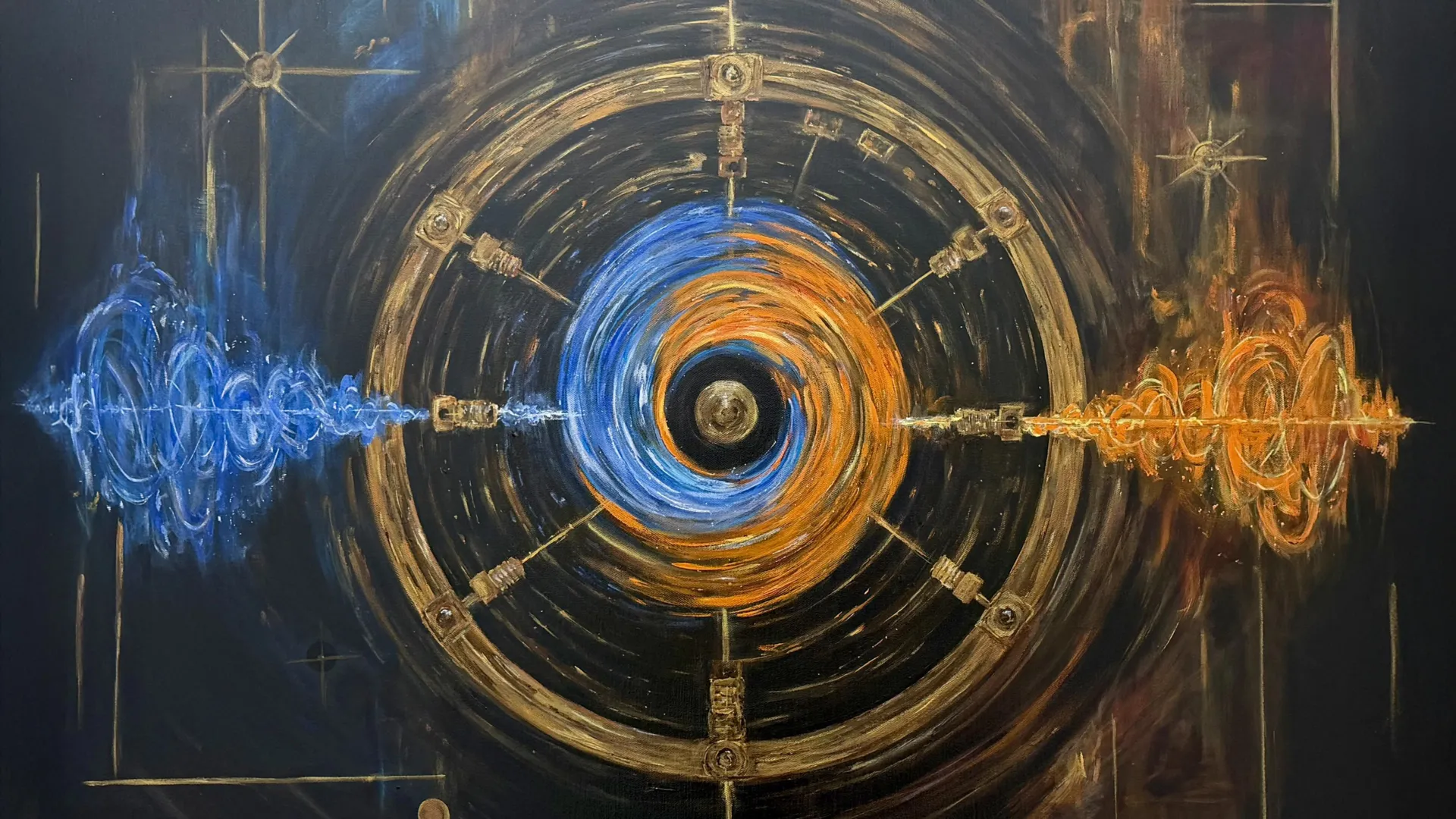
The researchers moved away from traditional mechanical engineering and toward the field of metamaterials—engineered substances designed to have properties not found in nature. Instead of a spinning disk, the team constructed a circular array, or ring, of electronic resonators. These resonators were connected to a series of high-speed switches that could alter their electromagnetic properties in a precisely timed sequence.
By rapidly changing the state of these resonators around the ring, the researchers created a "traveling wave" of property changes. To an incoming electromagnetic wave, this sequence of changes looks and acts exactly like a physical object rotating at incredible speeds. This synthetic rotation can reach effective velocities that far exceed the speed of light, as it is not the matter itself moving, but rather a pattern of information and energy states.
"Our approach facilitates a new method of wave-matter interaction in which waves with selected rotational properties extract energy from synthetic time-engineered rotation," explained Professor Andrea Alù. The system allowed the team to create a form of broadband selective amplification, where only waves with specific rotational characteristics (orbital angular momentum) were boosted by the system, while others remained unaffected or were suppressed.
Experimental Methodology and Data Analysis
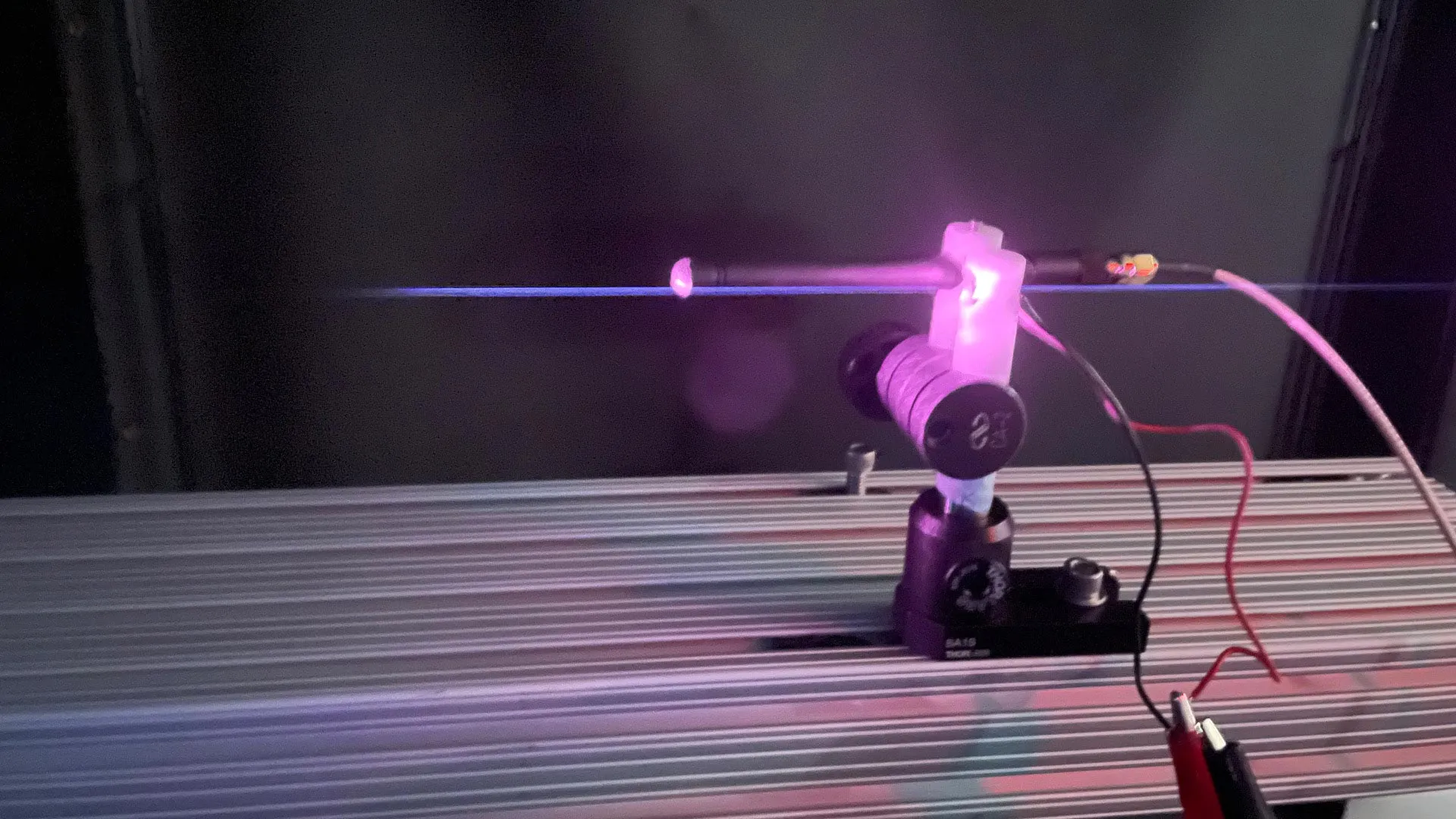
The experimental setup involved a ring of several dozen resonators tuned to radio frequencies. The researchers used a sophisticated control system to modulate the capacitance of each resonator in a synchronized "chirp" or sequence. As a radio wave was introduced to the center of the ring, the synthetic rotation pattern began.
The data gathered during the experiment showed a clear and measurable increase in the amplitude of the reflected waves. When the "synthetic speed" of the ring surpassed a specific threshold—matching the criteria set by Zel’dovich in 1971—the waves began to draw energy from the electronic switching system. The researchers recorded amplification levels that confirmed the transition from energy absorption to energy extraction.
Lead author Hadiseh Nasari, a post-doctoral researcher at the CUNY ASRC, noted that the success of the experiment transforms a long-standing theoretical concept into a practical research tool. The ability to control this amplification through electronic timing rather than mechanical speed provides a level of precision that was previously unattainable. The team was able to tune the system to amplify specific frequencies and rotational modes, proving that synthetic rotation can be used as a "knob" to control wave-matter interactions.
Official Responses and Scientific Context
The scientific community has reacted with significant interest to the CUNY ASRC findings. By providing a laboratory-scale platform to study the physics of the ergosphere, the team has bridged the gap between the gargantuan scales of astrophysics and the microscopic scales of quantum science.
"This successful experiment moves ideas about extreme rotational dynamics from theory to practice," said Nasari. "It creates a versatile experimental platform for exploring a broad range of phenomena at the intersection of astrophysics, wave physics, and quantum science."
The research was supported by a coalition of high-level scientific bodies, including the U.S. Department of Defense, the U.S. National Science Foundation, and the Simons Foundation. These organizations have a vested interest in the fundamental physics of wave propagation, as the principles uncovered here have direct applications in defense technologies, such as radar and secure communications.
The implications for fundamental science are profound. The Penrose process is often discussed in the context of "Hawking Radiation," the theoretical radiation predicted to be released by black holes due to quantum effects near the event horizon. While the CUNY experiment is classical in nature (using radio waves), the underlying principle of extracting energy from a vacuum-like state or a rotating spacetime metric provides a blueprint for future quantum experiments that could one day probe the very nature of gravity itself.
Broader Impact: From Black Holes to 6G
While the inspiration for the work comes from the stars, the applications are firmly grounded on Earth. The ability to amplify waves selectively and without mechanical motion has the potential to revolutionize several technological sectors:
- Wireless Communications: As we move toward 6G and beyond, the need for high-frequency, broadband amplification becomes critical. Synthetic rotation could allow for the development of new types of signal boosters that are more efficient and smaller than current technologies.
- Optics and Photonics: By applying these principles to light waves (photonics), researchers could create "one-way" mirrors or optical isolators that allow light to pass in one direction but not the other, which is essential for the stability of laser systems and optical computers.
- Quantum Technologies: The control over wave-matter interaction at such a granular level is a key requirement for quantum computing and quantum sensing. Synthetic rotation could be used to protect quantum bits (qubits) from noise or to amplify weak quantum signals without introducing decoherence.
- Non-Reciprocal Systems: In traditional physics, if a wave can travel from point A to point B, it can also travel from B to A. Synthetic rotation breaks this symmetry (Lorentz reciprocity), allowing for the creation of devices that prevent signal feedback and interference in complex networks.
Conclusion and Future Directions
The work of the CUNY ASRC team marks a turning point in the study of "analog gravity"—the use of laboratory systems to mimic the physics of the cosmos. By demonstrating that the Penrose-Zel’dovich process can be replicated using synthetic rotation, they have removed the mechanical barriers that have stalled this field for half a century.
However, the researchers caution that this is only the beginning. Translating these laboratory results into practical, commercial devices will require further engineering to minimize energy loss and to scale the technology to higher frequencies, such as infrared and visible light. The team also plans to explore the quantum regime of these interactions, looking for ways that synthetic rotation might influence the emission of single photons.
As we look to the future, the experiment serves as a reminder that the most extreme and distant phenomena in the universe can often be understood through clever engineering and fundamental physics right here on Earth. The "synthetic black hole" in a New York laboratory has not only confirmed the brilliance of Penrose and Zel’dovich but has also paved the way for a new generation of technologies that could redefine how we communicate, compute, and perceive the physical world.