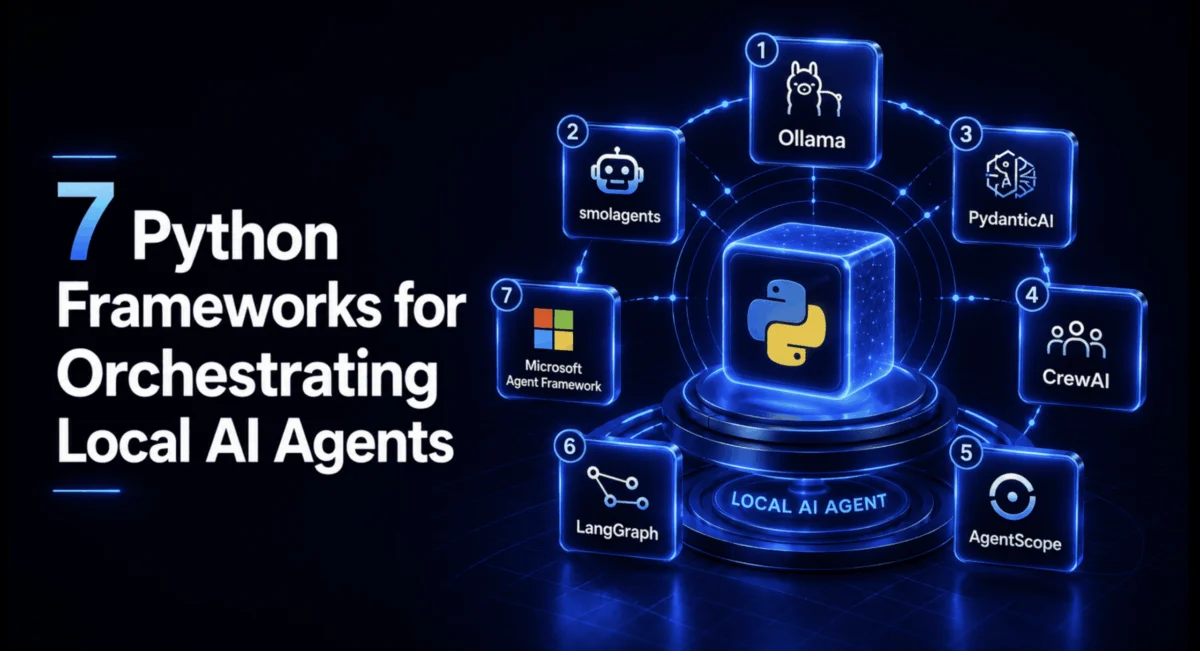
The landscape of artificial intelligence is undergoing a significant transformation, with a notable shift towards the deployment and orchestration of AI agents on local infrastructure. This pivot, driven by compelling imperatives of data privacy, operational cost reduction, and minimized latency, is reshaping how developers and enterprises approach AI solutions. Historically, AI agents largely relied on cloud-based APIs, incurring per-token costs, requiring API keys, and mandating data egress, which presented inherent limitations. A locally run agent, by contrast, operates within a controlled environment, eliminating these dependencies and fostering greater autonomy. However, this local paradigm necessitates a robust orchestration layer capable of seamlessly interfacing with models residing on proprietary hardware rather than external APIs. As of 2026, a sophisticated ecosystem of Python tools has emerged, empowering engineers to construct, coordinate, and execute AI agents entirely within their local environments, spanning from the model runtime itself to advanced frameworks dictating agent behavior.
The Dawn of On-Device Intelligence: Why Local AI is Gaining Momentum
The strategic advantages of local AI agent deployment are increasingly evident. Data sovereignty, a paramount concern in an era of stringent privacy regulations such as GDPR and CCPA, is inherently guaranteed when AI processes remain within an organization’s perimeter. This eliminates the risks associated with transmitting sensitive data to third-party cloud providers. Furthermore, the economic implications are substantial; once a model is downloaded and configured, subsequent inferences incur no additional per-call costs, a stark contrast to the pay-per-token model of cloud APIs. For applications requiring frequent, high-volume interactions, this translates into significant long-term savings. Latency, another critical factor, is drastically reduced as requests no longer traverse external networks, enabling real-time decision-making in edge computing scenarios and mission-critical applications. This shift is also fueled by the rapid advancements in open-source large language models (LLMs) and the increasing accessibility of powerful local hardware, making on-device intelligence not just feasible but often preferable. The ability to customize and fine-tune models without vendor lock-in further accelerates innovation within enterprises.
Foundational Layer: Orchestrating Models on Local Hardware
Before any sophisticated agent orchestration can commence, a fundamental component is required to host and serve the AI models themselves on local machines. This foundational layer is crucial for enabling local execution.

Ollama: The Ubiquitous Local LLM Runtime
At the bedrock of local AI agent orchestration lies Ollama, a lightweight, yet remarkably powerful, runtime specifically engineered for deploying open-source large language models on personal machines. Often likened to "Docker for language models," Ollama simplifies what was once a complex process involving intricate Python environment configurations and manual CUDA driver installations. With just a few command-line instructions, developers can pull a model and serve it via a local API, democratizing access to powerful AI capabilities.
The strategic genius behind Ollama’s widespread adoption and its status as a cornerstone for many frameworks on this list is its design choice to expose an OpenAI-compatible API. This crucial feature ensures that Ollama seamlessly integrates into the majority of existing agent frameworks without requiring custom adapters, providing an immediate pathway to leveraging local models. Beyond the technical convenience, this compatibility offers immense practical benefits: data privacy is inherently enhanced as information never leaves the local machine, and the cost benefit is clear—every request is free once the model is downloaded. While Ollama excels in ease of use and local development, it is important to note that its primary design focus is not raw throughput. For high-concurrency workloads or production environments requiring superior performance, teams often combine Ollama’s development simplicity with specialized serving solutions like vLLM, which utilizes PagedAttention for optimized inference, while maintaining the same high-level agent orchestration layer. This hybrid approach allows for agile development and seamless scaling from a single developer’s laptop to robust enterprise deployments. The integration diagram often depicts Ollama as the base, sitting directly beneath the local model file, which in turn feeds into the agent framework, illustrating its indispensable role.
Crafting Transparent and Code-Centric Agents
As AI agents become more sophisticated, understanding their internal workings and ensuring predictable behavior becomes paramount. Frameworks that prioritize transparency and direct code execution offer significant advantages in this regard.
Smolagents: Simplicity and Control for Agent Development
For engineers prioritizing a deep understanding of their agent’s actions, free from opaque layers of abstraction, smolagents from Hugging Face presents a compelling solution. This framework is meticulously designed for clarity and control, with its entire agent logic encapsulated within approximately 1,000 lines of code. This minimalist approach keeps abstractions to their bare essentials, providing developers with direct visibility into the underlying operations. Crucially, smolagents is entirely model-agnostic, supporting a wide array of local transformers and Ollama-served models, alongside dozens of hosted providers, offering unparalleled flexibility in model choice.
The defining characteristic of smolagents lies in its unique philosophy regarding agent behavior. It provides first-class support for CodeAgents, which are designed to write their actions directly in code rather than merely generating code after the fact. This paradigm shift offers enhanced debugging capabilities and greater predictability. To ensure safety and isolation, smolagents supports executing this generated code within sandboxed environments, leveraging technologies like Docker, E2B, or Modal. This feature is vital for preventing malicious or unintended side effects when agents interact with system resources. However, an important trade-off to consider is performance: smolagents can exhibit degraded performance and introduce subtle bugs when used with smaller open-source models, particularly those below the 7B parameter range. Therefore, this framework is best suited for scenarios where a reasonably capable local model is available, rather than extremely constrained hardware environments. Its emphasis on explicit code generation and sandboxed execution positions smolagents as a powerful tool for building agents where transparency, security, and direct control over actions are paramount.
Ensuring Data Integrity: The Backbone of Reliable AI Pipelines
The reliability of AI agents, particularly those interacting with external tools or handling structured data, hinges critically on the integrity of their outputs. Malformed data can silently propagate errors throughout a pipeline, leading to system failures or incorrect decisions.
PydanticAI: Type Safety for Agent Interactions
In complex AI pipelines where data integrity is non-negotiable, PydanticAI, developed by the creators of the widely-used Pydantic library, stands out as an essential tool. Its core mission is to bridge the gap between flexible LLM outputs and the rigid requirements of structured data. PydanticAI achieves this by leveraging Python type hints, transforming every agent input, output, and tool call into a type-safe operation. This approach provides automatic schema validation and, critically, self-correction mechanisms that prompt the LLM to revise its output if it fails to conform to the expected structure. This "fail-fast" principle, borrowed from robust software engineering practices, significantly enhances the reliability of AI systems.
PydanticAI proves particularly invaluable for local agents operating in compliance-heavy industries such as finance, healthcare, or legal services, where data accuracy and adherence to predefined formats are critical. By ensuring that all data is structured, validated, and consistently reliable, PydanticAI mitigates the risks associated with AI-generated inconsistencies. Its design philosophy allows it to work seamlessly with any OpenAI-compatible endpoint, making integration with a local Ollama server a straightforward configuration rather than a complex bespoke solution. The project has demonstrated rapid evolution, reaching version 1.85.1 by April 2026 under the active stewardship of the Pydantic core team. Reviewers consistently highlight its strong type safety, minimal dependencies, and robust validation capabilities as its most significant advantages, cementing its role in building trustworthy and production-ready local AI applications.

Collaborative Intelligence: Orchestrating Multi-Agent Systems Locally
As AI tasks grow in complexity, the need for multiple specialized agents to collaborate, each contributing to different facets of a problem, becomes apparent. Orchestrating these multi-agent systems efficiently, especially within a local context, requires purpose-built frameworks.
CrewAI: Rapid Prototyping for Collaborative Agents
When the task at hand moves beyond the scope of a single agent and demands the coordinated effort of multiple AI entities, CrewAI frequently emerges as the go-to framework for its unparalleled speed in getting a working multi-agent system operational. CrewAI simplifies the complex task of multi-agent collaboration: developers define individual agents, assign them distinct roles and goals, and then group them into a "crew." This crew is then empowered to collaborate autonomously, tackling intricate problems through a structured workflow. Its intuitive design and declarative approach make it arguably one of the most accessible agent frameworks for integration with local models.
CrewAI’s commitment to local model support is not an afterthought; it is a core design principle. The framework deliberately avoids external dependencies on larger agent frameworks like LangChain, positioning itself as a self-contained and lean solution. While it supports OpenAI as a default model provider, it offers explicit and robust support for local runtimes via Ollama, ensuring that privacy and cost benefits of local deployment are readily accessible. Furthermore, CrewAI incorporates support for the Model Context Protocol (MCP) across various transport layers, including stdio, SSE, and streamable HTTP. This ensures that even a local CrewAI setup can seamlessly interact with standardized tool servers, maintaining the advantages of a local-first model architecture while extending its capabilities through external resources. Its focus on rapid deployment and native local model integration makes CrewAI an excellent choice for prototyping and deploying collaborative AI solutions within controlled environments.
AgentScope: Enterprise-Grade Multi-Agent Orchestration
While some frameworks prioritize quick startups, AgentScope is meticulously engineered with production deployment in mind, treating local execution as a first-class option rather than an edge case. AgentScope 2.0 stands as a robust, production-ready agent framework, featuring comprehensive workspace and sandbox support. This allows for the secure execution of tools and code in isolated environments, offering built-in backends for local execution, Docker, and E2B. With an impressive track record, boasting over 27,300 GitHub stars and two peer-reviewed papers validating its design principles, AgentScope is positioned as one of the most comprehensive solutions for teams developing multi-agent systems that require enterprise-grade reliability and scalability.
The privacy dimension of AgentScope is explicit and central to its architecture. Agents are designed to operate entirely within the user’s infrastructure—be it local servers or a private cloud—with no data ever transmitted to AgentScope’s own servers. Its flexible model abstraction layer facilitates the seamless integration of local or private models for sensitive workloads, eliminating the need to rewrite agent code. Multi-agent coordination within AgentScope is managed through an innovative "message hub," where agents communicate via structured message passing rather than relying on shared implicit context. This approach ensures that all interactions are transparent and auditable, a significant advantage for debugging complex multi-agent systems where discerning which agent influenced a particular decision can often be challenging. AgentScope’s blend of production readiness, robust privacy features, and clear communication mechanisms makes it an ideal choice for organizations requiring high assurance and traceability in their local AI deployments.
Building Resilient and Stateful Agent Workflows
For AI agents to move beyond simple, one-off interactions and engage in complex, multi-step tasks, they require the ability to maintain state, handle branching logic, and recover gracefully from interruptions. This necessitates frameworks that provide a robust backbone for stateful execution.
LangGraph: State Management for Complex Agentic Behavior
LangGraph has rapidly solidified its position as the de facto choice for building anything stateful, branching, or recoverable within agent orchestration, and its local-model capabilities are particularly noteworthy. Given LangGraph’s inherent compatibility with any OpenAI-compatible backend, directing a complex agent graph to a local Ollama instance for tasks such as planning and tool decisions becomes a simple, one-line configuration change. This seamless integration ensures that the advanced features that make LangGraph so reliable in cloud environments—such as pause-and-resume functionality, time-travel debugging, and multi-instance scaling—operate identically whether the underlying model is a cutting-edge frontier API or a model running on a local GPU.
This capability is critically important for local agents that need to perform more than just a single prompt response. A robust local agent loop often benefits from a predictable structure where the model first proposes a plan, then executes one tool action at a time, observes the results, and subsequently decides on the next step. In scenarios where this loop must endure system crashes or extended pauses between steps, LangGraph’s sophisticated persistence layer is invaluable. It ensures that the agent can resume its operation precisely from where it left off, eliminating the need to restart from scratch every time. This resilience makes LangGraph an indispensable tool for developing durable, long-running local AI agents that can manage complex, multi-stage workflows with high reliability and efficiency, bridging the gap between local processing power and enterprise-grade operational stability.
Enterprise Adoption: Microsoft’s Vision for Local AI Governance
As local AI matures, the demand for enterprise-grade features such as governance, middleware, and telemetry becomes increasingly important, even when maintaining the flexibility of local infrastructure deployment.
Microsoft Agent Framework: Unifying Enterprise AI Orchestration
For large engineering organizations requiring robust governance and sophisticated middleware features without sacrificing the option for local infrastructure deployment, the Microsoft Agent Framework represents a significant advancement. Announced in October 2025 as Microsoft’s unified orchestration SDK, it is the direct successor to the previously distinct AutoGen and Semantic Kernel frameworks, developed by the same pioneering teams. This consolidation combines AutoGen’s powerful conversational multi-agent abstractions with Semantic Kernel’s enterprise-centric features, including session-based state management, comprehensive middleware capabilities, and integrated telemetry. The framework aims to provide a cohesive and scalable solution for AI agent development across the enterprise.
A key detail that firmly places the Microsoft Agent Framework on this list is its explicit and deeply integrated support for local models, rather than an afterthought. The framework ships with a dedicated Python package and offers out-of-the-box compatibility with a broad spectrum of model providers, including Microsoft Foundry, Azure OpenAI, OpenAI, Anthropic, Amazon Bedrock, Google Gemini, and, critically, Ollama. This extensive support ensures that teams standardizing on this framework for its enterprise features do not have to compromise on the flexibility of running fully local agents for sensitive workloads or offline development. This strategic choice enables organizations to leverage cutting-edge AI capabilities while adhering to internal data residency and security policies. However, it is worth noting that community-reported issues sometimes cluster around provider adapters outside the "Azure OpenAI happy path." Therefore, teams primarily utilizing Ollama or other non-Microsoft infrastructure are advised to thoroughly validate provider integration before committing to a broad adoption of the framework to ensure seamless operation.
The Broader Landscape: Implications for AI Development and Deployment
The proliferation of these sophisticated Python frameworks for local AI agent orchestration signifies a pivotal moment in the evolution of artificial intelligence. This trend towards on-device intelligence is not merely a technical advancement but a fundamental shift with profound implications for how AI is developed, deployed, and governed.

The decentralization of AI capabilities, enabled by tools like Ollama, is democratizing access to powerful language models. Developers no longer require extensive cloud budgets or complex infrastructure to experiment with and build advanced AI applications. This fosters innovation, allowing smaller teams and individual researchers to contribute to the AI ecosystem. Furthermore, the enhanced privacy and security inherent in local deployments are accelerating AI adoption in highly regulated sectors. Industries such as finance, healthcare, and defense, which deal with sensitive data, can now integrate AI solutions with greater confidence, ensuring compliance and mitigating data breach risks.
From an economic perspective, the long-term cost efficiencies of local AI are undeniable. While initial hardware investments may be required, the elimination of recurring per-token cloud costs translates into significant operational savings, especially for high-volume inference tasks. This makes advanced AI more accessible and sustainable for a wider range of organizations. The emphasis on transparency (Smolagents), data integrity (PydanticAI), and auditable multi-agent collaboration (AgentScope) reflects a growing maturity in AI engineering, moving beyond black-box models to systems that are explainable and trustworthy. The ability to build resilient, stateful agents with LangGraph further expands the complexity of tasks that can be reliably handled locally.
However, challenges remain. Hardware requirements, particularly for larger models, can still be a barrier for some. The ongoing need for efficient model compression and optimization for edge devices will continue to drive research and development. The learning curve associated with mastering these diverse frameworks also presents a hurdle for new developers. Yet, the trajectory is clear: local AI is not just a niche; it is becoming an integral part of the broader AI strategy, complementing cloud-based solutions by addressing specific needs for privacy, cost, and real-time performance.
Conclusion: Strategic Choices in a Maturing Local AI Ecosystem
The seven Python tools highlighted—Ollama, smolagents, PydanticAI, CrewAI, AgentScope, LangGraph, and Microsoft Agent Framework—are not direct competitors but rather complementary components within a maturing local AI ecosystem. Ollama serves as the indispensable runtime foundation, enabling the execution of open-source LLMs on local hardware. Smolagents and PydanticAI operate a layer above, with smolagents optimizing for minimal abstraction and direct code-as-action, while PydanticAI rigorously enforces type safety and data integrity, crucial where malformed outputs are unacceptable.

For multi-agent systems, CrewAI excels in rapid prototyping and quickly bringing collaborative agents online, leveraging its explicit local model support. AgentScope and Microsoft Agent Framework cater to the needs of production-grade deployments, offering robust structures, comprehensive audit trails, and enterprise-level governance for local AI solutions. Bridging these layers, LangGraph provides a durable, checkpointed backbone for any local agent requiring stateful, branching, or recoverable workflows, ensuring reliability for long-running tasks.
Ultimately, the optimal choice among these frameworks is not about identifying a single "best" solution, but rather about aligning the framework’s strengths with the specific constraints and requirements of a given project. Whether the priority is speed of prototyping, stringent data validation, robust production governance, or managing long-running state, the local AI orchestration landscape now offers a sophisticated array of tools. Running AI locally no longer implies a compromise on capability; it signifies a strategic decision to select the framework best suited to the most critical demands of the application being deployed.