In a groundbreaking achievement poised to redefine our understanding of neural circuitry and behavior, an international consortium of scientists, spearheaded by researchers at Harvard Medical School and Princeton University, has unveiled the first complete map of all neural connections within the central nervous system of an adult fruit fly (Drosophila melanogaster). This monumental work, published in the esteemed journal Nature, provides an unprecedented, neuron-by-neuron account of how the brain and nerve cord are interconnected, offering a powerful new lens through which to examine the fundamental principles governing nervous system function.
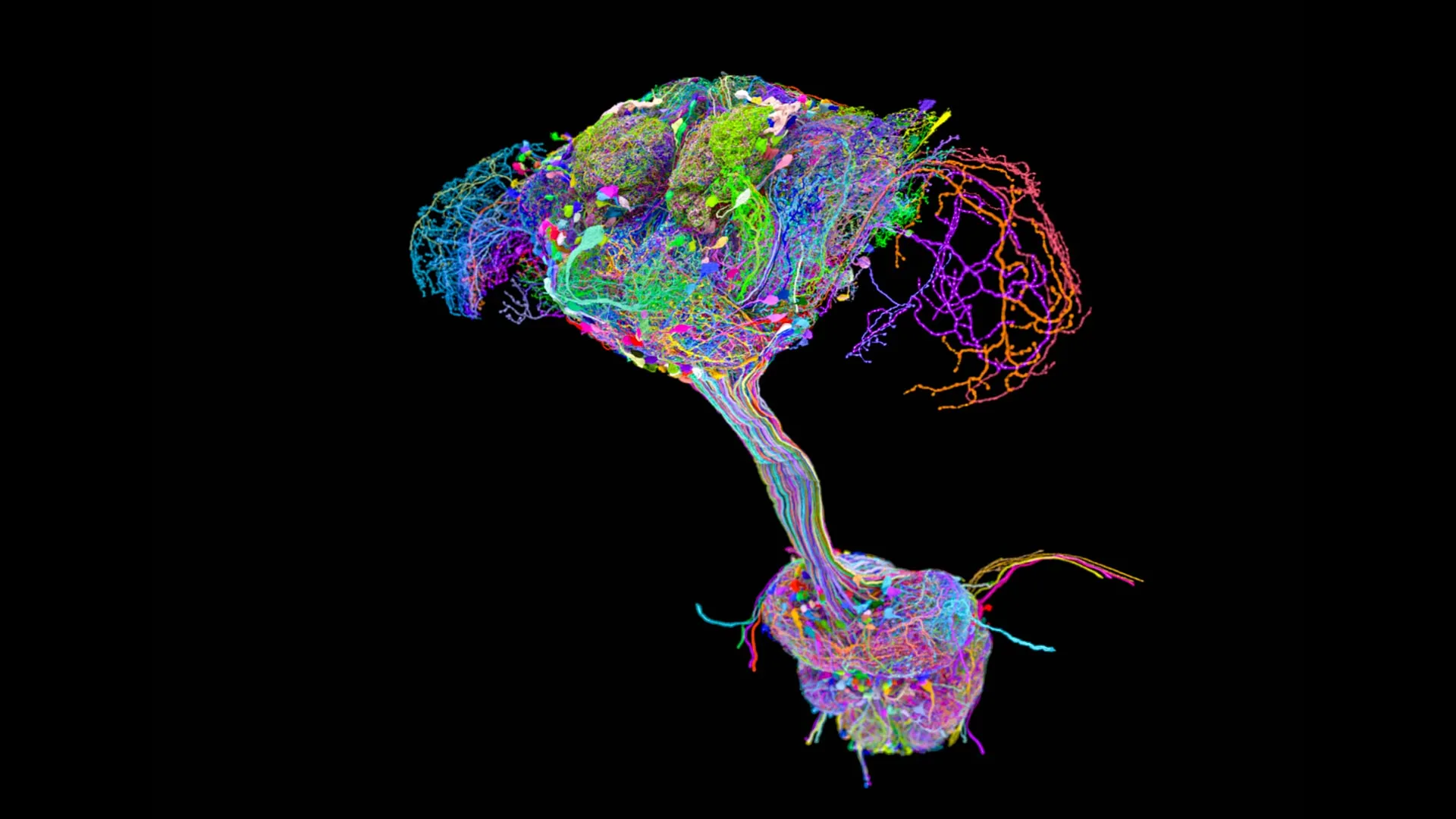
The meticulously constructed map, known as a connectome, extends previous efforts by incorporating not only the fruit fly’s brain but also its nerve cord – the equivalent of a spinal cord in vertebrates. This comprehensive "brain and nerve cord" (BANC) connectome allows scientists, for the first time, to trace the intricate pathways of information flow from sensory input to motor output across an entire nervous system. This holistic view is critical for understanding how complex behaviors, from the seemingly simple act of walking to the intricate maneuvers of flight, are orchestrated by the coordinated activity of millions of neural connections.
"This is a pivotal moment for neuroscience," stated Dr. Rachel Wilson, a co-senior author and the Joseph B. Martin Professor of Basic Research in the Field of Neurobiology at Harvard Medical School’s Blavatnik Institute. "We can now visualize all the neurons and their connections as a unified system and begin to unravel the profound insights this integrated architecture offers. It’s like having a detailed blueprint of a complex machine, allowing us to dissect its operation with unparalleled precision."
The Fruit Fly: A Cornerstone of Neuroscience Research
The choice of the fruit fly as the subject for this ambitious mapping project is far from arbitrary. Drosophila melanogaster has long served as a principal model organism in neuroscience due to its relatively simple yet highly functional nervous system, its ease of genetic manipulation, and its capacity for exhibiting a surprising range of complex behaviors. Despite possessing approximately 160,000 neurons, significantly fewer than the estimated 86 billion in the human brain, fruit flies can navigate their environment, engage in social interactions, learn, and respond to sensory stimuli with remarkable agility.
The genetic toolkit available for fruit flies is exceptionally sophisticated, empowering researchers to precisely control and monitor the activity of individual neurons or entire neural circuits. This level of experimental control is indispensable for validating hypotheses generated from connectomic data and for investigating the causal relationships between neural activity and behavior.
A Collaborative Endeavor: Bridging Brain and Body
The genesis of this complete BANC connectome is rooted in the synergistic efforts of two key research groups: the FlyWire Consortium, led by Professors Mala Murthy and Sebastian Seung at Princeton University, and a parallel initiative at Harvard Medical School. In 2024, the FlyWire Consortium achieved a significant milestone by publishing a comprehensive connectome of the fruit fly brain. Simultaneously, the Harvard team, under the direction of Associate Professor Wei-Chung Allen Lee, was diligently constructing a connectome of the fruit fly’s nerve cord, which is responsible for controlling appendages like legs and wings, as well as processing crucial sensory information from the periphery.
The publication of the individual brain and nerve cord connectomes was a monumental achievement in itself. However, the true power of this research lies in their subsequent integration. "The brain and nerve cord connectomes are each valuable on their own," explained co-first author Helen Yang, a research fellow in neurobiology in Dr. Wilson’s lab. "But until you can bridge the two, it’s challenging to fully comprehend how information flows between the brain and the body. This unified map unlocks that crucial understanding."
The nerve cord, though smaller in neuron count than the brain, contains a substantial proportion of neurons directly involved in sensation and motor control. As co-first author Alexander Bates, also a research fellow in neurobiology in the Wilson Lab, pointed out, these neurons are "some of the most useful" for studying behavior because their functions are often more readily observable and interpretable.
Unraveling Neural Architecture: Methodology and Findings
The construction of the BANC connectome involved an array of cutting-edge techniques. Researchers meticulously sliced a single fruit fly into thousands of ultra-thin serial sections. These sections were then subjected to high-resolution electron microscopy, generating millions of images that captured the intricate architecture of neurons and their synaptic connections. Sophisticated artificial intelligence (AI) algorithms played a pivotal role in aligning these vast image datasets and reconstructing them into a coherent, three-dimensional map of the central nervous system.
The resulting connectome provides a synapse-level resolution, detailing every point of contact between individual neurons within both the brain and the nerve cord. While the map does not encompass every neuron in the fly’s entire body, the researchers ingeniously integrated identifiable neurons and extensive prior scientific literature to effectively "embody" the connectome. This involved linking central nervous system neurons to their counterparts in various appendages and sensory organs, thereby creating a functional representation of how the brain and body are integrated.
The newly released connectome is now freely accessible online through the FlyWire platform (codex.flywire.ai/?dataset=banc), providing a powerful and invaluable resource for neuroscientists worldwide. This collaborative, open-science approach mirrors the spirit of monumental scientific endeavors like the Human Genome Project, promising to catalyze a wave of new research and discoveries.
A Paradigm Shift in Understanding Motor Control
Early analyses of the BANC connectome have already yielded surprising insights, particularly concerning the control of motor functions. A long-held tenet in neuroscience suggested that complex behaviors are orchestrated by a centralized command center within the brain, which dictates the actions of the body. However, the fruit fly connectome challenges this view, revealing a more distributed and localized model of motor control.
The research team discovered that the movement of specific body parts, such as a single leg, is primarily governed by local neural circuits dedicated to that appendage. These local circuits then communicate with each other to coordinate more complex, synchronized actions, like walking. This pattern of distributed control was also observed in circuits associated with the fly’s wings, mouthparts, and other appendages.
"Our findings strongly suggest that the control for actions is highly distributed across local modules that can link up and collaborate in diverse ways," commented Bates. This distributed architecture allows for flexibility and adaptability in behavior, enabling the organism to respond effectively to a variety of environmental stimuli and internal states. The motor circuits also integrate with other neural systems, including visual and endocrine pathways, which provide supplementary information that refines and shapes behavior.
This discovery has significant implications for our understanding of biological computation and may offer valuable lessons for the field of artificial intelligence. The ability of decentralized systems to achieve complex, coordinated outcomes is a principle that AI researchers are increasingly seeking to replicate in the design of intelligent agents and robots.
Broader Implications and Future Directions
The implications of the complete fruit fly BANC connectome extend far beyond the study of insects. Many fundamental principles of neural organization and function discovered in fruit flies have proven to be conserved across species, including mammals. This includes insights into navigation, olfaction, and memory.
"This connectome is like the Human Genome Project for neuroscience," remarked Yang. "It’s a foundational resource that will be utilized in countless unforeseen ways." The research team plans to further enrich the connectome by incorporating additional layers of information, such as the distribution and function of neuropeptides – crucial signaling molecules used by neurons.
A key future direction for connectome research is to scale up these efforts to map the nervous systems of more complex organisms. Advances in AI, computational power, and collaborative scientific models are making this ambitious goal increasingly attainable. Dr. Lee is already spearheading investigations into whether the distributed neural control observed in fruit flies is also present in mammals, with ongoing studies in mice.
"I would be surprised if this organizational principle is unique to the fly," stated Yang. "While we lack the same level of detailed resolution in other animals, we know they possess numerous local neural circuits. It’s highly probable that similar distributed control mechanisms are at play."
Impact on Artificial Intelligence and Beyond
The detailed biological blueprint provided by the fruit fly connectome offers a rich source of data for the field of artificial intelligence. As AI systems become more sophisticated and are employed in increasingly complex tasks, understanding how biological brains achieve efficient and robust control can provide critical design principles.
"It’s truly remarkable how much a tiny fruit fly can accomplish," Yang observed. "Even our most advanced AI agents and robots struggle to replicate the full spectrum of a fly’s capabilities. There are likely fundamental lessons embedded in the organization of the nervous system that can inform the development of more capable and adaptable AI."
The collaborative nature of this project, involving researchers from institutions across the globe and supported by significant federal funding from initiatives like the BRAIN Initiative, the National Institutes of Health, and the National Science Foundation, highlights the power of collective scientific endeavor. The open accessibility of the data further democratizes scientific discovery, enabling researchers worldwide to build upon this foundational achievement.
The complete mapping of the fruit fly’s central nervous system represents not just a technical triumph but a conceptual leap forward. It provides a tangible framework for exploring how intricate neural networks give rise to emergent properties like behavior, offering a powerful new tool to address some of neuroscience’s most enduring questions and paving the way for future discoveries across a spectrum of biological and computational disciplines. The implications for understanding brain disorders, developing novel therapeutic strategies, and advancing artificial intelligence are profound and far-reaching.