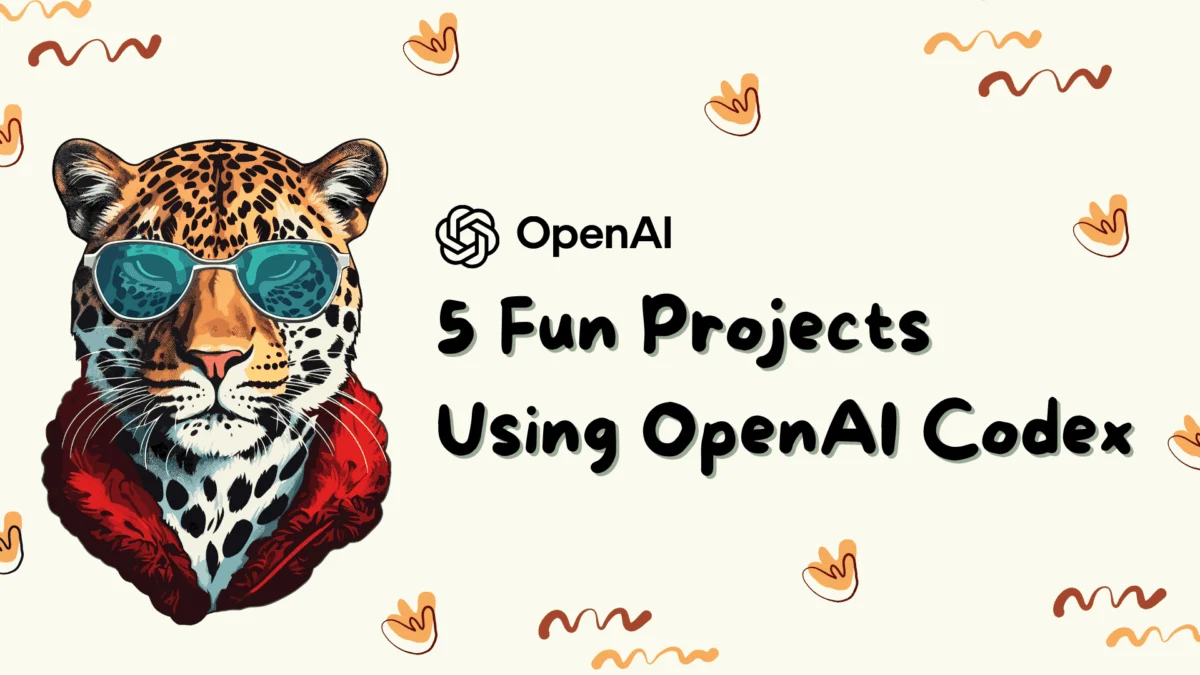
The advent of sophisticated artificial intelligence models, particularly in the realm of code generation and assistance, has ushered in a new era for software development. At the forefront of this transformation is OpenAI Codex, a powerful AI tool designed not merely to generate lines of code but to act as a comprehensive development partner, aiding in feature planning, file editing, bug fixing, tool integration, and the rapid prototyping of ideas into functional projects. This capability marks a significant shift from traditional programming paradigms, offering developers and innovators unprecedented speed and efficiency. The tool’s versatility is effectively demonstrated through a series of practical project tutorials, providing a clear roadmap for leveraging AI to streamline complex development workflows, from simple applications to full-stack platforms and interactive games.
The Rise of AI in Software Development: Context and Capabilities
OpenAI Codex, building upon the foundational language models like GPT-3, was specifically fine-tuned on a massive dataset of publicly available code, alongside natural language. This extensive training enables Codex to understand and generate code across numerous programming languages, translating human language instructions into executable code. Its introduction has been pivotal in the broader trend of AI-assisted development, a movement gaining rapid traction across the technology sector. Unlike earlier code completion tools that offered basic syntax suggestions, Codex can interpret high-level requests, reason about code, and even suggest architectural patterns. This allows developers to articulate their intentions in natural language, enabling the AI to generate or modify substantial blocks of code, debug errors, or even connect various development tools and APIs.
Industry reports suggest that AI-powered coding assistants are becoming indispensable, with a significant percentage of developers already integrating these tools into their daily routines. Projections indicate that the market for AI in software development tools is expected to grow substantially, reaching tens of billions of dollars within the next few years. This growth is driven by the demand for increased productivity, reduced development cycles, and the democratization of coding, allowing individuals with less specialized knowledge to contribute to software creation. Codex, in particular, empowers users to move beyond merely asking for code snippets, encouraging a more holistic approach where the AI assists throughout the entire project lifecycle, from conceptualization to deployment.
A Brief Chronology: The Evolution of AI-Powered Coding
The journey towards sophisticated AI coding assistants like Codex began with early research into natural language processing and machine learning applied to code. Initial efforts focused on static code analysis, basic autocompletion, and simple code generation based on templates. The breakthrough moment arrived with the development of large language models (LLMs) like OpenAI’s GPT series.
- 2019-2020: OpenAI began exploring the capabilities of its early GPT models for code generation, recognizing the potential to extend their natural language understanding to programming languages.
- 2021: OpenAI officially unveiled Codex, demonstrating its ability to translate natural language into code. This marked a significant leap, as Codex could handle more complex programming tasks and understand broader contextual instructions. It was initially released as a private beta, garnering immense interest from developers and researchers.
- 2022: The technology underpinning Codex was integrated into tools like GitHub Copilot, a collaboration between GitHub and OpenAI, making AI-powered code assistance widely accessible to millions of developers. This integration solidified the practical application of Codex’s capabilities in real-world development environments.
- Ongoing: Since its initial release, Codex has undergone continuous refinement, improving its accuracy, efficiency, and understanding of diverse programming paradigms. Its ongoing development reflects the rapid pace of innovation in AI, with a constant push towards more autonomous and intelligent coding assistance. The existence of tutorials, even those dated "2026," underscores the forward-looking nature of this technology, emphasizing its enduring relevance and potential for future enhancements.
This chronological progression highlights a fundamental shift: from AI as a mere helper to AI as an integral partner in the creative and technical process of software engineering.
Market Dynamics: Impact on Developer Productivity and Industry Growth
The integration of tools like OpenAI Codex into the development ecosystem has profound implications for market dynamics, particularly concerning developer productivity and industry growth. Studies conducted by various tech firms and research institutions suggest that AI coding assistants can significantly boost developer efficiency, with some reports indicating a 20-30% increase in coding speed for routine tasks and a reduction in the time spent debugging. This efficiency gain translates directly into faster time-to-market for new products and features, offering a competitive advantage to companies that adopt these technologies.
Moreover, AI tools lower the barrier to entry for aspiring developers and non-technical founders. By abstracting away some of the syntax and boilerplate code, Codex allows individuals to focus on the logic and problem-solving aspects of development, making coding more accessible. This democratization fuels innovation, enabling a broader range of individuals and small teams to conceptualize and build software solutions, potentially leading to a surge in new startups and applications. The venture capital community has also taken note, with increased investment in AI-driven development platforms and companies leveraging AI for rapid prototyping.
The five project tutorials highlighted serve as concrete examples of this transformative potential, illustrating how Codex can be deployed across various software development domains, from foundational app building to complex full-stack solutions and creative game design.
Project Spotlight 1: Rapid Prototyping – Building Your First Application
The initial step for many embarking on the journey with OpenAI Codex is to grasp its fundamental workflow through building a simple application. This foundational tutorial, often titled "Building Your First App in Minutes," focuses on demystifying the core interaction loop: articulating a desired feature in natural language, allowing Codex to generate or modify code, reviewing the AI’s output, testing the application, and iteratively refining it through subsequent prompts. This process starkly contrasts with traditional development, where a developer might spend hours setting up a project, writing boilerplate code, and debugging initial errors.
With Codex, the emphasis shifts to prompt engineering – crafting clear, concise instructions that guide the AI effectively. For instance, a user might simply request, "Create a web page with a button that changes color when clicked," and Codex would generate the necessary HTML, CSS, and JavaScript. This rapid prototyping capability is invaluable for quickly validating ideas, creating proof-of-concepts, or training new developers on the practical application of AI in coding. It underscores how Codex reduces cognitive load and accelerates the initial phases of development, enabling faster iteration and experimentation.
Project Spotlight 2: Venturing into Mobile – Crafting iOS Applications with Codex
Mobile application development presents unique challenges, including platform-specific languages (like Swift for iOS), integrated development environments (IDEs) such as Xcode, and intricate UI/UX considerations. The tutorial "Building a Mobile App with OpenAI Codex" demonstrates how the AI tool can navigate these complexities, focusing on the creation of a Swift iOS application. This project is particularly illustrative because it moves beyond simple web interfaces to tackle native mobile development, showcasing Codex’s ability to assist with platform-specific APIs and design patterns.
A key concept explored is "vibe coding," where users describe their desired app features and aesthetics in natural language, allowing Codex to translate these abstract ideas into functional mobile code. For example, a developer might ask Codex to "Design an iOS screen with a user profile picture, name, and a list of recent activities," and the AI would generate the appropriate Swift UI code. The tutorial highlights the integration of Codex with local tooling like Xcode, demonstrating how the AI can suggest code, fix errors within the IDE, and help structure complex mobile applications. This capability is crucial for empowering developers to build sophisticated mobile experiences without getting bogged down in the minutiae of platform-specific coding, thereby expanding the reach of mobile development to a wider audience.
Project Spotlight 3: Accelerating Innovation – From Idea to AI Startup in a Week
The entrepreneurial landscape is often characterized by the imperative for speed – to validate ideas, build minimum viable products (MVPs), and iterate rapidly based on user feedback. The project "Building an AI Startup in Just One Week" vividly illustrates how OpenAI Codex can serve as a catalyst for this accelerated innovation. This tutorial showcases a lean development methodology, where a simple startup idea is transformed into a working web application within a highly compressed timeframe.
The process involves leveraging Codex to incrementally build features, resolve technical challenges, and continuously refine the product. Instead of needing a large engineering team or extensive coding expertise, a single founder or small team can use natural language prompts to guide Codex in generating the necessary frontend and backend components, database structures, and API integrations. This dramatically reduces the time and resources typically required to launch an MVP, democratizing the process of creating technology-driven startups. The video demonstrates how Codex streamlines the entire product development lifecycle, from initial concept to a deployable application, enabling entrepreneurs to test market viability much faster and pivot their strategies with agility.
Project Spotlight 4: Gamification of Development – Crafting a 2D Beat ‘Em Up Game
Beyond traditional business applications, OpenAI Codex also proves its mettle in creative domains such as game development. The tutorial "Vibe Coding a Complete 2D Beat ‘Em Up Game From Scratch" stands out as a testament to Codex’s versatility and playful potential. This project delves into the intricacies of game mechanics, character movement, visual assets, and overall game structure for a browser-based 2D beat ’em up using frameworks like Phaser.
Game development is notoriously complex, involving graphics rendering, physics engines, state management, and intricate user interactions. Codex assists throughout this process, from generating character sprites (potentially in conjunction with image generation AI tools) to scripting combat mechanics, defining player controls, and managing game states. For instance, a developer could prompt, "Create a player character that can move left, right, jump, and punch," and Codex would generate the corresponding Phaser code. This project makes coding feel more intuitive and creative, allowing developers to experiment with different game styles, add new characters, and see how Codex handles the interactive elements that bring a game to life. It highlights AI’s role in expanding the creative bandwidth of game developers, enabling more rapid prototyping of game ideas and reducing the technical hurdles associated with asset creation and scripting.
Project Spotlight 5: Mastering Complexity – Building a Full-Stack Airbnb Clone
Perhaps the most ambitious project on the list, "Building a Full-Stack Airbnb Clone," showcases OpenAI Codex’s capability to orchestrate the development of highly complex, multi-tiered applications. A full-stack application encompasses both the client-side (frontend) and server-side (backend) components, including database management, user authentication, and payment processing. This tutorial specifically leverages modern frameworks and services such as Expo and React Native for mobile frontend development, Supabase for backend data management and authentication, and Stripe for payment gateway integration.
The project demonstrates how Codex can facilitate the creation of an application mimicking a vacation rental platform, complete with user browsing, property viewing, and a basic booking flow. This involves generating mobile UI screens, defining database schemas, implementing user authentication workflows, and integrating third-party payment APIs. For example, a developer might instruct Codex to "Set up a user authentication flow using Supabase" or "Integrate Stripe for payment processing on the booking screen," and Codex would provide the necessary code and configuration. This tutorial is critical for understanding how Codex can manage the integration of disparate technologies and services, a common challenge in full-stack development. It underlines the AI’s potential to simplify the construction of robust, real-world applications by handling the intricate connections between various architectural layers.
Broader Implications and the Future of Software Engineering
The collective insights from these projects paint a vivid picture of the profound implications OpenAI Codex and similar AI tools hold for the future of software engineering.
- Elevated Developer Roles: Rather than replacing developers, AI tools are shifting their roles. Developers are evolving from pure coders to architects, strategists, and prompt engineers. Their focus is increasingly on defining high-level logic, reviewing AI-generated code for security and efficiency, and managing complex integrations, allowing them to tackle more challenging problems.
- Enhanced Accessibility and Diversity: By lowering the technical barrier to entry, Codex empowers a more diverse group of individuals to engage in software creation. This aligns with broader industry goals to foster inclusion in STEM fields, potentially leading to a richer variety of applications and solutions.
- Accelerated Innovation Cycles: The ability to rapidly prototype, build MVPs, and iterate quickly significantly shortens innovation cycles. This not only benefits startups but also allows established enterprises to experiment with new ideas and respond to market demands with unprecedented agility.
- Economic Impact: Faster development means reduced labor costs and quicker time-to-market, leading to substantial economic benefits for businesses. It also allows for the reallocation of human capital to more complex and creative problem-solving.
- Challenges and Ethical Considerations: While beneficial, the rise of AI in coding also presents challenges. These include ensuring the security and robustness of AI-generated code, addressing potential biases embedded in training data, and navigating intellectual property concerns. The need for human oversight remains paramount to validate code quality, maintain security standards, and ensure ethical deployment.
Conclusion: The Collaborative Future of Human and AI Development
The diverse array of projects executable with OpenAI Codex underscores its remarkable flexibility and transformative potential across the software development spectrum. From crafting a simple inaugural application to engineering complex full-stack solutions, building mobile interfaces, accelerating startup prototypes, or even designing engaging 2D games, Codex proves to be an invaluable asset. The overarching lesson from these demonstrations is the power of a collaborative development paradigm: treating Codex not as a replacement for human intelligence, but as an exceptionally capable coding partner.
Effective utilization hinges on clear communication through well-structured prompts, consistent testing of AI-generated output, and iterative refinement. As AI continues to evolve, the partnership between human developers and intelligent coding assistants like Codex is poised to redefine the contours of software engineering, fostering an era of enhanced creativity, unprecedented productivity, and broader accessibility within the technology landscape. The future of development is undeniably a synergistic endeavor, where human ingenuity guides AI capabilities to build the next generation of innovative solutions.