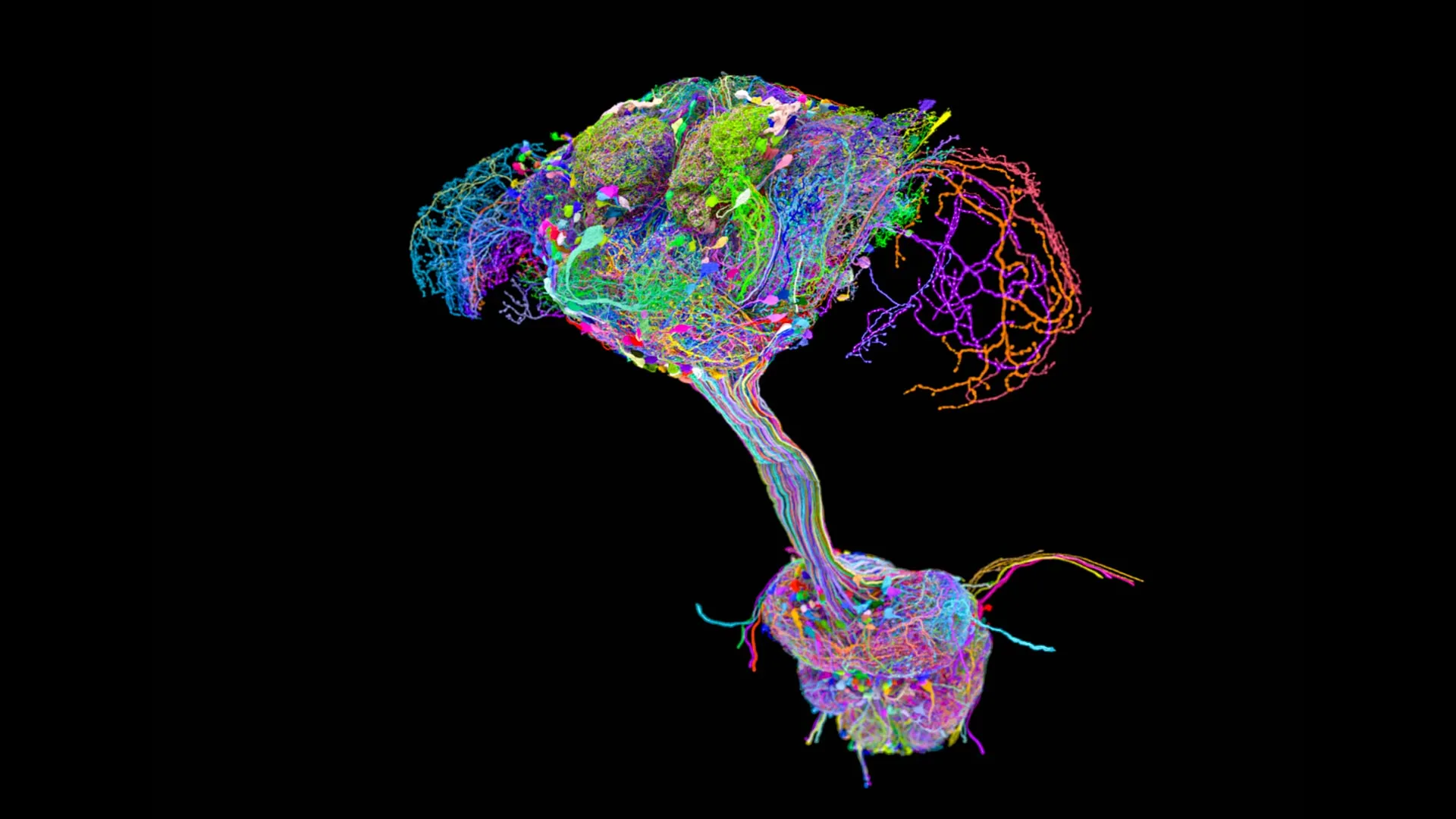
An international consortium of researchers, spearheaded by teams at Harvard Medical School and Princeton University, has achieved a monumental breakthrough in neuroscience: the complete mapping of every neural connection within the central nervous system of an adult fruit fly. This comprehensive atlas, known as a connectome, represents a pivotal moment, offering an unprecedented view of how billions of neurons communicate and coordinate to drive complex behaviors. The findings, published on June 8th in the prestigious journal Nature, not only illuminate the intricate workings of the fruit fly’s nervous system but also promise to unlock fundamental principles governing nervous systems across a wide spectrum of life, including humans.
The Genesis of a Complete Connectome: Bridging Brain and Body
This groundbreaking work builds upon previous efforts to map the fruit fly’s brain. In 2024, the FlyWire Consortium, a collaborative effort involving researchers like Mala Murthy and Sebastian Seung from Princeton University, published a detailed connectome of the fruit fly brain. Simultaneously, a parallel research effort, led by Wei-Chung Allen Lee at Harvard Medical School, focused on constructing a connectome of the fruit fly’s nerve cord. The nerve cord, analogous to a spinal cord in more complex organisms, plays a crucial role in processing sensory information and controlling motor functions of the fly’s appendages, such as legs and wings.
The true significance of the current publication lies in the successful integration of these two previously distinct datasets. "The brain and nerve cord connectomes are each useful on their own, but until you can bridge the two, it’s hard to understand how information moves between the brain and the body," explained Helen Yang, a co-first author and research fellow in neurobiology in the Wilson Lab at Harvard. This newly unified map, referred to as the Brain and Nerve Cord (BANC) connectome, provides the first holistic view of the entire central nervous system, enabling scientists to trace the flow of information from sensory input to motor output across the entire organism.
"We can see all of the neurons and their connections as a complete unit for the first time and ask, ‘What do we learn from that?’" stated Rachel Wilson, co-senior author and the Joseph B. Martin Professor of Basic Research in the Field of Neurobiology in the Blavatnik Institute at HMS. This integrated perspective is crucial for understanding how the brain and body collaborate to generate behaviors like walking, flying, and navigating complex environments.
The Power of the Fruit Fly: A Model for Understanding Neural Complexity
The choice of the fruit fly (Drosophila melanogaster) as the subject for this extensive mapping endeavor is deliberate and rooted in decades of successful research. Despite possessing a relatively small nervous system, estimated to contain around 160,000 neurons, fruit flies exhibit a remarkable range of complex behaviors. These include sophisticated navigation, intricate social interactions, learning capabilities, and nuanced responses to sensory stimuli.
Furthermore, fruit flies offer a powerful genetic toolkit, as described by Wei-Chung Allen Lee, an associate professor of neurobiology at HMS and HMS professor of neurology at Boston Children’s Hospital. This genetic accessibility allows researchers to precisely manipulate, observe, and record the activity of individual neurons or entire neural circuits. This capacity for detailed experimental manipulation, combined with the comprehensive neural map, creates an unparalleled platform for investigating fundamental neuroscience questions.
Unraveling the Mechanics of Movement: A Distributed Control System
One of the most striking discoveries emerging from the newly completed connectome concerns the control of motor functions. Traditionally, the prevailing hypothesis in neuroscience posited a centralized brain as the primary command center dictating an organism’s actions. However, the fruit fly connectome reveals a more nuanced reality, suggesting that motor control is largely distributed across local neural circuits within specific body parts.
"The connectome has shown us that most of our hypotheses are too simple. Now, we can develop more complex hypotheses and move forward with experiments to test them," remarked Lee. The research indicates that, for instance, the intricate movements of a single leg are primarily orchestrated by neural circuits dedicated to that specific appendage. These local circuits then communicate and synchronize with circuits governing other legs, ensuring coordinated locomotion such as walking.
This principle of distributed control extends to other motor systems, including the fly’s wings and mouthparts. Moreover, these motor circuits are not isolated; they intricately connect with other neural systems, such as the visual and endocrine systems. This integration allows for the incorporation of external sensory information and internal hormonal signals, which collectively shape and refine behavioral output.
"Our findings suggest that control for actions is highly distributed in local modules that link up and work together in different ways," elaborated Alexander Bates, a co-first author and research fellow in neurobiology in the Wilson Lab. This discovery challenges long-held assumptions about hierarchical neural control and opens new avenues for understanding how decentralized systems can achieve complex, coordinated actions.
Technical Prowess: Constructing the Neural Atlas
The creation of such an intricate map was an immense undertaking, requiring advanced technological capabilities and sophisticated computational analysis. The process involved preparing a single adult fruit fly by slicing its central nervous system into thousands of exceptionally thin serial sections. Each section was then subjected to high-resolution electron microscopy, generating millions of images that captured the intricate architecture of neurons and their synaptic connections.
Artificial intelligence (AI) played a crucial role in processing this massive dataset. Advanced AI algorithms were employed to meticulously align these serial images, stitching them together to reconstruct a cohesive three-dimensional model of the fruit fly’s neural network. This painstaking process allowed researchers to identify and trace every neuron and its synaptic connections at the most fundamental level.
While the connectome primarily details the connections within the central nervous system (brain and nerve cord), the researchers employed established scientific literature and identified key neurons to effectively "embody" the map. This means linking central nervous system neurons to neurons in peripheral appendages and sensory organs, providing a functional context for the neural circuitry.
A Public Resource for Global Neuroscience
In a move to accelerate scientific discovery, the complete BANC connectome has been made freely available online through the FlyWire platform (http://codex.flywire.ai/?dataset=banc). This open-access initiative ensures that researchers worldwide can access this invaluable resource, fostering collaborative research and the development of novel hypotheses and experimental designs.
"The new connectome represents a major advance for the field, with the ability to understand how circuits in the brain receive feedback from and control the actions of the body," commented Mala Murthy, co-senior author and the Karol and Marnie Marcin ’96 Professor of Neuroscience at Princeton. She likened the connectome’s potential to that of the Human Genome Project, a monumental undertaking that has since catalyzed countless research endeavors across diverse biological disciplines.
Broader Implications: From Fundamental Biology to Artificial Intelligence
The implications of this complete fruit fly connectome extend far beyond the study of this single organism. Scientists anticipate that the fundamental principles of neural organization and function revealed in the fruit fly may hold true for nervous systems across species. Many significant discoveries in fruit fly neuroscience, from insights into navigation and olfaction to memory formation, have previously been found to be conserved in mammals, underscoring the model organism’s predictive power.
"I would be shocked if this is unique to the fly," stated Helen Yang, referring to the observed distributed motor control. "We don’t have this level of resolution in other animals, but we know that they have a lot of these local circuits." Researchers, including Wei-Chung Allen Lee, are already investigating the presence of similar distributed control mechanisms in more complex organisms, such as mice, to test this hypothesis.
Beyond its impact on biological research, the connectome offers valuable insights for the burgeoning field of artificial intelligence. The detailed neural architecture of a biological system provides a rich source of data for designing more efficient and intelligent AI agents. As Yang noted, "One thing that always amazes me is that this tiny little fly does a hell of a lot; even our best AI agents and robots can’t do everything that a fly does. There may be lessons for AI in how the nervous system is organized." The study of biological neural networks can inform the development of more sophisticated algorithms for robotics, machine learning, and autonomous systems.
Future Directions and Funding Acknowledgements
The research team plans to further enrich the connectome by incorporating additional layers of information, such as the role of neuropeptides, which are crucial signaling molecules in neuronal communication. The long-term vision includes extending connectome mapping to increasingly complex organisms, a goal that is becoming more attainable due to rapid advancements in AI, computational power, and collaborative scientific methodologies.
This monumental achievement was made possible through substantial support from various U.S. federal funding agencies, including the BRAIN Initiative (Brain Research Through Advancing Innovative Neurotechnologies), the National Institutes of Health, and the National Science Foundation. Additional funding was provided by a diverse array of international and private sources, reflecting the global collaborative nature of the project.
The research also involved significant intellectual property considerations, with Harvard University filing a patent application related to the GridTape technology used in the mapping process. Several authors declared financial interests in AI and biotechnology companies, underscoring the potential commercial applications of this fundamental research. The comprehensive list of authors and funding sources highlights the vast network of individuals and institutions that contributed to this landmark scientific endeavor.