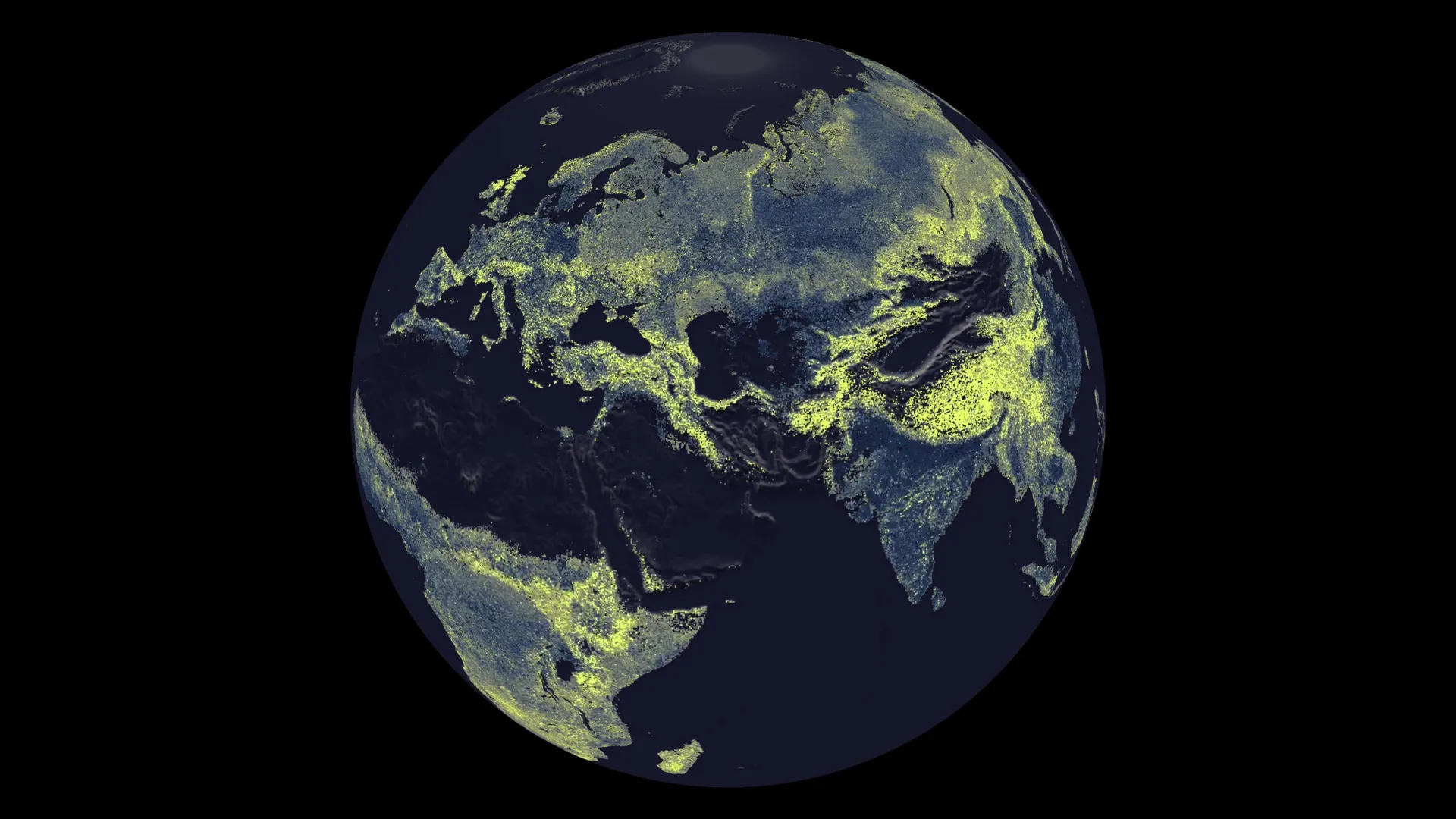
Beneath the surface of our planet lies a vast, intricate, and largely invisible infrastructure that underpins terrestrial life and plays a critical role in regulating Earth’s climate. For millennia, these intricate networks of fungi have quietly supported plant growth, facilitated nutrient cycling, and sequestered carbon into soils. Now, for the first time, researchers have meticulously charted the global distribution and density of these vital underground fungal networks, revealing a planetary circulatory system of staggering scale and profound ecological significance.
The groundbreaking study, published in the prestigious journal Science, focuses on arbuscular mycorrhizal (AM) fungi, a ubiquitous group of fungi that form symbiotic partnerships with an estimated 70% of all plant species on Earth. This research not only provides unprecedented global maps but also introduces an interactive visualization, allowing anyone to explore the immense scale of this hidden biological architecture. The insights gleaned from these maps are poised to equip scientists and policymakers with essential tools to identify areas where these crucial fungal networks are flourishing and, importantly, where they are under threat.
The Unseen Architects of Ecosystems: A Symbiotic Foundation
Arbuscular mycorrhizal fungi are not merely passive inhabitants of the soil; they are active partners in the success of most terrestrial ecosystems. These fungi establish a mutually beneficial relationship with plants, a partnership that has been crucial for the evolution and diversification of plant life over hundreds of millions of years. Plants, through the process of photosynthesis, provide the fungi with vital carbon compounds – sugars and starches – which serve as their primary energy source. In return, the fungi act as an extended root system for the plants. Their thread-like hyphae, far finer than plant roots, can explore a vastly larger volume of soil, efficiently absorbing and transporting essential nutrients like phosphorus and nitrogen, as well as water, back to their plant hosts. This exchange is so efficient that AM fungi can supply over 80% of a plant’s phosphorus requirements and expand the effective foraging area of plant roots by up to an astonishing 100 times.
These underground fungal networks function as living infrastructure, not only sustaining individual plants but also connecting entire ecosystems. They are instrumental in the movement of carbon from the atmosphere, captured by plants, into the soil, where it can be stored for extended periods, thus playing a crucial role in the global carbon cycle and climate regulation. This carbon sequestration capacity is substantial; the study estimates that AM fungal networks globally contain approximately 300 megatons of carbon, a mass equivalent to four to six times that of all living humans.
This recent work builds upon previous foundational research. In 2025, a landmark global analysis of underground mycorrhizal fungal diversity was published in Nature by many of the same researchers, alongside the launch of the "Underground Atlas," a digital platform designed to pinpoint biodiversity hotspots hidden beneath the surface. However, prior to this Science publication, no comprehensive attempt had been made to quantify and map the physical density and worldwide distribution of the AM fungal networks themselves.
Charting the Unimaginable: The Scale of the Fungal Network
The creation of these first-ever global maps involved an ambitious undertaking. Researchers meticulously compiled data from over 16,000 soil cores collected from diverse locations across the globe. These real-world measurements provided a crucial ground truth for their models. To extrapolate these findings to regions where direct soil sampling was not feasible, the team employed sophisticated machine-learning algorithms. These models integrated a wide array of environmental data, including soil type, climate patterns, vegetation cover, and topography, from various ecosystems ranging from arid deserts to frigid tundra and dense forests. This allowed for the prediction of fungal network density in areas lacking direct empirical data.
Further enhancing the precision of their estimates, the researchers collaborated with the Physics of Behavior group at the AMOLF research institute. Here, cutting-edge robotic imaging techniques were utilized to analyze more than 300,000 living AM fungal hyphae cultured under controlled laboratory conditions. This high-resolution analysis provided invaluable insights into the structure and growth patterns of individual fungal filaments. By synthesizing data from both field samples and laboratory experiments, the team was able to generate robust estimates for both the total length and the sheer mass of the global AM fungal network.
The results are staggering: the study suggests that these underground fungal networks extend for an astonishing approximate length of 110 quadrillion kilometers. To put this into perspective, this is a length so vast it could theoretically wrap around the Earth approximately 2.75 billion times. Dr. Justin Stewart, lead author of the study and affiliated with the Society for the Protection of Underground Networks (SPUN), emphasized the profound significance of these findings. "It is hard to overstate the importance and enormity of these fungi," Dr. Stewart stated. "There could be up to 10 meters (32 feet) of mycorrhizal network in just a teaspoon of soil." This density underscores the pervasive and intricate nature of this hidden biological system.
Earth’s Subterranean Circulatory System: Facilitating Life and Climate
Scientists frequently draw parallels between mycorrhizal networks and Earth’s circulatory system, and for good reason. These fungal webs are not static; they are dynamic conduits that actively transport essential resources – carbon, nutrients, and water – throughout underground ecosystems, connecting diverse plant communities and influencing soil health and stability. This continuous flow is critical for maintaining the health and resilience of terrestrial biomes.
The implications of these networks for plant life are profound. Beyond providing essential nutrients, they enhance a plant’s ability to access resources, particularly in challenging soil conditions. This increased efficiency and reach contribute significantly to plant survival and productivity.
The advent of new technologies has been pivotal in unlocking these hidden secrets. "With the emergence of new technologies in high-resolution imaging, machine-learning and robotics, we are starting to reveal what has long been hidden under our feet," remarked co-lead author, Dr. Corentin Bisot, a biophysicist at AMOLF. "We are learning how the complex bodies of network-forming fungi transport nutrients and help regulate the climate." This technological convergence is enabling a deeper understanding of processes that have been operating unseen for eons.
A Visual Gateway to the Underground: The Mycorrhizal Infrastructure Map
To make these complex findings accessible and understandable to a wider audience, the researchers collaborated with award-winning data visualization designer Moritz Stefaner. Together, they developed the "Mycorrhizal Infrastructure Map" (accessible at https://a-hidden-infrastructure.spun.earth/). This interactive platform offers the most detailed global visualization to date of Earth’s fungal infrastructure. The maps provide estimates of fungal network density for every square kilometer of terrestrial land, with the exclusion of ice caps and regions where data was insufficient for reliable predictions. This visualization tool is not just for public curiosity; the underlying data is publicly accessible, providing governments, conservation organizations, and researchers with a powerful new resource for monitoring the health and status of underground fungal communities worldwide.
This research builds directly on prior investigations by several of the same authors, published in Nature. That earlier study delved into the highly efficient systems created by mycorrhizal fungi and plants for exchanging carbon and nutrients. The researchers quantified carbon movement through these living networks at remarkable speeds, reaching up to 120 micrometers per second. If one were to experience this flow from within the network, it would feel akin to traveling at approximately 400 kilometers per hour. The current study extends this understanding by examining how these vital flows operate on a planetary scale, providing a crucial global context.
Areas of Concern: Threats to a Vital Ecosystem
While the new maps illuminate the extraordinary scale and importance of AM fungal networks, they also highlight critical areas of concern and potential vulnerability. The study’s predictions indicate that network densities in agricultural croplands are, on average, about half those found in comparable wild ecosystems. This suggests that intensive agricultural practices may be diminishing the functional capacity of these vital fungal communities.
Furthermore, wild grasslands emerge as particularly significant reservoirs of AM fungal biomass, containing roughly 40% of the world’s total. Despite their immense ecological importance, grasslands are among the least protected ecosystems globally. They are currently being converted to agricultural land at a rate four times faster than forests, posing a severe threat to the fungal networks they harbor. This conversion not only impacts biodiversity but also compromises the soil’s ability to sequester carbon and support robust plant growth.
These findings align with previous research conducted by SPUN, which has shown that a staggering 95% of biodiversity hotspots for arbuscular mycorrhizal fungi lie outside of existing protected areas. This underscores a critical gap in current conservation strategies, which often overlook the subterranean realm.
Dr. Toby Kiers, Executive Director of SPUN and an evolutionary biologist, emphasized the urgent need to integrate fungi into broader climate and conservation planning. "Fungi have been ignored in climate and conservation for too long. Now is the time to change that trajectory," Dr. Kiers stated. Dr. Kiers’s significant contributions to understanding plant-fungal relationships have been recognized with prestigious accolades, including a MacArthur Fellowship and the Tyler Prize, often referred to as the "Nobel Prize for the Environment."
Unanswered Questions and Future Directions
Despite the monumental advances presented by this research, significant knowledge gaps persist. "Mycorrhizal fungi have shaped life on Earth for hundreds of millions of years, but we still understand too little about how the infrastructure of these living transport systems is distributed across the planet," commented co-author and biologist Dr. Merlin Sheldrake. "This study is an exciting step towards understanding how this planetary circulatory system operates and suggests ways that we can better work with fungi to help address many of the unfolding challenges of our times, from food security to climate change."
The new global maps, while comprehensive, also serve as a roadmap for future scientific inquiry. Large regions of the world remain inadequately sampled, representing frontiers for further research into one of the planet’s most essential yet least visible ecosystems. Understanding the precise distribution, functional diversity, and vulnerability of these fungal networks across all terrestrial biomes is crucial for developing effective strategies to protect and harness their immense ecological services, from enhancing agricultural sustainability to mitigating the impacts of climate change. The scientific community now possesses a clearer picture of this hidden world, setting the stage for a new era of research and conservation focused on the vital subterranean realm.