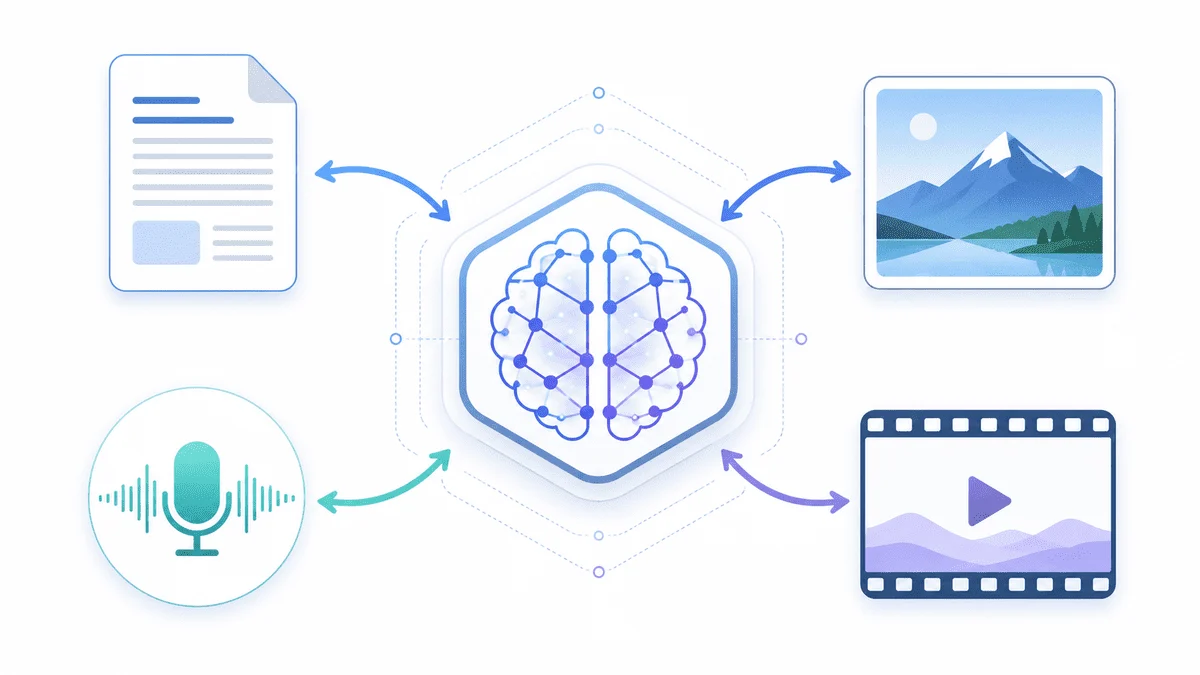
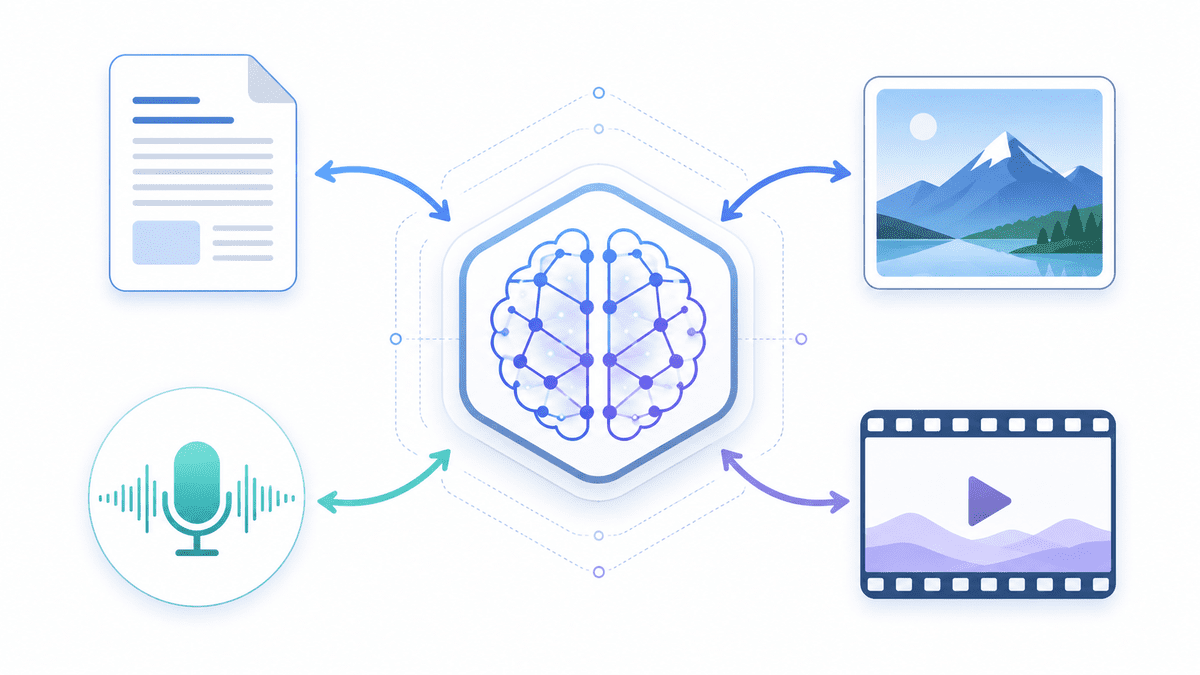
A profound shift is underway in the landscape of artificial intelligence, as what once felt like a distant promise — AI models capable of seamlessly understanding and interacting across text, images, audio, and video — rapidly becomes a tangible reality. This evolution marks a pivotal moment, moving beyond specialized, siloed AI systems to integrated "omni-modal" architectures that mirror the multifaceted nature of human perception and communication. Just a year ago, the concept of a single AI model processing and responding to diverse input types was largely theoretical, with most multimodal systems relying on complex orchestrations of separate, modality-specific models. Today, open-source innovation is accelerating the development of truly unified models, empowering developers and enterprises to build AI applications that are more intuitive, efficient, and versatile than ever before.
The Evolution of Multimodal AI: From Siloed Systems to Unified Intelligence
The journey towards omni-modal AI began with the groundbreaking success of large language models (LLMs), which demonstrated remarkable proficiency in understanding and generating text. However, the real world rarely presents information in a single format. Human interaction involves visual cues, spoken language, environmental sounds, and dynamic video. Early attempts to bridge this gap involved linking separate AI components: a vision model for images, an automatic speech recognition (ASR) model for audio, and a text-based LLM for reasoning and generation. While functional, this "pipeline" approach introduced significant complexity, latency, and integration overhead. Each component required its own training, deployment, and maintenance, creating a fragmented user experience.
The aspiration for a truly unified model — one that could ingest multiple data types simultaneously and reason holistically, then respond in various formats — has driven significant research and development. This pursuit is not merely an academic exercise; it addresses a fundamental bottleneck in AI deployment. Imagine an AI assistant that can analyze a complex financial document (text and charts), understand spoken queries about its contents (audio), summarize a video conference discussing it (video), and then generate a concise text report or even a spoken response. Such capabilities demand a deeper, intrinsic multimodal understanding, rather than a superficial stitching together of disparate systems.
The current wave of open-source omni-modal models represents a significant leap forward in this regard. These models are engineered to handle text, images, audio, and video in a much more integrated fashion, often within a single architectural framework. This fundamental shift reduces the engineering burden, minimizes latency, and paves the way for more natural, real-time AI interactions. Industry analysts project substantial growth in the multimodal AI sector, with increased investment reflecting the growing demand for integrated solutions that can operate effectively across varied enterprise and consumer applications.
Leading the Charge: Five Open-Source Omni-Modal Models Reshaping AI
The open-source community is at the forefront of this innovation, providing accessible tools that democratize advanced AI capabilities. While not all models achieve "any-to-any" input-output versatility, they each push the boundaries of multimodal understanding and generation. The distinction between models that accept many input types but only generate text, versus those that support speech, image generation, or real-time audio-video interaction, is crucial for developers tailoring solutions to specific needs.
1. NVIDIA Nemotron 3 Nano Omni 30B A3B Reasoning: Enterprise-Grade Multimodal Intelligence
NVIDIA’s Nemotron 3 Nano Omni 30B A3B Reasoning emerges as a powerful contender in the enterprise AI space, specifically engineered for robust multimodal understanding. This model’s ability to process video, audio, images, and text, then generate detailed text-based responses, positions it as a critical tool for sophisticated business intelligence. Its applications span a wide array of enterprise workflows, including comprehensive video and speech analysis, advanced document intelligence (parsing complex layouts and data), precise chart reasoning, optical character recognition (OCR), high-fidelity transcription, graphical user interface (GUI) understanding for automation, and intricate multimodal question answering.
Architecturally, Nemotron 3 Nano Omni is built upon a 31-billion-parameter Mamba2-Transformer hybrid Mixture-of-Experts (MoE) design. This innovative architecture utilizes approximately 3 billion active parameters per token, striking a balance between powerful reasoning capabilities and efficient inference, a crucial factor for large-scale enterprise deployments. Furthermore, its support for an expansive 256K-token context window is particularly noteworthy. This allows the model to analyze exceptionally long documents, extended transcripts of meetings or calls, comprehensive training videos, and other voluminous rich media content without losing context, addressing a key challenge in many business applications.
What truly distinguishes Nemotron 3 Nano Omni is its pragmatic focus on real-world enterprise workflows rather than mere demonstration. It is meticulously designed for use cases such as enhancing customer support systems, performing in-depth media content analysis, streamlining document review processes, powering advanced AI assistants, enabling sophisticated browser and email agents, and facilitating GUI automation. Its capabilities are directly aligned with the complex demands of modern businesses seeking to leverage AI for operational efficiency and deeper insights.
Best for: Video and speech analysis, document intelligence, OCR, chart understanding, GUI workflows, automatic speech recognition (ASR), and comprehensive enterprise multimodal Q&A.
2. Google Gemma 4 12B IT: Efficient Multimodality for Local and Edge Deployments
Google DeepMind’s Gemma 4 12B IT represents a significant contribution to the open-source community, designed as a compact yet highly efficient multimodal model. Part of the broader Gemma family, it is optimized for local and self-hosted AI applications, offering impressive capabilities within a smaller footprint. This model excels at processing text, images, audio, and video inputs, subsequently generating precise text-based responses.
Its utility extends to tasks such like visual question answering, detailed document and PDF understanding, robust OCR, comprehensive chart comprehension, accurate audio transcription, effective speech translation, sophisticated coding assistance, complex reasoning tasks, and streamlined multimodal assistant workflows. These capabilities make it an ideal choice for developers seeking powerful AI tools that can run efficiently on more constrained hardware.

A standout feature of the 12B Unified model is its pioneering encoder-free multimodal architecture. Unlike conventional approaches that rely on separate, specialized vision or audio encoders, Gemma 4 12B directly projects raw image patches and audio waveforms into the language model’s embedding space using lightweight linear layers. This streamlined design reduces computational overhead and simplifies the overall architecture. Similar to Nemotron, Gemma 4 12B also supports an extensive 256K-token context window, proving invaluable for handling lengthy documents, substantial codebases, extended conversational histories, and complex multimodal inputs comprising combined text, images, audio, and video frames. This makes it particularly attractive for applications where data locality and efficiency are paramount, such as on-device AI for smartphones or embedded systems.
Best for: Efficient multimodal assistants, document understanding, image and audio reasoning, video-frame analysis, coding, multilingual tasks, and local AI applications.
3. Qwen3-Omni 30B A3B Instruct: The Real-Time Conversationalist
Qwen3-Omni 30B A3B Instruct stands out as one of the most capable open omni-modal models currently available, pushing the boundaries of truly interactive AI. Engineered as a natively end-to-end multilingual omni-modal system, it processes text, images, audio, and video, and uniquely responds in both text and natural speech. This capability is transformative, enabling the construction of AI assistants that can not only "see" and "listen" but also "understand" and "speak" in real time, fostering highly natural interactions.
Its diverse applications include advanced speech recognition, seamless speech translation across languages, intelligent audio captioning, sophisticated music analysis, precise OCR, accurate image question answering, comprehensive video understanding, and engaging audio-visual dialogue. Such a broad range of functionalities positions it as a cornerstone for next-generation conversational AI.
The model leverages a Mixture-of-Experts architecture combined with a "Thinker-Talker" design. The "Thinker" component is responsible for deep multimodal understanding and complex reasoning, while the "Talker" component enables fluid and natural speech output. This innovative separation ensures both profound analytical capabilities and low-latency spoken interaction, critical for real-time applications.
One of Qwen3-Omni’s most compelling strengths is its design for real-time audio and video interaction. Unlike many multimodal models that operate on a slower upload-and-response paradigm, Qwen3-Omni is specifically built for streaming use cases, facilitating natural turn-taking in conversations and providing immediate text or speech responses. Furthermore, its robust multilingual support encompasses 119 text languages, 19 speech input languages, and 10 speech output languages. This extensive linguistic coverage makes it exceptionally valuable for global applications, multilingual voice assistants, accessibility tools, and advanced audio-video systems that must operate across diverse linguistic contexts. Its capabilities approach the ideal of a true omni-assistant, capable of generating natural speech, following complex system prompts, and handling intricate audio-visual tasks, marking a significant step towards more human-like AI.
Best for: Open omni assistants, real-time speech interaction, video understanding, audio reasoning, multilingual applications, audio-visual dialogue, and both text and speech responses.

4. DeepSeek Janus-Pro 7B: Bridging Vision Understanding and Generation
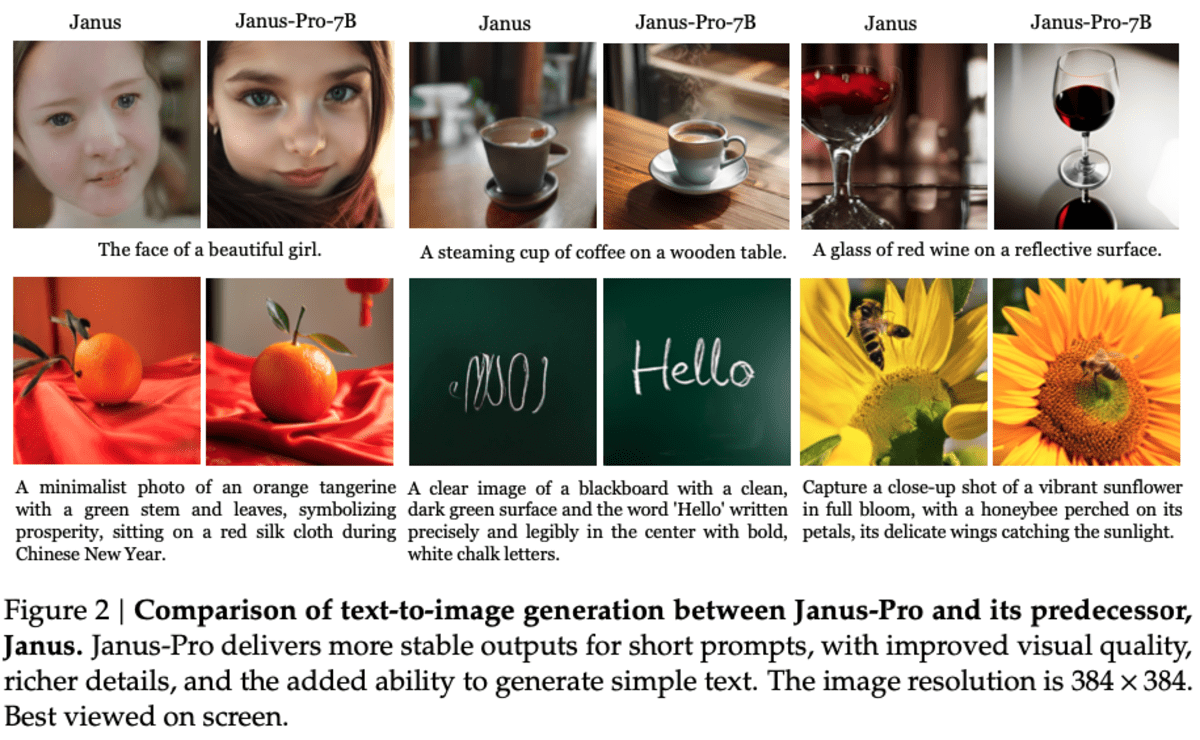
DeepSeek Janus-Pro 7B carves a unique niche among these models, focusing specifically on unified visual understanding and image generation. While not a full omni-modal model encompassing text, audio, images, and video, its significant contribution lies in its ability to integrate image understanding and image creation within a single, coherent framework. This makes it an invaluable tool for tasks such as visual question answering, advanced image reasoning, precise image captioning, sophisticated text-to-image generation, and various multimodal creative workflows.
Janus-Pro is built upon the DeepSeek-LLM-7B foundation and employs a novel autoregressive framework that intelligently separates visual encoding into distinct pathways for understanding and generation. This architectural innovation addresses a common challenge in traditional multimodal models, where a single visual encoder often struggles to optimally support both the recognition of existing images and the generation of new ones. By decoupling these functions, Janus-Pro achieves greater flexibility and superior performance across both tasks.
For image understanding, the model utilizes SigLIP-L as its vision encoder, supporting 384 x 384 image inputs. Crucially, for image generation, it employs a dedicated image tokenizer, which empowers the model to generate high-quality images directly from textual prompts. This simple yet highly effective architecture, by maintaining a unified transformer while differentiating visual processing, allows Janus-Pro to excel in scenarios demanding both insightful visual analysis and creative image synthesis. Its implications for content creation, visual search engines, and design automation are substantial.
Best for: Image understanding, visual reasoning, image captioning, visual question answering, and text-to-image generation.
5. MiniCPM-o 4.5: Full-Duplex Multimodal Live Streaming and Proactive AI
MiniCPM-o 4.5 represents one of the most forward-looking open omni-modal models, specifically designed for vision, speech, and full-duplex multimodal live streaming. Its comprehensive capabilities include processing text, images, video, and audio, and generating both text and speech outputs. This makes it uniquely suited for developing live AI assistants that can simultaneously "see," "listen," and "speak," enabling highly interactive and dynamic applications.
This model is instrumental for real-time voice conversations, continuous video understanding, advanced OCR, intelligent document parsing, accurate visual question answering, fluid speech interaction, and complex multimodal assistant workflows. The ability to engage in full-duplex communication – where the AI can process input and generate output concurrently – distinguishes it for applications requiring immediate and seamless interaction.

Built with a total of 9 billion parameters, MiniCPM-o 4.5 integrates several high-performing components, including SigLIP2 for vision, Whisper-medium for audio processing, CosyVoice2 for speech generation, and Qwen3-8B for language capabilities. This strategic combination bestows it with robust visual, speech, and language proficiencies while maintaining a relatively compact size, making it feasible for practical local deployment.
Its full-duplex multimodal streaming capability is a game-changer. Unlike traditional models that wait for complete input before formulating a response, MiniCPM-o 4.5 can continuously process live video and audio streams while simultaneously generating text and speech outputs. Furthermore, it supports proactive interaction, meaning the model can actively observe a live scene and autonomously decide when to speak, offer comments, or respond, rather than merely reacting to explicit user prompts. This proactive nature is a critical step towards more intelligent and helpful AI agents.
MiniCPM-o 4.5 also demonstrates strong visual understanding and OCR capabilities, adept at processing high-resolution images, high-FPS videos, and documents with diverse aspect ratios. This makes it invaluable for tasks such as intricate document parsing, screen understanding in automation, and various real-world visual AI applications. A significant advantage is its deployment flexibility, supporting PyTorch inference on NVIDIA GPUs, along with quantized models compatible with llama.cpp, Ollama, GGUF, vLLM, and SGLang. This broad compatibility greatly simplifies development and allows for deployment on a wide range of hardware, from powerful GPUs to personal computers and even some edge devices, further democratizing advanced multimodal AI.
Best for: Real-time multimodal assistants, live video and audio understanding, speech interaction, OCR, document parsing, edge AI, and full-duplex omni-modal applications.
Implications and Broader Impact of Omni-Modal AI
The rise of open-source omni-modal AI models heralds a new era for artificial intelligence, transcending the limitations of single-modality systems. This shift carries profound implications across numerous sectors, promising to redefine how humans interact with technology and how businesses leverage AI for decision-making and automation.
Democratization of Advanced AI: The open-source nature of these models is perhaps their most significant contribution. By making sophisticated multimodal capabilities freely available, they lower the barrier to entry for developers, researchers, and startups. This fosters rapid innovation, encourages experimentation, and accelerates the integration of advanced AI into a broader range of applications and industries.
Reduced Complexity and Latency: The move towards unified architectures inherently simplifies AI system design. Instead of managing a labyrinth of separate models for different modalities, developers can work with a single, integrated framework. This reduces engineering overhead, streamlines deployment, and, critically, minimizes the latency often associated with passing data between multiple specialized models. The result is a smoother, more responsive user experience, particularly vital for real-time applications.
New Application Frontiers: Omni-modal models unlock previously unimaginable applications:
- Enterprise Solutions: Enhanced customer support agents that can analyze customer sentiment from voice, identify issues from screenshots, and pull relevant information from internal documents. Automated media analysis that understands both the visual and auditory content of video streams. Advanced document intelligence that can process complex forms with text, checkboxes, and signatures.
- Conversational AI and Accessibility: More natural and empathetic AI assistants capable of understanding non-verbal cues (like facial expressions in video) and responding with appropriate tone and modality (text or speech). Multilingual voice assistants become truly global, breaking down language barriers in real-time. Accessibility tools for individuals with disabilities can be revolutionized, offering richer, more intuitive interfaces.
- Edge Computing and Robotics: Compact yet powerful omni-modal models, like Gemma 4 12B IT and MiniCPM-o 4.5, enable sophisticated AI to run directly on devices such as smartphones, smart home appliances, and robots. This facilitates ambient intelligence, allowing devices to perceive and respond to their environment in a holistic manner, enhancing privacy and reducing reliance on cloud infrastructure.
- Creative Industries: Models like DeepSeek Janus-Pro 7B open new avenues for content creation, allowing artists and designers to generate complex visual narratives from text prompts, or to seamlessly integrate image understanding into their creative workflows.
- Safety and Monitoring: Real-time analysis of surveillance footage, combined with audio monitoring, can provide more comprehensive insights for safety and security applications, identifying anomalies that single-modality systems might miss.
Challenges and Future Outlook: While the progress is remarkable, challenges remain. Ensuring the ethical deployment of these powerful models, particularly regarding bias and potential misuse, is paramount. The computational demands for training and deploying even larger, more capable omni-modal models will continue to be significant. Data curation for truly multimodal datasets, which accurately represent the complexities of real-world interactions, is an ongoing area of research.
Despite these hurdles, the trajectory is clear: omni-modal AI is becoming an indispensable component of the future technological landscape. Industry leaders, developers, and researchers are united in the belief that these models represent a significant leap towards more practical, intelligent, and human-centric AI systems. The ability of AI to naturally comprehend the diverse streams of information that define our world — text, images, audio, and video — is not just an advancement; it is a fundamental transformation that will underpin the next generation of intelligent applications, making AI truly useful in real-world situations. The current wave of open-source innovation is rapidly paving the way for a future where AI interacts seamlessly and intuitively with the rich tapestry of human experience.
Abid Ali Awan (@1abidaliawan) is a certified data scientist professional who loves building machine learning models. Currently, he is focusing on content creation and writing technical blogs on machine learning and data science technologies. Abid holds a Master’s degree in technology management and a bachelor’s degree in telecommunication engineering. His vision is to build an AI product using a graph neural network for students struggling with mental illness.