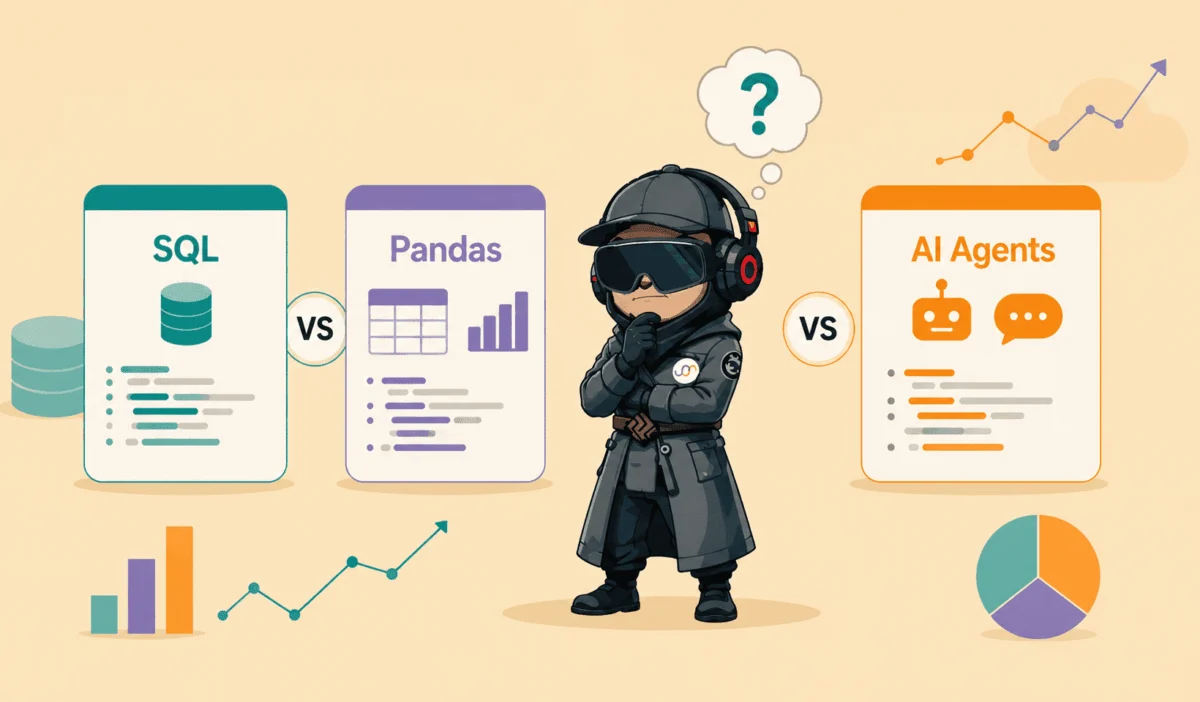
A recent rigorous benchmarking study, spearheaded by data science education platform StrataScratch, has shed critical light on the comparative performance of three prominent data analysis paradigms: traditional SQL, the Python-based Pandas library, and emerging AI agents powered by large language models (LLMs). This comprehensive evaluation, which subjected each methodology to identical data challenges across varying levels of complexity, reveals distinct strengths, weaknesses, and optimal use cases for each tool in the modern data landscape. The findings are poised to influence how data professionals approach query formulation, data transformation, and ultimately, how organizations leverage technology for data-driven insights.
Methodology and Benchmarking Rigor: A Foundation for Fair Comparison
To ensure a statistically sound and reproducible comparison, the study meticulously controlled for variables, employing a standardized approach across all tests. Three interview questions, sourced directly from StrataScratch’s extensive bank of real-world data science interview problems, were selected to represent "Easy," "Medium," and "Hard" difficulty levels. These questions were designed to progressively test capabilities ranging from simple data retrieval to multi-step aggregations and complex window functions across multiple tables.
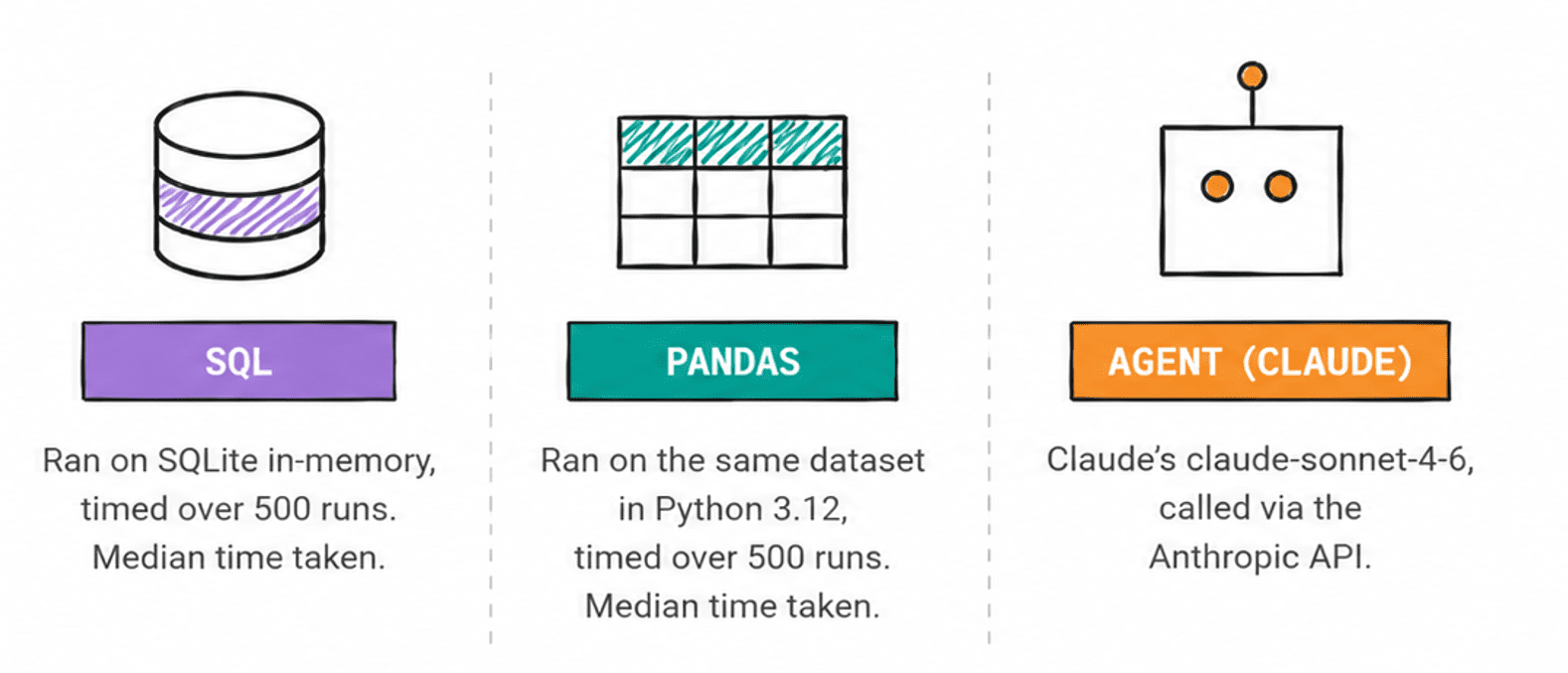
The technical setup was equally precise. SQL queries were executed on an in-memory SQLite database, a choice that allowed for precise measurement of raw query execution speed without I/O bottlenecks. Each SQL query was run 500 times, and the median execution time was recorded. Similarly, Pandas operations were performed using Python 3.12 on the same dataset, with 500 runs to capture median performance. The AI agent chosen for the comparison was Anthropic’s claude-sonnet-4-6, accessed via the Anthropic API. Unlike SQL and Pandas, where execution time is purely computational, the AI agent’s "speed" was measured as the end-to-end latency from the moment the request was sent to the receipt of the first generated token—a crucial distinction representing the human user’s waiting time for code generation.
A critical aspect of the AI agent’s evaluation was the use of "schema-grounded user prompts." For each question, the prompt explicitly included table names, column names, and a few sample rows, alongside the specific analytical question. A consistent system prompt was maintained across all calls to minimize variability in the agent’s initial instruction set. This meticulous approach to prompt engineering was identified as paramount for the agent’s success, directly addressing the common challenge of AI "hallucinations" or misinterpretations of data context.
Performance Across Difficulty Levels: Unpacking the Results
The study systematically presented each data challenge to SQL, Pandas, and the Claude agent, meticulously recording their output and performance metrics.
Case Study 1: Simple Retrieval – The Foundation
The "Easy" question, originating from a Meta interview scenario, tasked users with identifying distinct user_ids who performed at least one scroll_up event from a single facebook_web_log table. This problem primarily tests basic filtering and distinct aggregation.
- SQL’s Efficiency: The SQL solution was remarkably concise and swift, executing in a mere 0.002 milliseconds. Its direct approach—
SELECT DISTINCT user_id FROM facebook_web_log WHERE action = 'scroll_up';—demonstrates SQL’s inherent optimization for set-based operations within a database engine. - Pandas’ Approach: Pandas, while still efficient for this task, exhibited a slightly higher execution time of 0.40 milliseconds. The solution involved filtering the DataFrame and then using
drop_duplicateson theuser_idcolumn. This overhead is typical of Python’s interpreter and DataFrame object management compared to native database operations. - AI Agent’s Accuracy and Latency: The Claude agent flawlessly generated the identical, correct SQL query. However, its "execution" time, representing the LLM inference, was approximately 2 seconds. This immediate latency for code generation, even for a simple query, highlights a fundamental difference in user experience. The study noted that without a clearly defined schema in the prompt, the agent might misinterpret column names, leading to silent failures—a key insight into the importance of meticulous prompt engineering.
Case Study 2: Multi-Step Aggregation – Where Schema Grounding Matters Most
The "Medium" difficulty question, also from a Meta interview, involved calculating the average feature completion percentage for each product feature across all users. This required joining two tables (facebook_product_features and facebook_product_features_realizations), determining the maximum step reached by each user for each feature, and critically, counting users who never started a feature as 0% complete. This task tests joins, aggregations, and conditional logic for missing data.

- SQL’s Structured Solution: The SQL solution, executing in 0.007 milliseconds, employed Common Table Expressions (CTEs) for clarity, first calculating
max_step_reachedper user and feature, then joining this with thefacebook_product_featurestable. The crucial element was theLEFT OUTER JOINcombined withCOALESCE(max_step_reached, 0)to correctly account for users who never engaged with a feature, ensuring their completion percentage was factored in as zero. - Pandas’ Workflow: Pandas mirrored this logic with a 2.05-millisecond execution. It used
groupby().max()to find max steps, followed by anoutermerge to include all features andfillna(0)to handle non-starters. Subsequent DataFrame operations then calculated the completion percentages and their averages. - AI Agent’s Precision and Prompt Dependency: The Claude agent again produced a correct SQL query, remarkably similar in logic to the reference solution, including the vital
LEFT JOINandCOALESCEfunction. Its generation time was around 3 seconds. The study emphatically stressed the "load-bearing" nature of the prompt’s instruction: "Users who never started count as 0% completion." Without this explicit instruction, the agent would likely default to anINNER JOIN, silently dropping non-starting users and producing incorrect, yet plausible, average completion percentages. This underscores that AI agents are only as good as the context and constraints provided in their prompts.
Case Study 3: Multiple Tables and Window Logic – Sophistication in Query Generation
The "Hard" question involved combining energy consumption data from three regional Meta data centers (fb_eu_energy, fb_na_energy, fb_asia_energy), summing consumption by date, and deriving two new columns: a cumulative running total and that total as a percentage of the grand total, rounded to a whole number. This challenge tests UNION ALL, GROUP BY, and advanced window functions.
- SQL’s Sophistication: The SQL solution, executing in 0.010 milliseconds, elegantly handled the task. It began by using
UNION ALLto combine data from the three regional tables. A subsequent CTE aggregated daily consumption, and then window functions were applied:SUM(total_energy) OVER (ORDER BY recorded_date ASC)for the cumulative total, and a scalar subquery(SELECT SUM(total_energy) FROM energy_by_date)to calculate the grand total for the percentage calculation. - Pandas’ Equivalence: Pandas achieved the same results in 1.84 milliseconds. It used
pd.concatto combine the DataFrames, followed bygroupby().sum()andsort_valuesfor daily totals. Thecumsum()method was then applied for the running total, and division bysum()of the total consumption yielded the percentages. Date formatting was handled bypd.to_datetime().dt.strftime(). - AI Agent’s Alternative Elegance: The Claude agent, with a generation time of approximately 4 seconds, produced a correct SQL query that diverged slightly from the reference solution but was equally valid and efficient. Instead of a scalar subquery for the grand total, the agent cleverly utilized a window function with no
ORDER BYclause:SUM(daily_total) OVER (). This approach is often more performant in many database systems for calculating a grand total within the same query. This demonstrated the agent’s ability to generate not just correct code, but sometimes even creative or more optimized alternative solutions, further highlighting the potential of LLMs beyond mere rote pattern matching.
Key Comparative Dimensions: A Deeper Dive into Trade-offs
The study extended its comparison beyond raw accuracy and speed, delving into eight critical dimensions that define the utility and practicality of each tool in real-world data environments.
-
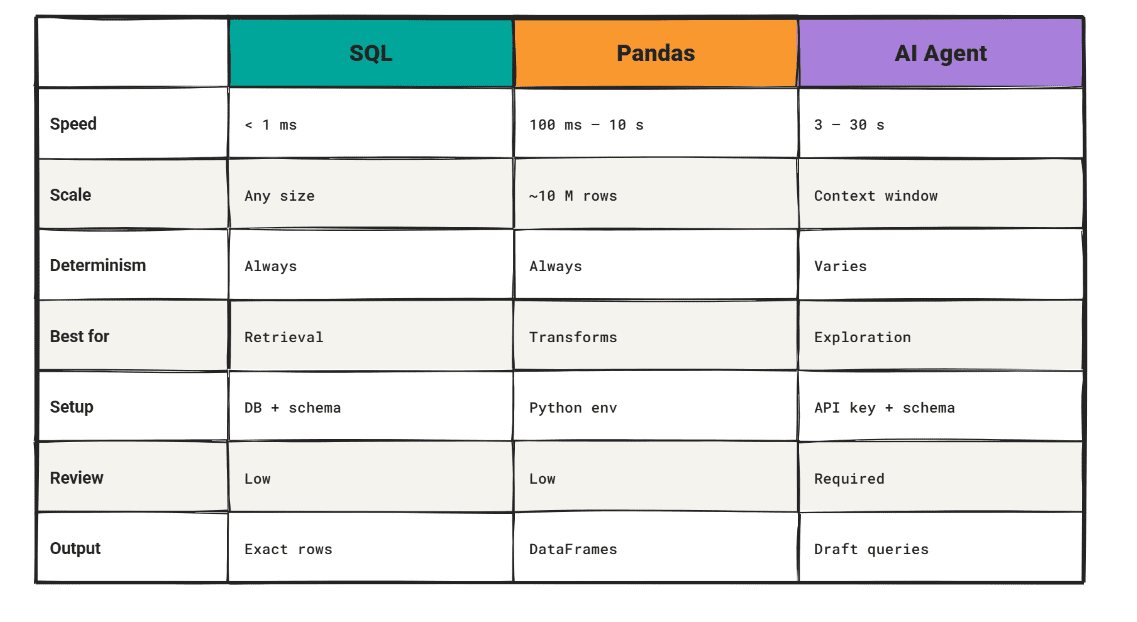
Speed: This was perhaps the most stark differentiator. SQL, operating directly within highly optimized database engines, consistently delivered results in microseconds (0.002-0.010 ms). Pandas, leveraging Python’s interpreter and DataFrame operations, operated in milliseconds (0.4-2.1 ms). The AI agent introduced a significant latency of 2-4 seconds for code generation before any execution could even begin. While this latency might be acceptable for ad-hoc exploration, it becomes a bottleneck for interactive analysis or real-time applications. For warehouse-scale data, the raw execution speed of the generated SQL would eventually dominate, but the initial LLM inference time remains a fixed overhead.
-
Accuracy and Hallucination Risk: SQL and Pandas are inherently deterministic; given the same code and data, they will always produce the same output. AI agents, being probabilistic models, exhibited variability. While Claude produced correct SQL in this schema-grounded study, each API call often yielded syntactically different, though functionally equivalent, queries. More concerning is the "hallucination risk": without a complete and accurate schema in the prompt, agents can invent non-existent columns or tables, leading to silent failures where plausible but incorrect results are generated without error messages. This necessitates robust validation of AI-generated code.
-
Explainability and Debugging: A SQL query, particularly when structured with CTEs, can be read and understood in blocks. Debugging involves inspecting the query logic directly. Pandas, while requiring Python fluency, allows for step-by-step inspection of DataFrame states, making debugging intuitive for Python developers. AI agents offer English explanations of their reasoning, which can be helpful. However, if the generated code is incorrect, debugging involves not only understanding the code but also inferring the model’s potentially flawed reasoning chain, a more abstract and challenging process.
-
Scalability: SQL, integrated with robust database management systems, scales exceptionally well, handling datasets ranging from gigabytes to petabytes efficiently through optimized storage, indexing, and distributed processing. Pandas, while powerful for in-memory operations, hits a memory ceiling around 10 million rows on a single machine, requiring distributed computing frameworks like Apache Spark or Polars for larger datasets. AI agents’ scalability relates to their API throughput and cost, not their direct data processing capability; they generate code, which then scales according to the chosen execution engine (e.g., SQL database).
-
Flexibility: Pandas stands out for its flexibility in custom transformations, complex string parsing, and iterative feature engineering, making it a go-to for machine learning preprocessing pipelines. SQL excels at set-based logic, complex joins, and aggregations but can become verbose for procedural tasks. AI agents offer flexibility in accepting natural language requests, but their consistency and reliability can wane with highly complex, ambiguous, or proprietary schema structures, requiring increasingly sophisticated prompt engineering.
-
Production Readiness: SQL remains the undisputed leader for production-grade analytics, owing to its maturity, widespread adoption, robust error handling, and integration with data warehousing and BI tools. Pandas is dependable for production when coupled with rigorous testing, version control, and CI/CD pipelines. AI agents, while rapidly advancing, are currently best suited for low-stakes ad-hoc queries, rapid prototyping, or scenarios where human review and validation of the generated output are an integral part of the workflow. Full production deployment of AI-generated code still requires significant advancements in reliability, auditability, and validation frameworks.
Strategic Implications for Data Professionals and Organizations
The findings of this StrataScratch study carry significant implications for the evolving roles of data professionals and the strategic adoption of data tools within organizations.
- Evolving Skill Sets: While SQL and Python (with Pandas) remain foundational, the emergence of AI agents introduces "prompt engineering" and "AI-generated code validation" as new, critical competencies. Data professionals will increasingly act as orchestrators, guiding AI tools with precise prompts and rigorously verifying their output, rather than solely writing every line of code from scratch.
- Hybrid Workflows: The future of data analysis is likely hybrid. AI agents can serve as powerful co-pilots, rapidly generating first drafts of queries, exploring initial hypotheses, or even translating complex business questions into technical specifications. Human data scientists can then refine, optimize, and validate this AI-generated code, especially for mission-critical applications. This could significantly accelerate the initial phases of data exploration and analysis.
- Data Governance and Trust: The probabilistic nature of AI-generated code raises important questions about data governance, auditability, and trust. Organizations will need robust frameworks to log, review, and approve AI-generated queries, especially when dealing with sensitive data or regulatory compliance. The potential for "silent failures" (incorrect yet plausible output) necessitates a higher degree of vigilance.
- Cost and Resource Allocation: The cost of AI agent API calls needs to be weighed against the efficiency gains and potential reduction in manual coding hours. For small, infrequent queries, the latency and cost might be acceptable, but for high-volume, repetitive tasks, optimized SQL or Pandas scripts running on dedicated infrastructure might still be more cost-effective.
- Democratization of Data Access: AI agents hold the promise of democratizing data access, allowing non-technical business users to query data using natural language. However, this democratization must be balanced with adequate guardrails and validation mechanisms to prevent misinterpretations and erroneous conclusions.
Conclusion: A Complementary Ecosystem
The StrataScratch study unequivocally demonstrates that SQL, Pandas, and AI agents each offer distinct advantages in the realm of data analysis. When used correctly, all three can yield accurate results across varying levels of complexity. However, their operational profiles—spanning speed, reproducibility, context dependency, and debugging paradigms—reveal them not as direct replacements for one another, but rather as complementary tools within a sophisticated data ecosystem.
SQL remains the bedrock for structured data retrieval and set-based logic, offering unparalleled speed and deterministic output within database engines. Pandas provides a flexible, step-by-step environment for custom data transformations, iterative feature engineering, and in-memory analysis up to moderate data volumes. The AI agent, exemplified by Claude-Sonnet-4-6, proves capable of generating correct and even creatively optimized SQL, particularly for complex tasks involving window functions. Its primary value lies in its natural language interface, accelerating the generation of first-draft queries and enabling ad-hoc exploration, provided it is furnished with a comprehensive, schema-grounded prompt and its outputs are subject to human review and validation.
The key takeaway is a nuanced one: the choice of tool is dictated by the specific context, scale of data, required performance, and tolerance for variability. The future of data analysis will likely involve a synergistic integration of these tools, with AI agents assisting human experts, transforming workflows, and allowing data professionals to focus on higher-level analytical challenges and strategic insights, rather than solely on syntax. As Nate Rosidi, a data scientist, adjunct professor, and founder of StrataScratch, emphasizes through his work, understanding these evolving trends is crucial for data professionals preparing for the demands of a rapidly changing industry.