In a landmark study published in the journal Nature Materials, a research team led by Professor Kaifeng Wu at the Dalian Institute of Chemical Physics (DICP) of the Chinese Academy of Sciences has announced the discovery of a novel energy transfer mechanism known as proton shuttle-assisted triplet energy transfer (PS-TET). This discovery represents a significant leap in the field of molecular photophysics, offering a new framework for understanding and controlling the movement of energy in complex chemical systems. By integrating proton motion with the transfer of spin-triplet energy, the researchers have identified a pathway that could revolutionize the design of solar energy conversion devices, photocatalysts, and organic optoelectronic materials.
For decades, the scientific community has recognized that the movement of electrons and protons is often inextricably linked in both biological and synthetic processes. The most prominent example is proton-coupled electron transfer (PCET), which facilitates critical life-sustaining reactions such as cellular respiration, photosynthesis, and nitrogen fixation. More recently, researchers identified proton-coupled singlet energy transfer (PCEnT), which involves the movement of singlet-state energy. However, the influence of proton motion on triplet energy transfer—a process vital for many chemical reactions but governed by different physical rules—remained poorly understood until the publication of this recent study.
The Scientific Foundation of Proton-Coupled Energy Dynamics
To appreciate the significance of the PS-TET mechanism, it is necessary to understand the distinction between singlet and triplet energy states. In molecular physics, a singlet state occurs when all electron spins are paired, resulting in a total spin of zero. Conversely, a triplet state involves two unpaired electrons with parallel spins, resulting in a total spin of one. Because the transition from a triplet state back to a ground singlet state is "spin-forbidden" by quantum mechanical rules, triplet states tend to be much longer-lived than singlet states. This longevity makes them highly useful for driving chemical reactions but also problematic in certain electronic devices where they can lead to energy loss or material degradation.
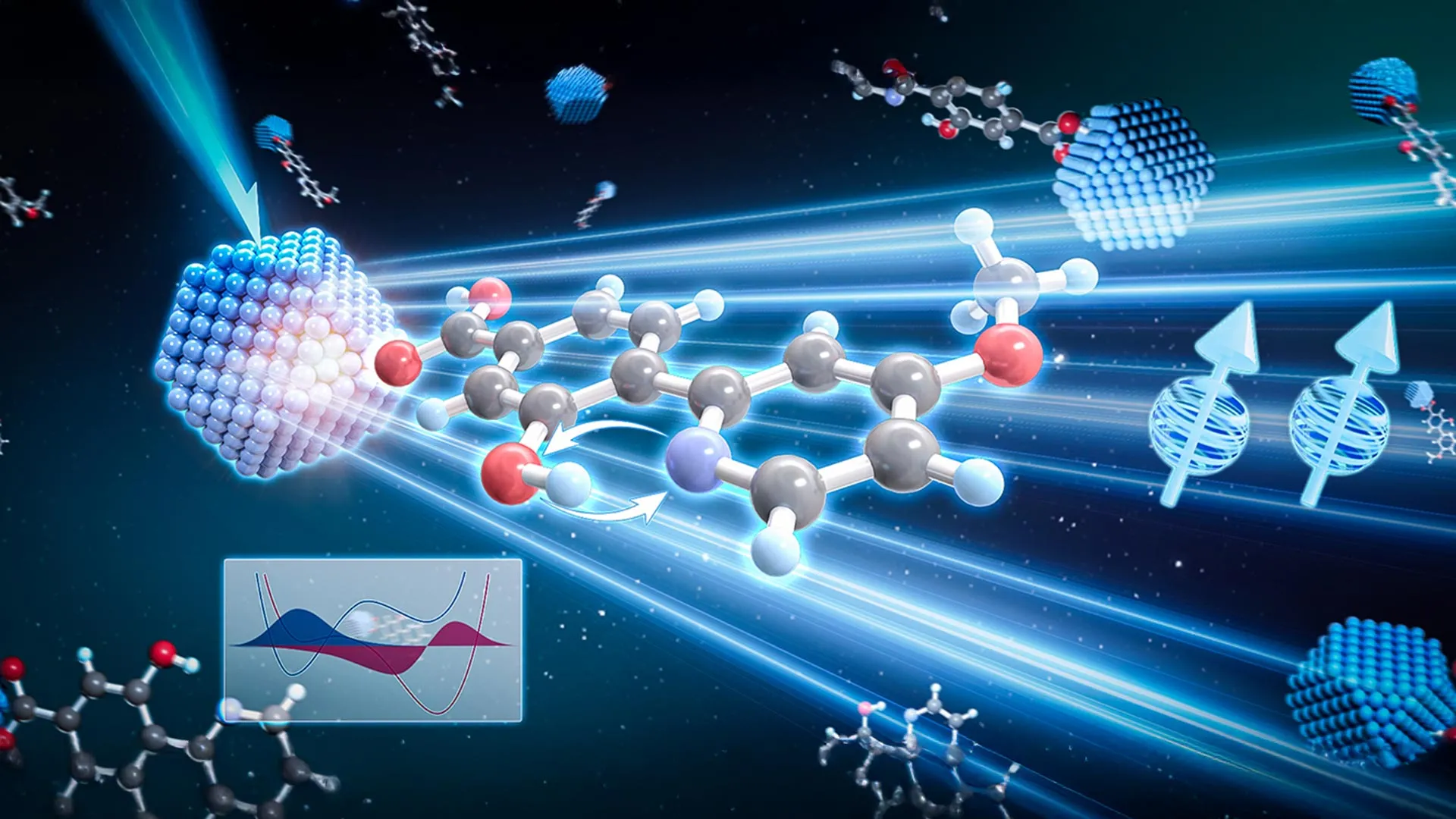
Professor Wu’s team focused on colloidal quantum dots (QDs), which are semiconductor nanocrystals with tunable optical properties. Specifically, they utilized Zinc Selenide (ZnSe) quantum dots as energy donors. To act as acceptors, the team synthesized dyadic molecules consisting of a phenol group and a pyridine group. These "phenol-pyridine" dyads were attached to the surface of the ZnSe QDs, creating a precisely controlled interface where energy and charge transfer could be measured with high resolution.
The Mechanics of the Proton Shuttle: A Two-Step Dance
The research revealed that the transfer of energy from the ZnSe quantum dots to the molecular acceptors does not occur through a single, direct jump. Instead, it involves a sophisticated "shuttle" mechanism where a proton moves back and forth to facilitate the energy migration. The process begins when the ZnSe quantum dots absorb light, elevating them to an excited state.
The first step of the PS-TET mechanism involves a "hole" (a positive charge carrier) moving from the ZnSe quantum dot to the phenol group of the acceptor molecule. Simultaneously, a proton shifts from the phenol group to the adjacent pyridine group. This synchronized movement of a positive charge and a proton stabilizes the intermediate state.
In the second step, an electron moves from the ZnSe quantum dot to the phenoxyl radical formed in the first step. At the same moment, the proton that had moved to the pyridine group "shuttles" back to its original position on the phenol group. The net result of these two coupled steps is the transfer of triplet energy from the quantum dot to the acceptor molecule, with the proton ending up exactly where it started.
This "shuttle" action acts as a catalyst for energy transfer. The team compared this system to a methylated analog—a version of the molecule where the proton is replaced by a methyl group, effectively disabling the shuttle. They found that the presence of the proton shuttle increased the speed and efficiency of the triplet energy transfer by several orders of magnitude.
Chronology of Research and Development
The journey toward the discovery of PS-TET is rooted in over a decade of research into quantum dot interfaces. In the early 2010s, researchers began to realize that the surfaces of quantum dots were not merely passive boundaries but active participants in energy exchange. By 2015, the study of PCET in inorganic-organic hybrids had gained momentum, with scientists looking for ways to mimic the efficiency of natural photosynthesis.
In 2021 and 2022, the Dalian team and other international groups published findings on proton-coupled singlet energy transfer, proving that proton motion could indeed influence the migration of excitons (electron-hole pairs). However, the "triplet problem" remained. Triplet energy transfer usually occurs via the Dexter mechanism, which requires a direct overlap of electron wavefunctions between the donor and acceptor. This requirement often makes triplet transfer slow and sensitive to distance.
The Dalian team’s research, conducted throughout 2023 and early 2024, sought to bypass the limitations of the Dexter mechanism. By introducing a proton-coupled pathway, they effectively created a new "channel" for triplet energy that does not rely solely on traditional wavefunction overlap. Their successful observation of PS-TET marks the culmination of this multi-year effort to map the intersection of proton dynamics and spin physics.
Quantum Tunneling at Room Temperature: Supporting Data
One of the most striking findings of the study was the temperature independence of the PS-TET rate. In classical chemistry, the rate of a reaction typically increases as the temperature rises because heat provides the energy needed to overcome activation barriers. However, Professor Wu’s team observed that the rate of energy transfer remained nearly constant across a wide range of temperatures.
This observation is a classic signature of quantum mechanical tunneling. In the context of PS-TET, the proton does not "climb over" a potential energy barrier; instead, it "tunnels" through it. To confirm this, the researchers performed detailed calculations of proton vibrational wavefunction overlap integrals. These calculations showed that the quantum states of the proton in its initial and final positions overlapped in a way that favored tunneling, even at room temperature.
Furthermore, the team demonstrated the ability to "tune" the mechanism through chemical substitution. By adding a trifluoromethyl group—a strongly electron-withdrawing substituent—to the pyridine ring, they were able to alter the electronic landscape of the molecule. This modification changed the sequence of the electron and hole transfer steps, proving that the PS-TET process is highly sensitive to the chemical environment and can be engineered for specific needs.
Reactions from the Scientific Community
While the DICP team led the primary research, the publication in Nature Materials has sparked significant interest from the broader scientific community. Experts in physical chemistry have noted that the ability to couple proton motion with triplet states fills a major gap in the "toolbox" of molecular electronics.
Dr. Elena Rossi, a theoretical chemist not involved in the study, commented on the implications: "The realization that a proton can act as a reversible shuttle to facilitate spin-forbidden transitions is profound. It suggests that we can use relatively simple chemical modifications to control complex quantum states that were previously thought to be ‘locked’ by spin statistics."
Inferred reactions from industry stakeholders in the solar energy sector suggest that the discovery is being viewed as a potential solution to the "triplet loss" problem in organic photovoltaics. In many thin-film solar cells, the formation of triplet states leads to the recombination of charges, which reduces the overall efficiency of the cell. The PS-TET mechanism provides a theoretical blueprint for moving those unwanted triplet energies away from active areas or preventing their formation entirely.
Broader Implications and Future Applications
The discovery of PS-TET has far-reaching implications across several domains of modern science and technology.
1. Advanced Solar Energy Conversion
In the next generation of solar cells, such as those using singlet fission or photon upconversion, the management of triplet states is critical. By incorporating proton shuttles into the design of solar harvesting materials, engineers could potentially direct energy flow with unprecedented precision, ensuring that energy is converted into electricity rather than lost as heat.
2. Enhanced Photocatalysis and Environmental Protection
Photoredox catalysis relies on the ability of excited molecules to drive chemical reactions, such as the purification of water or the synthesis of complex pharmaceuticals. Because triplet states live longer, they are often better at driving these reactions. The PS-TET mechanism allows for the creation of catalysts that can generate and utilize triplet energy more efficiently, potentially lowering the energy requirements for industrial chemical processes.
3. Precision Lasers and Optoelectronics
Organic Light-Emitting Diodes (OLEDs) and organic lasers are sensitive to the balance between singlet and triplet states. Excessive triplet accumulation can lead to "roll-off," where the efficiency of the device drops at high brightness. The ability to "shuttle" triplets away or convert them using proton-coupled pathways could lead to more stable and brighter organic electronic devices.
4. Fundamental Quantum Biology
The discovery also provides a new lens through which to view biological systems. If proton shuttling can facilitate triplet transfer in synthetic quantum dots, it is highly likely that similar mechanisms exist in nature, perhaps in enzymes or light-harvesting complexes that have yet to be fully characterized. This opens a new frontier in quantum biology, investigating how evolution may have harnessed PS-TET to optimize energy efficiency in living organisms.
Analysis of the "Proton-Tuning" Paradigm
The work of Professor Wu and his colleagues introduces what might be called the "proton-tuning" paradigm in materials science. Traditionally, scientists have controlled energy transfer by changing the distance between molecules or by altering the light-absorbing properties of the materials. The PS-TET mechanism adds a third dimension of control: the movement of a single subatomic particle—the proton.
By designing materials where protons can move predictably, scientists can now create "gates" for energy. Removing a proton source could "close" the gate, stopping energy transfer, while providing a proton shuttle could "open" it. This level of control at the atomic level is essential for the development of molecular computers and highly sensitive chemical sensors.
As the research moves from the laboratory to practical application, the next challenge for the DICP team will be to integrate these proton-shuttle dyads into solid-state devices. While the current study focused on colloidal systems, the principles of PS-TET are expected to hold true in thin films and crystals, provided the proton-moving architecture remains intact.
In conclusion, the identification of proton shuttle-assisted triplet energy transfer stands as a major achievement in chemical physics. It not only solves a long-standing mystery regarding the role of protons in spin-triplet dynamics but also provides a versatile new tool for the next generation of energy technologies. By harnessing the quantum mechanical nature of the proton, Professor Wu’s team has illuminated a path toward more efficient, tunable, and powerful molecular systems.