Modern physics is constructed upon two exceptionally successful yet fundamentally incompatible pillars. On one hand, quantum mechanics governs the realm of the extremely small, describing the bizarre, probabilistic behavior of atoms, subatomic particles, and molecules. On the other hand, Albert Einstein’s theory of general relativity explains gravity and the large-scale architecture of the universe, dictating the motion of planets, stars, galaxies, and falling bodies. For nearly a century, physicists have labored to formulate a grand unified theory—often dubbed a "theory of everything"—that seamlessly bridges these two domains. While a complete unification remains elusive, a significant step forward has been achieved. An international coalition of researchers, including Nobel Prize-winning physicist Professor Sir Roger Penrose, has directly observed a long-predicted gravitational effect on a falling quantum object for the first time.
Published on September 2 in the journal Science Advances, the landmark study was spearheaded by a collaborative team from Ben-Gurion University of the Negev in Israel, the University of Ulm and the German Aerospace Center in Germany, and the University of Oxford and the University of Southampton in the United Kingdom, alongside Texas A&M University in the United States. By engineering an innovative experimental apparatus known as the Quantum Galileo Interferometer, the research team successfully measured a precise alteration in the quantum properties of atoms as they underwent free fall under the influence of Earth’s gravity. The resulting data demonstrated that a cornerstone of general relativity—Einstein’s equivalence principle—continues to hold true and remains fully compatible with quantum behavior under the specific, highly controlled conditions tested.
Historical Context and the Theoretical Divide
To appreciate the magnitude of this achievement, one must examine the historical divergence of physics during the early 20th century. While Max Planck, Niels Bohr, and Erwin Schrödinger were revolutionizing the microscopic landscape with quantum theory, Albert Einstein was single-handedly reshaping our understanding of space, time, and gravity through his special and general theories of relativity.
General relativity treats gravity not as a traditional force, but as a curvature of spacetime caused by mass and energy. A central tenet of this framework is Einstein’s equivalence principle. Simply stated, the principle asserts that the effects of gravity are indistinguishable from the effects of acceleration. For an observer in a state of free fall—such as an astronaut orbiting the Earth or a person inside a freely descending elevator—gravity effectively vanishes locally, inducing a state of apparent weightlessness.
Over the decades, physicists have subjected the equivalence principle to rigorous testing using macroscopic, classical matter. Experimental validation has achieved extraordinary precision through torsion balances, lunar laser ranging, and satellite missions. However, testing the equivalence principle at the quantum scale has presented an immense experimental hurdle. Quantum objects do not behave like traditional, localized billiard balls. Instead, they exhibit wave-particle duality, meaning they can behave like waves and simultaneously occupy multiple positions or follow multiple distinct trajectories at the same time—a phenomenon known as quantum superposition.
Before this breakthrough, observing how gravity explicitly impacts a quantum object in superposition during free fall was exceedingly difficult, largely due to decoherence and the extreme sensitivity of quantum states to external environmental noise.
The Chronology and Architecture of the Experiment
The realization of the Quantum Galileo Interferometer represents years of meticulous engineering and theoretical refinement. The experimental setup was constructed and executed at Ben-Gurion University of the Negev, utilizing ultra-advanced atom-chip technology and precision laser systems.
The investigative process began with the preparation of a dense cloud of rubidium atoms. Utilizing laser cooling and evaporative cooling techniques, the research team lowered the temperature of the atoms to just fractions of a degree above absolute zero, entering the ultracold regime necessary to suppress thermal noise and highlight quantum properties.
Once the rubidium atoms were appropriately cooled, the experimental timeline proceeded through several tightly controlled stages:
- Superposition Generation: Led by researchers including PhD student Or Dobkowski, the team applied precise microwave pulses to the ultracold rubidium cloud. This action placed the atoms into a quantum superposition, effectively forcing each individual atom to simultaneously traverse two distinct spatial paths.
- Magnetic Manipulation via Atom Chips: The experiment utilized specialized micro-fabricated electrical wires embedded within an atom chip positioned near the atoms. These wires generated meticulously controlled, localized magnetic fields.
- Separation of Paths: Through the application of these magnetic fields, the team induced an upward force on one half of the atomic wave packet. This upward magnetic force was precisely calibrated to counteract and balance the downward acceleration of Earth’s gravity. Consequently, this specific portion of the atomic wave remained entirely stationary relative to the laboratory frame of reference.
- The Free Fall Phase: Simultaneously, the other portion of the atomic wave was propelled upward using a sharply tuned magnetic pulse and then transitioned into a quantum state that rendered it virtually immune to the surrounding magnetic fields. Deprived of magnetic interference, this portion of the wave was allowed to fall freely under the sole influence of gravity, tracing a classic ballistic trajectory comparable to a ball tossed straight up into the air and allowed to descend.
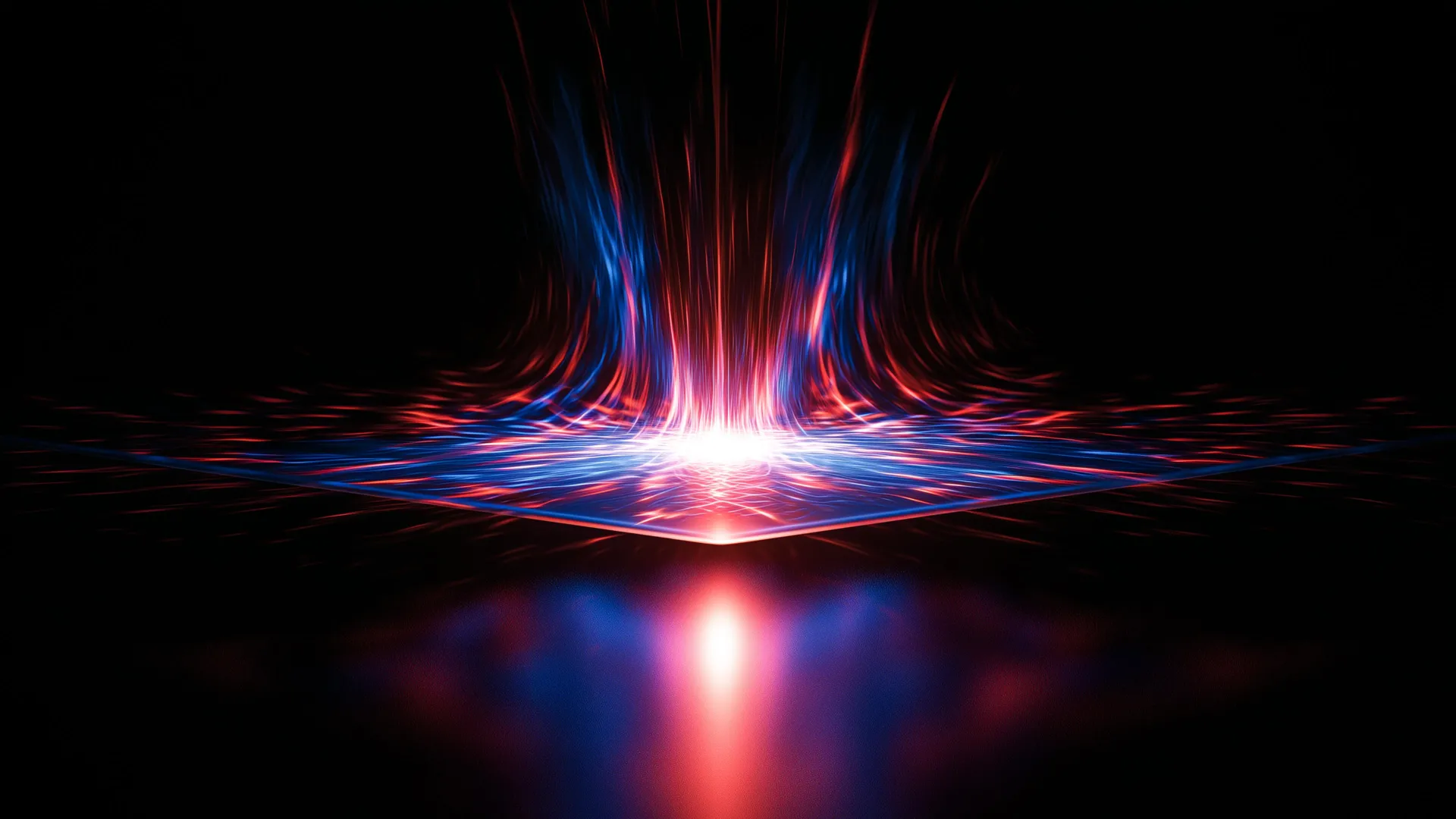
- Recombination and Interference: After the falling portion of the wave completed its trajectory, another carefully timed magnetic pulse was introduced to redirect and rejoin the two separated halves of the atomic wave. Upon recombination, the two wave packets interfered with one another. This interference pattern provided the researchers with a high-precision metric to quantify the minute difference in quantum phase that had accumulated while one portion of the atom remained stationary and the other experienced free fall.
Measurable Quantum Signatures of Gravity
The culmination of these intricate manipulations yielded a definitive empirical result. The quantum phase measured by the research team matched the theoretical predictions derived from extending Einstein’s equivalence principle to quantum waves.
By capturing this data, the experiment successfully established a direct, empirical bridge in a laboratory setting between the principles of quantum mechanics and Einstein’s geometric description of gravity. While previous studies had utilized quantum particles as passive sensors to measure gravitational fields, this marks the first time scientists have directly observed the predicted quantum phase explicitly generated by an object undergoing free fall in a superposition state.
Lead author Professor Ron Folman of Ben-Gurion University of the Negev emphasized the conceptual weight of the findings in a statement following publication. "This is a unique paper, in the sense that it combines a hard experiment with a far-reaching theoretical interpretation, about one of the most fundamental questions in physics: How can gravity (described by Einstein’s theory of relativity) and quantum theory, be unified into one understanding of the universe?" Professor Folman remarked. "These two pillars of modern physics have so far eluded all attempts at a unified theoretical framework, but this complex experiment gives more hints as to how such a unification may be achieved."
Echoing this sentiment, study co-author Professor Vlatko Vedral from the Department of Physics at the University of Oxford underscored the robustness of the standard framework under extreme testing. "We have no consistent theory telling us why quantum physics should fail," Professor Vedral noted. "This experiment pushes quantum mechanics into one of its most intriguing frontiers, gravity, and shows that, once again, its predictions hold."
Scope, Limitations, and Theoretical Implications
To maintain scientific accuracy, the research team was careful to delineate what the experiment successfully demonstrates and what questions remain unanswered.
First and foremost, the finding does not provide a finalized theory of quantum gravity. It does not prove that gravity itself possesses quantized properties—a theoretical property often theorized as the graviton. Rather, the experiment demonstrates that Einstein’s equivalence principle remains entirely compatible with the laws of quantum mechanics within the operational parameters and energy scales explored.
Furthermore, the results do not rule out alternative hypotheses proposed by theoretical physicists regarding the ultimate limits of quantum mechanics. Notably, co-author Professor Sir Roger Penrose has long championed the hypothesis that quantum mechanics may inherently break down when objects of significant mass remain in quantum superpositions for extended periods, resolving the paradox through objective reduction or gravitational self-energy thresholds.
The experimental apparatus utilized in the current study did not involve objects possessing enough mass, nor did it maintain superpositions for long enough durations, to test Penrose’s specific predictions regarding macroscopic quantum collapse. However, the successful deployment of the Quantum Galileo Interferometer opens a viable technological pathway forward. The research team has already initiated follow-up experiments at Ben-Gurion University aimed at scaling up the technique to encompass much heavier objects, such as nanodiamonds and complex macromolecules.
Broader Impact on Future Physics Research
The successful execution of the Quantum Galileo Interferometer marks a technological turning point for gravitational physics and quantum optics. By demonstrating that sensitive quantum interferometry can be executed near atom chips while subjected to localized gravitational gradients, the collaboration has provided experimentalists worldwide with a powerful new blueprint.
As research groups push toward testing the boundaries where quantum mechanics meets macroscopic reality, instrumentation capable of isolating quantum states from environmental decoherence while measuring gravitational interactions will prove indispensable. Whether future iterations of these experiments will finally expose the cracks where general relativity and quantum mechanics diverge—paving the way for a true theory of quantum gravity—remains one of the most compelling quests in modern science. For now, the foundations laid by Einstein and quantum pioneers alike have successfully weathered yet another rigorous empirical interrogation.