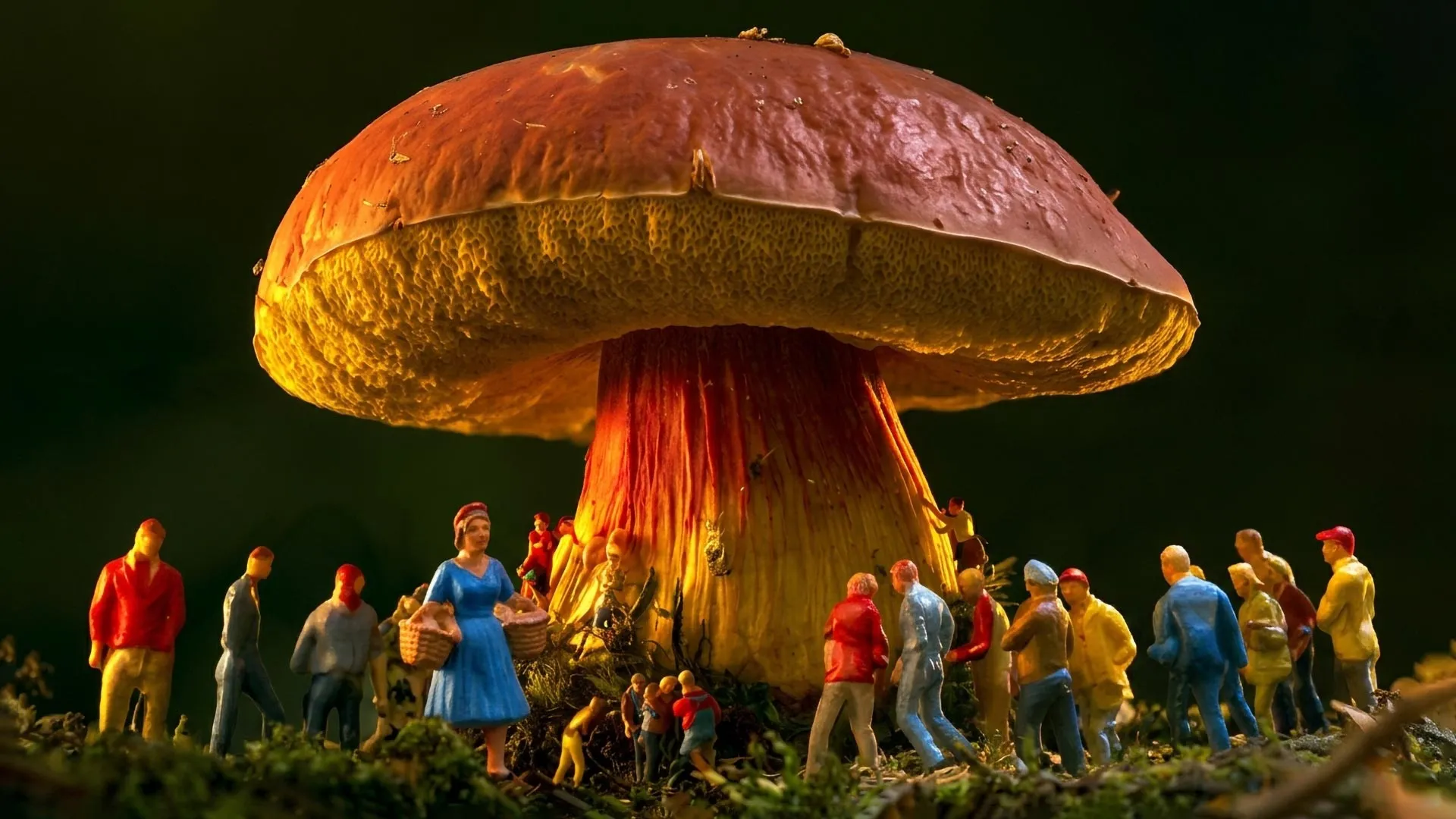
For nearly a century, a peculiar and haunting phenomenon has emerged among disparate populations across the globe: the experience of witnessing tiny, sentient human figures navigating the physical world with startling, life-like clarity. These visions, termed "Lilliputian hallucinations" in reference to the miniature inhabitants of Jonathan Swift’s Gulliver’s Travels, have long been dismissed as cultural artifacts or products of folklore. However, recent scientific investigations led by researchers at the University of Utah have provided evidence that these experiences are grounded in a biological reality triggered by the consumption of a specific, yet poorly understood, wild mushroom: Lanmaoa asiatica.
A Century of Speculation: From Papua New Guinea to the Global Stage
The scientific documentation of "mushroom madness" dates back to 1934, when Western observers in Papua New Guinea first reported that indigenous groups experienced vivid, consistent hallucinations of tiny people after consuming certain wild fungi. Throughout the mid-20th century, the phenomenon gained minor notoriety among anthropologists, who attempted to categorize the bolete mushrooms—a group characterized by pores rather than gills—suspected of causing the visions.
Despite the intensity of these reports, the mystery remained stagnant for decades. In the 1960s, the renowned chemist Albert Hofmann, who famously isolated psilocybin and LSD, conducted chemical analyses on samples collected from Papua New Guinea. His failure to identify any known hallucinogenic compounds led many in the scientific community to abandon the study, shifting the narrative toward a psychological or sociological framework. Researchers theorized that the visions were not the result of a chemical agent, but rather a manifestation of shared cultural expectations and traditional beliefs regarding spirits or supernatural beings.
This skepticism persisted until the 1990s, when reports of similar hallucinations surfaced in Yunnan, Southwest China. Locals consuming a mushroom known as "Jian shou qing" (which translates to "see hand blue," referring to the bruising color change when the mushroom is handled) described the same hallmark symptoms: the appearance of miniature, clown-like, or elf-like entities, often no larger than 30 centimeters, interacting with their environment in a physically coherent manner.
The Breakthrough: DNA Sequencing and Geographic Convergence
The turning point for the investigation occurred in 2024, when Colin Domnauer, a doctoral student at the University of Utah, identified a parallel set of reports in the Northern Cordillera region of the Philippines. Local communities there described an edible mushroom called "Sedesdem," which, if improperly prepared, caused the same Lilliputian visions documented in China and Papua New Guinea.
Domnauer, working alongside mycologist Bryn Dentinger of the Natural History Museum of Utah, initiated a rigorous field study to collect and sequence the DNA of these mushrooms. Their findings, published in the journal Mycologia, confirmed that the Chinese "Jian shou qing" and the Philippine "Sedesdem" are the same species: Lanmaoa asiatica.
This confirmation is significant because it suggests a singular, biological cause for the hallucinations rather than a convergence of unrelated cultural myths. While the team was unable to secure samples from Papua New Guinea due to adverse weather conditions preventing the collection of fresh specimens, the geographic and anecdotal overlap strongly indicates that a single species—or a very closely related group—is responsible for the phenomenon across the Asia-Pacific region.
The Nature of the Hallucination: A Neurological Curiosity
What distinguishes the L. asiatica experience from typical psychedelic episodes is its uncanny, hyper-realistic nature. While psilocybin or LSD users often report geometric patterns, shifting colors, or ego dissolution, those affected by L. asiatica describe highly specific, human-like figures. Approximately 90% of those affected report seeing dozens or even hundreds of small beings, often dressed in vibrant, colorful attire, performing mundane tasks.
The behavior of these figures is particularly unsettling to researchers because they appear to obey the laws of physics. They do not pass through walls; they walk around cups, climb over furniture, and fall from ledges. One account documented by researchers involved a participant witnessing tiny figures leaping from a spoonful of soup into a bowl and swimming, maintaining their presence even when the subject brought the spoon to their mouth.
This level of detail suggests that the unidentified compound within L. asiatica may interact with the human visual processing system in a way that is vastly different from known serotonergic hallucinogens. The substance does not merely distort vision; it appears to override the brain’s perception of scale and population, populating the user’s environment with complex, autonomous agents.
The Search for the Unknown Compound
Despite rigorous chemical testing, the researchers found no trace of psilocybin, muscimol, or other standard psychoactive alkaloids. This absence of known compounds is perhaps the most significant aspect of the study. It implies the existence of a novel chemical entity—one that has evolved to interact with the mammalian brain in a highly specialized manner.
Identifying this substance is now a priority for the research team. Should they succeed, the implications for neuroscience would be profound. Lilliputian hallucinations are not exclusively tied to mushroom ingestion; they are frequently observed in patients suffering from alcohol withdrawal, dementia with Lewy bodies, Charles Bonnet syndrome (vision loss), and various neurological disorders. Currently, medical science lacks a clear understanding of why the brain generates these specific, miniature figures. By isolating the chemical from L. asiatica, scientists could create a model to study the brain circuits responsible for these visions, potentially leading to breakthroughs in the treatment of neurological visual disturbances.
Expanding the Fungal Map: Taxonomic Discoveries
The investigation into L. asiatica led to a broader survey of the Lanmaoa genus. By analyzing 53 specimens from international fungarium collections, the team identified 17 species within the group, four of which were previously unknown to science. Two of these new species had been sitting in U.S. museum collections for years, their unique characteristics hidden until modern DNA sequencing was applied.
This finding underscores the vital role of natural history museums and preserved specimens. The study suggests that even within the well-trodden paths of botanical and mycological science, there is an immense amount of undocumented diversity. The research team’s success demonstrates that historical collections are not static archives, but rather dynamic resources for future discovery.
Broader Implications and Future Directions
The discovery that a single species of mushroom can explain a century-old mystery spanning thousands of miles provides a compelling case for the necessity of interdisciplinary research. By bridging the gap between ethnobotany, mycology, and neuroscience, the researchers have turned a folkloric curiosity into a legitimate biological inquiry.
The funding provided by the National Science Foundation reflects the high stakes of this research. Beyond the immediate interest in the "mushroom madness" mystery, the chemical diversity of fungi remains one of the least tapped resources for medical development. As seen with the discovery of penicillin, fungi are prolific producers of complex secondary metabolites—chemicals that often have potent, highly specific effects on human biological systems.
For the scientific community, the focus now shifts to the laboratory. The next phase of the project will involve advanced mass spectrometry and structural biology to determine the chemical signature of the hallucinogen. While the journey from a local forest floor to a standardized pharmaceutical compound is long and fraught with regulatory and technical challenges, the L. asiatica mushroom represents a gateway to understanding the mechanisms of perception itself.
Ultimately, the research suggests that our understanding of the brain’s capacity to construct reality is still in its infancy. If a small, unassuming bolete mushroom can trick the human brain into seeing hundreds of tiny, coherent, and physically active figures, it speaks to the hidden complexity of our neural pathways. As Domnauer and Dentinger continue their work, the scientific world awaits the isolation of the compound, which may hold the key to unlocking the mysteries of the human visual system and the chemical processes that define our conscious experience.