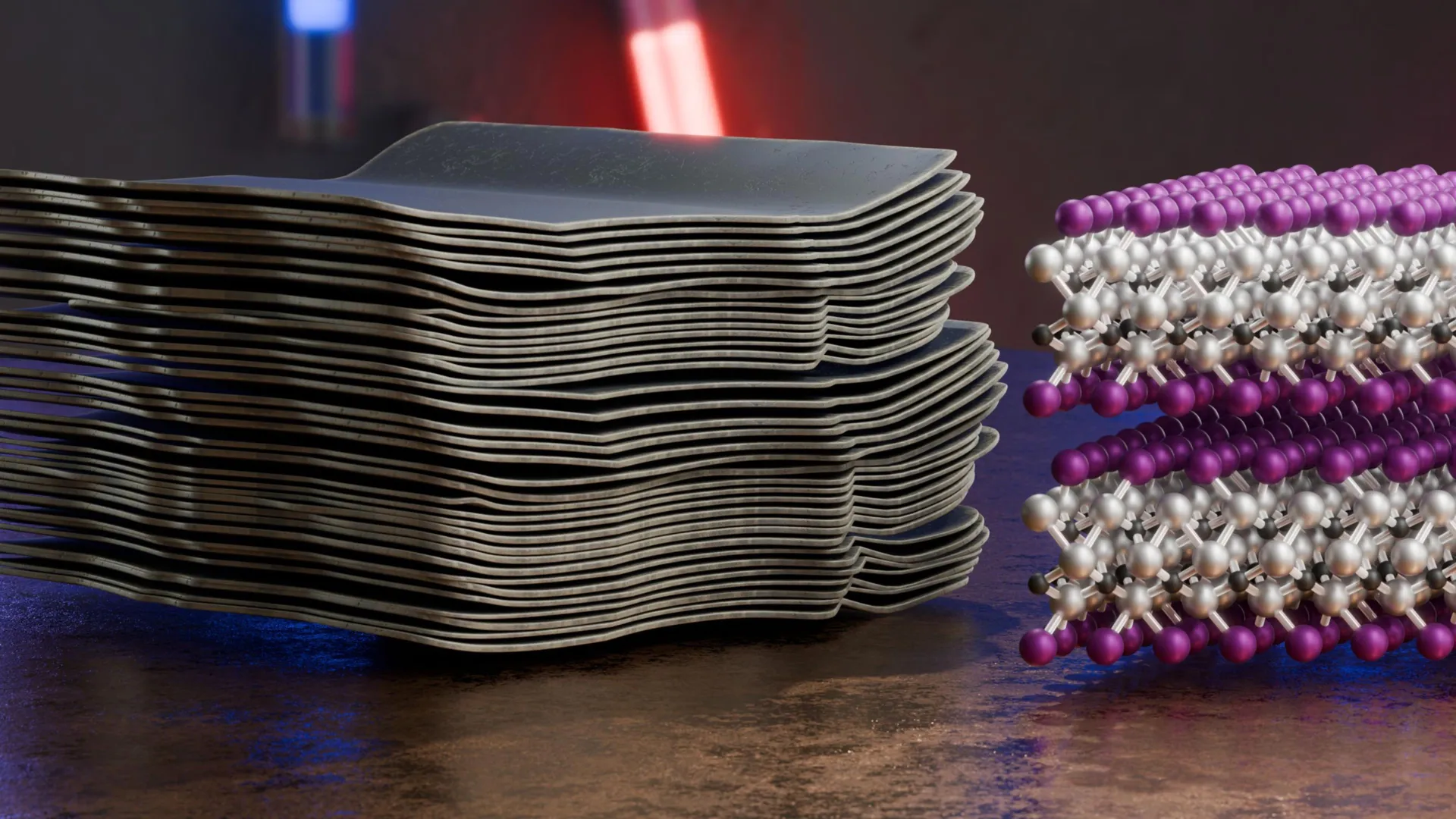
The field of two-dimensional (2D) materials has reached a significant milestone with the development of a new synthesis technique that addresses one of the most persistent challenges in nanomaterial science: atomic-level surface disorder. Researchers from the Institute of Ion Beam Physics and Materials Research at the Helmholtz-Zentrum Dresden-Rossendorf (HZDR) and the Technische Universität Dresden (TU Dresden) have pioneered a "Gas-Liquid-Solid" (GLS) method that allows for the creation of MXenes with highly ordered surface structures. This breakthrough has resulted in a staggering 160-fold increase in macroscopic conductivity for certain MXene variants, effectively clearing the "atomic potholes" that have historically hindered the performance of these ultra-thin inorganic materials.
MXenes, first discovered in 2011 at Drexel University, represent a vast and rapidly expanding family of transition metal carbides, nitrides, or carbonitrides. Composed of layers just a few atoms thick, these materials possess a unique combination of metallic conductivity and hydrophilic surfaces. However, their potential has long been bottlenecked by the traditional methods used to produce them. The introduction of the GLS method marks a departure from a decade of reliance on harsh chemical etching, offering a path toward the precise "functionalization" of surfaces that could redefine the capabilities of electronics, energy storage, and telecommunications.
The Evolution of MXene Synthesis: Moving Beyond Chemical Etching
To understand the significance of the GLS method, it is necessary to examine the history of MXene production. For over ten years, the standard procedure for synthesizing MXenes has involved the selective etching of "MAX phases"—layered ternary carbides or nitrides. In this traditional approach, a MAX phase (where ‘M’ is a transition metal, ‘A’ is an element like aluminum or silicon, and ‘X’ is carbon or nitrogen) is submerged in a strong acid, most commonly hydrofluoric acid (HF). The acid eats away the ‘A’ layers, leaving behind the ‘MX’ layers.
While effective at creating 2D sheets, this wet-chemical process is inherently chaotic. As the ‘A’ layers are removed, the exposed surfaces of the transition metals are immediately populated by whatever ions are present in the solution. This typically results in a random mixture of oxygen (-O), hydroxyl (-OH), and fluorine (-F) groups. This "surface termination" is not merely a superficial trait; it dictates the material’s fundamental properties.
The lack of control over these surface atoms has been a major hurdle. In electronic applications, these randomly scattered atoms act as impurities. Dr. Dongqi Li of TU Dresden compares this phenomenon to a highway. If the road surface is uneven and filled with potholes, traffic—or in this case, electrons—must slow down, scatter, or become trapped. This atomic disorder limits the "charge carrier mobility," which is the speed at which electrons can move through the material when an electric field is applied. By replacing this haphazard process with the GLS method, researchers have effectively repaved the "electronic highway."
Decoding the GLS Method: A New Paradigm in Atomic Engineering
The Gas-Liquid-Solid (GLS) method introduced by the HZDR and TU Dresden team represents a cleaner, more controlled alternative to acid etching. Rather than using liquid acids, the process utilizes molten salts and iodine vapor to interact with the MAX phase precursors. This environment allows for a high degree of selectivity regarding which atoms are allowed to bond with the MXene surface.
During the synthesis, the iodine vapor acts as a chemical transport agent, while the molten salts provide a stable medium for the reaction. This configuration enables the researchers to introduce specific halogens—such as chlorine, bromine, or iodine—to serve as the surface termination groups. Because the process occurs under controlled thermal conditions rather than in a volatile acid bath, the resulting surface atoms arrange themselves in a uniform, periodic lattice.
The team demonstrated the robustness of this technique by applying it to eight different MAX phases, proving that the GLS method is not a niche solution but a versatile platform for the entire MXene family. The resulting materials exhibited significantly higher purity than their acid-etched counterparts, with a near-total absence of the unwanted oxygen and hydroxyl impurities that typically degrade performance.
Quantitative Breakthroughs: Analyzing the 160-Fold Conductivity Leap
The most dramatic evidence of the GLS method’s efficacy came from the study of titanium carbide MXene (Ti3C2), which is currently the most widely researched member of the MXene family. The researchers compared a standard version of Ti3C2 (produced via traditional etching) with a chlorine-terminated version (Ti3C2Cl2) produced via the GLS method.
The experimental data revealed a transformative shift in electrical properties:
- Macroscopic Conductivity: The chlorine-terminated MXene showed a 160-fold increase in macroscopic conductivity. This measurement reflects the material’s ability to conduct electricity over larger, bulk-scale distances, which is critical for industrial applications like wiring or circuit boards.
- Terahertz Conductivity: At the microscopic level, measured using terahertz spectroscopy, the conductivity saw a 13-fold enhancement. This suggests that the internal resistance within the individual 2D flakes is drastically reduced.
- Charge Carrier Mobility: The team observed a nearly fourfold increase in charge carrier mobility. This metric is a direct reflection of the "highway" analogy—electrons in the GLS-produced MXene move four times more freely because they are no longer being scattered by surface defects.
These improvements are not merely incremental; they represent a leap that could move MXenes from the laboratory into high-performance commercial hardware. The ability to move electrons with such efficiency makes these materials competitive with, and in some cases superior to, other 2D materials like graphene or transition metal dichalcogenides (TMDs).
Theoretical Modeling and the Role of Density Functional Theory
To validate their experimental findings, the research team employed advanced computational modeling. Using Density Functional Theory (DFT) calculations, the researchers simulated the behavior of electrons within the MXene structure based on different surface terminations.
"By combining theory with our experimental ability to precisely control surface terminations, we open a new path toward MXenes with improved stability and tailored functional properties," noted Dr. Mahdi Ghorbani-Asl from HZDR. The simulations confirmed that a uniform chlorine surface creates a more symmetric electronic potential, which reduces the likelihood of an electron being "trapped" by a local charge imbalance.
Furthermore, the quantum transport simulations provided a clear explanation for the observed performance boost. They showed that in traditionally etched MXenes, the random mixture of surface atoms creates "localized states" that act like electronic dead ends. In contrast, the ordered halogen surfaces produced by the GLS method allow for "extended states," where electron wavefunctions can overlap across the entire material, facilitating seamless flow.
Strategic Applications in Electromagnetic Shielding and Wireless Communication
Beyond pure conductivity, the ability to swap surface halogens—exchanging chlorine for bromine or iodine—allows for the "tuning" of how the material interacts with electromagnetic waves. This has profound implications for the future of telecommunications and defense technology.
The study found that different surface terminations change the frequency at which the MXene absorbs electromagnetic radiation. For example:
- Chlorine-terminated MXenes exhibited strong absorption in the 14-18 GHz range, which is part of the Ku-band used for satellite communications and radar.
- Bromine and Iodine versions shifted this absorption profile to different frequency ranges.
This tunability makes GLS-produced MXenes ideal candidates for next-generation electromagnetic interference (EMI) shielding. As electronic devices become smaller and more densely packed, the need to prevent signal interference becomes critical. Furthermore, these materials could be used to develop "stealth" coatings that can be customized to absorb specific radar frequencies, or high-speed wireless components for 6G networks that require materials capable of handling extremely high frequencies with minimal signal loss.
Environmental and Industrial Implications of Halogen-Terminated MXenes
The shift away from hydrofluoric acid (HF) etching also carries significant environmental and safety benefits. HF is a highly toxic and corrosive substance that requires stringent safety protocols and specialized disposal methods, which increases the cost and complexity of industrial-scale MXene production. The GLS method, while requiring high temperatures for molten salts, avoids the use of aqueous HF, potentially offering a more sustainable pathway for mass manufacturing.
Furthermore, the increased stability of halogen-terminated MXenes addresses one of the primary weaknesses of the material: its tendency to degrade in humid environments. Traditionally etched MXenes, with their hydroxyl-rich surfaces, are prone to oxidation. The GLS-produced variants, featuring more stable halogen bonds, show improved resistance to environmental degradation, which is a prerequisite for any material intended for use in consumer electronics or long-term infrastructure.
Conclusion: Setting the Stage for Next-Generation Optoelectronics
The work led by HZDR and TU Dresden represents a fundamental shift in MXene chemistry. By transforming surface terminations from an uncontrolled byproduct into a precisely engineered feature, the researchers have unlocked the true electronic potential of this material class.
The implications of this research extend far beyond conductivity. The ability to create MXenes with two or three types of halogens in specific ratios—"halide alloying"—suggests that we are only at the beginning of discovering what these materials can do. In the coming years, the GLS method is expected to facilitate breakthroughs in:
- Flexible Electronics: Where high conductivity and mechanical durability are essential.
- Energy Storage: Using ordered surfaces to improve ion transport in supercapacitors and batteries.
- Catalysis: Utilizing the specific chemical signatures of halogen surfaces to speed up chemical reactions.
- Photonics: Leveraging the unique light-matter interactions of these 2D sheets for ultra-fast sensors and lasers.
As Dr. Ghorbani-Asl and his colleagues concluded, the marriage of theoretical precision and experimental control has provided the blueprint for a new generation of functional materials. The "potholes" on the atomic highway have been filled, and the road is now clear for MXenes to drive the next wave of technological innovation.