For decades, the global scientific community has pursued the "holy grail" of energy: nuclear fusion. By replicating the processes that power the sun, researchers hope to provide the world with a near-limitless source of clean, carbon-free electricity. However, the path to commercial fusion is fraught with engineering hurdles, many of which exist at the intersection of extreme heat and complex magnetism. One of the most persistent mysteries in this field has centered on the behavior of plasma within tokamaks—the doughnut-shaped devices that serve as the leading candidates for fusion reactors. Specifically, scientists have long struggled to explain why particles exiting the plasma core distribute themselves unevenly within the machine’s exhaust system, known as the divertor.
New research led by the U.S. Department of Energy’s (DOE) Princeton Plasma Physics Laboratory (PPPL) has finally provided a definitive answer to this puzzle. According to a study published in the prestigious journal Physical Review Letters, the missing variable in previous models was toroidal rotation—the high-speed circular motion of the plasma as it orbits the tokamak. By incorporating this rotation into their simulations, researchers have bridged a significant gap between theoretical physics and experimental reality, paving the way for more durable and efficient reactor designs.
The Role of the Divertor in Fusion Energy
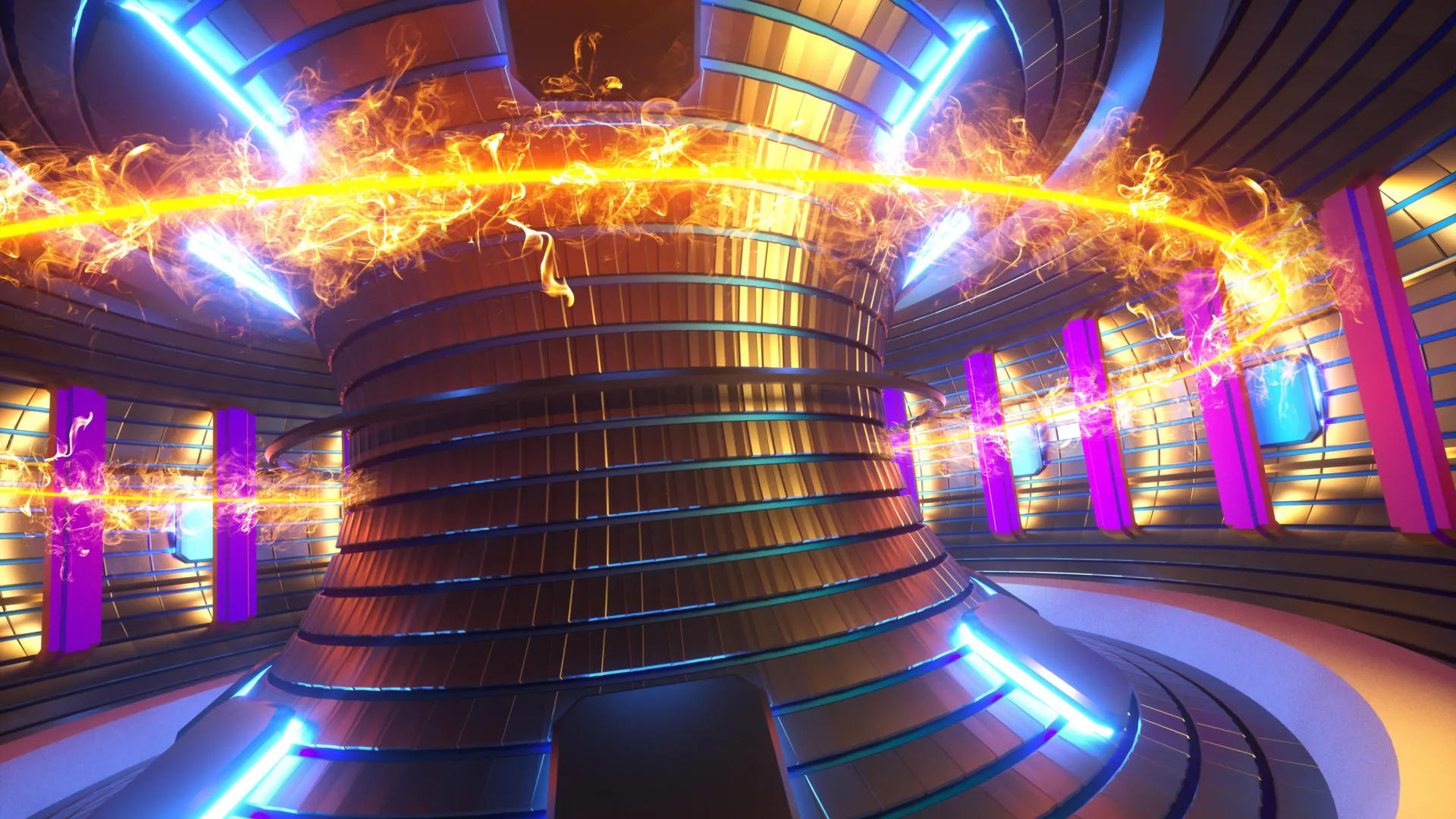
To understand the significance of this discovery, one must first understand the environment inside a tokamak. These machines use powerful magnetic fields to confine a "soup" of charged particles, or plasma, heated to temperatures exceeding 100 million degrees Celsius. At these temperatures, hydrogen isotopes fuse to form helium, releasing massive amounts of energy.
However, no magnetic cage is perfect. Some particles inevitably escape the hot central core and migrate toward the edges of the device. If these stray particles were allowed to strike the main vacuum vessel walls directly, they would melt the structure and contaminate the plasma with impurities, instantly quenching the fusion reaction. To prevent this, engineers utilize a divertor.
The divertor is the tokamak’s exhaust system. It uses specialized magnetic field lines to "divert" escaping particles toward heavily armored metal plates, usually made of tungsten or carbon. When particles hit these plates, they lose energy, cool down, and are eventually neutralized and pumped out of the system. Some of these atoms rebound back into the plasma to fuel further reactions.
The Mystery of the Asymmetric Exhaust
For years, experiments on tokamaks worldwide—including the DIII-D National Fusion Facility in San Diego and the Joint European Torus (JET) in the United Kingdom—consistently revealed a baffling phenomenon. Despite the symmetrical design of many divertors, far more particles were striking the "inner" divertor target (the side closer to the center of the doughnut) than the "outer" target.
This imbalance, known as divertor asymmetry, presented a major headache for reactor designers. If heat and particle flux are concentrated in one specific area, that component will wear out much faster than predicted. In a future commercial reactor like ITER, which is currently under construction in France, the divertor must withstand heat loads equivalent to the surface of the sun for extended periods. If engineers cannot predict where the heat will land, they cannot build a machine that lasts.
Historically, the leading explanation for this imbalance was "cross-field drifts." These are sideways movements caused by the interaction of the plasma’s pressure and the magnetic field, which push particles across the field lines rather than along them. However, when scientists ran computer simulations that accounted only for these drifts, the results never quite matched the real-world data recorded during experiments. The simulated imbalance was always less than what was actually observed, suggesting a fundamental piece of physics was missing from the equations.
Identifying Toroidal Rotation as the Missing Factor
The breakthrough came when Eric Emdee, an associate research physicist at PPPL, and his team decided to look at the plasma’s overall motion. In a tokamak, the plasma does not just sit still; it rotates at incredible speeds around the torus (the doughnut shape). This is known as toroidal rotation.
"There are two components to flow in a plasma," Emdee explained. "There’s cross-field flow, where particles drift sideways across the magnetic field lines, and parallel flow, where they travel along those lines. A lot of people said cross-field flow was what created the asymmetry. What this paper shows is that parallel flow, driven by the rotating core, matters just as much."
The team utilized the SOLPS-ITER modeling code, a sophisticated software suite designed to simulate the "Scrape-Off Layer" (SOL)—the thin region of plasma at the edge that feeds into the divertor. By running simulations that included both the cross-field drifts and the parallel flow generated by toroidal rotation, the researchers found that the two effects amplified one another.
Experimental Validation at DIII-D
To validate their hypothesis, the researchers turned to data from the DIII-D National Fusion Facility, operated by General Atomics. DIII-D is one of the most flexible and highly instrumented tokamaks in the world, making it the ideal "test bed" for checking the accuracy of new models.
The team ran four distinct simulation scenarios to isolate the variables:
- A baseline simulation with no drifts and no rotation.
- A simulation with cross-field drifts only.
- A simulation with toroidal rotation only.
- A comprehensive simulation including both cross-field drifts and a measured core rotation speed of 88.4 kilometers per second.
The results were definitive. The first three scenarios failed to replicate the particle distribution seen in the DIII-D experiments. However, the fourth scenario—which included the 88.4 km/s rotation—produced a near-perfect match to the experimental data.
At 88.4 kilometers per second (roughly 200,000 miles per hour), the plasma is moving at a significant fraction of the speed of sound within that medium. This high-speed rotation creates a "centrifugal-like" effect and alters the pressure balance along the magnetic field lines, effectively "shoveling" more particles toward the inner divertor target. The study proved that rotation isn’t just a minor correction; it is a primary driver of the exhaust’s behavior.
Institutional Collaboration and Support
The success of this research was the result of a broad collaboration across several of the world’s leading nuclear and plasma physics institutions. In addition to Eric Emdee, the research team included Laszlo Horvath, Alessandro Bortolon, George Wilkie, and Shaun Haskey of PPPL. The team also benefited from the expertise of Raúl Germán Miguelez of the Massachusetts Institute of Technology (MIT) and Florian Laggner of North Carolina State University.
The work was funded by the DOE’s Office of Fusion Energy Sciences. It utilized the DIII-D National Fusion Facility as a DOE Office of Science user facility. This collaborative framework allowed the researchers to combine theoretical modeling with high-fidelity experimental data, a hallmark of modern big-science projects.
Implications for Future Reactors and ITER
The implications of this discovery extend far beyond the laboratory. As the international community moves toward the next generation of fusion devices, such as ITER and the proposed Fusion Pilot Plant (FPP) in the United States, the ability to accurately predict heat loads is critical for economic viability.
-
Material Longevity: Divertor plates are typically made of tungsten, a metal with the highest melting point of any element. Even so, constant bombardment by high-energy plasma causes "sputtering," where atoms are knocked off the surface, gradually eroding the plate. By knowing exactly how rotation affects particle distribution, engineers can thicken the armor in high-impact zones or adjust the magnetic geometry to spread the load more evenly.
-
Operational Stability: Fusion reactions are notoriously delicate. If too many particles accumulate in one area of the divertor, it can lead to "detachment" issues or the recycling of impurities back into the core, which can terminate the fusion process. Understanding the role of rotation allows operators to better control the "fueling" of the reactor.
-
Cost Reduction: Fusion energy has often been criticized for its high capital costs. Much of this cost stems from the extreme engineering requirements of the internal components. If scientists can use rotation—which is often naturally occurring or can be induced via neutral beam injection—to manage heat loads, it may reduce the need for even more expensive and exotic cooling systems.
Analysis: A Paradigm Shift in Plasma Modeling
For years, the fusion community focused on "drifts" as the primary culprit for divertor imbalances. This new research represents a paradigm shift, suggesting that the "bulk" movement of the plasma—its rotation—is just as influential as the microscopic drifts of individual particles.
This finding also highlights the interconnectedness of a tokamak’s regions. Previously, the hot core and the cooler edge (the SOL) were often treated as semi-independent systems in models to save on computational power. Emdee’s work demonstrates that what happens in the core (rotation) directly dictates the fate of particles at the very edge of the machine.
As fusion moves from the realm of physics experiments to industrial engineering, the importance of "computational fidelity"—the ability of a computer model to mirror reality—cannot be overstated. With the inclusion of toroidal rotation, the SOLPS-ITER code has become a much more powerful tool for the global fusion effort.
Conclusion
The journey toward fusion energy is often described as a "marathon of a thousand hurdles." By solving the mystery of divertor asymmetry, the researchers at PPPL and their partners have cleared one of the most persistent obstacles in the field.
The realization that plasma rotation at 88.4 kilometers per second is the key to understanding particle exhaust provides a new level of clarity for reactor design. As the world watches the progress of ITER and other advanced fusion projects, this research serves as a reminder that in the complex world of plasma physics, the most important answers are often found by looking at the "big picture"—or in this case, the big rotation.
With more accurate models in hand, the dream of a clean, fusion-powered future is one step closer to becoming a practical reality. The focus now shifts to applying these findings to the design of the next generation of divertors, ensuring they can withstand the rigors of a sustained, sun-like reaction for years to come.