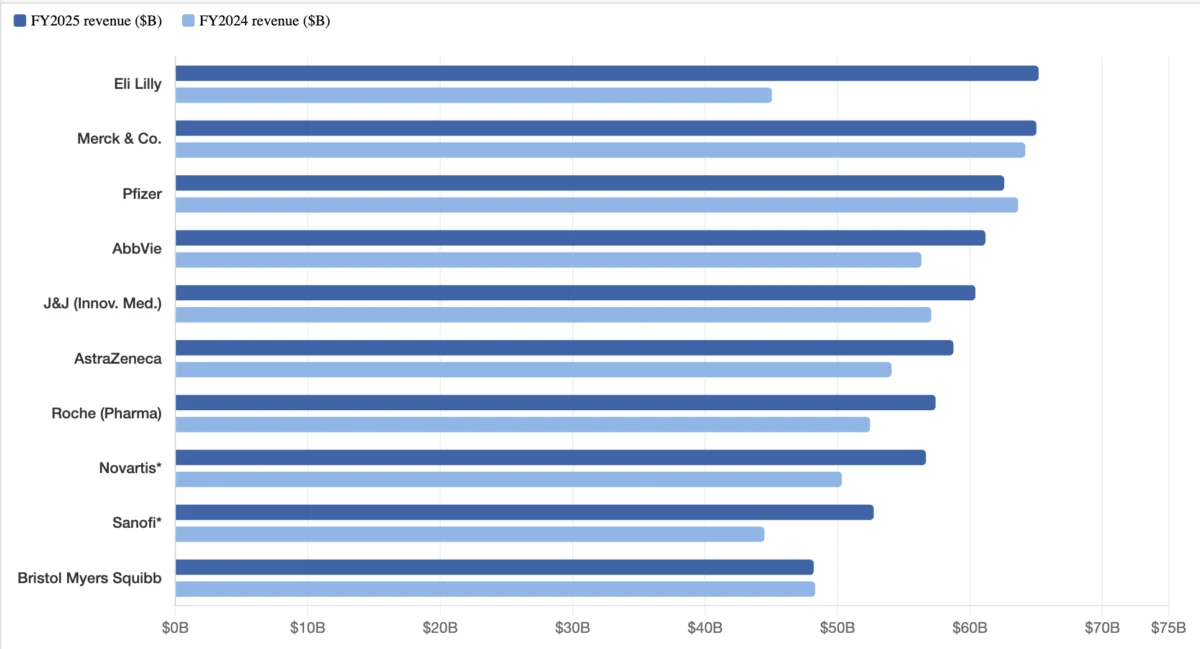
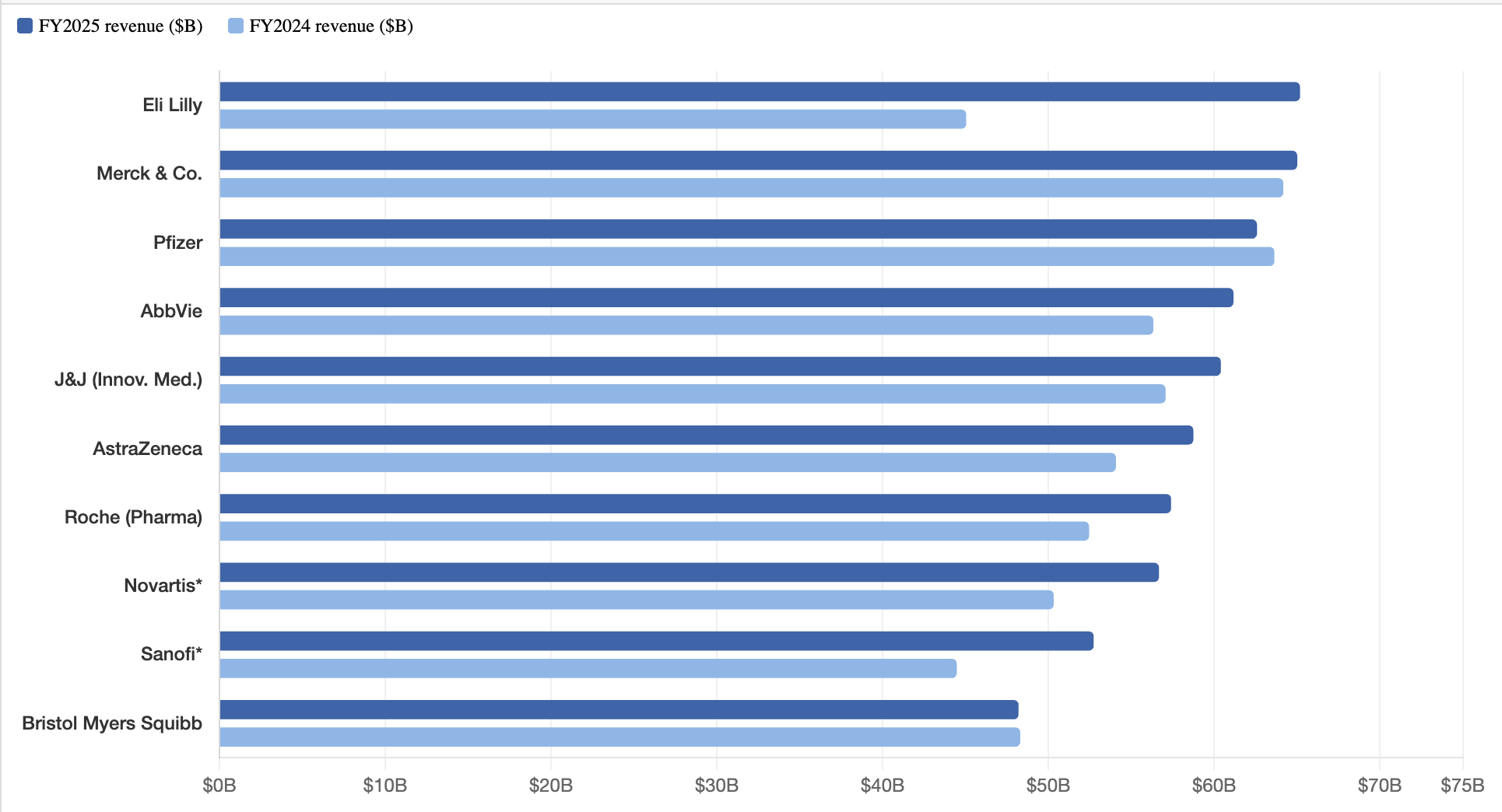
Eli Lilly and Company has officially claimed the top position in the global pharmaceutical industry by revenue for fiscal year 2025, a significant milestone that arrived notably earlier than industry predictions. The Indianapolis-based pharmaceutical giant reported a staggering $65.2 billion in total revenue, narrowly surpassing long-standing competitor Merck & Co., which posted $65.0 billion. This remarkable ascent is overwhelmingly attributed to the unprecedented success of its tirzepatide franchise, comprising Mounjaro for type 2 diabetes and Zepbound for chronic weight management, which collectively generated $36.5 billion. Lilly’s overall revenue saw an approximate 44.7% year-over-year increase, representing a formidable gain of roughly $20.1 billion in a single year, largely propelled by sustained and escalating demand for its flagship metabolic therapies. In stark contrast, Merck’s revenue remained essentially flat during the same period, underscoring the dramatic shift in market dynamics.
The Rapid Ascent: A Timeline of Strategic Growth and Innovation
Eli Lilly and Company, with a storied history dating back to its founding in 1876, has long been a prominent player in the pharmaceutical landscape, particularly known for its pioneering work in insulin and diabetes care. For decades, the company maintained a strong, but not always leading, position among the global pharma elite. In 2020, Lilly’s reported revenue stood at $24.5 billion, a solid performance indicative of a major pharmaceutical enterprise. However, the subsequent five years have witnessed an extraordinary transformation, with the company’s revenue nearly tripling, a growth trajectory almost unparalleled in an industry of this scale.
Industry analysts had previously projected that Lilly would likely overtake Merck by late 2026, based on a cautious assessment of its pipeline and market penetration. The company’s actual performance has decisively outpaced these optimistic forecasts, achieving this leadership position a full year ahead of schedule. Furthermore, Lilly’s guidance for 2026, projecting revenues between $80 billion and $83 billion, already surpasses the base-case model’s estimate of $77.2 billion, signaling sustained confidence in its growth engines.
The timeline of tirzepatide’s development and market introduction is crucial to understanding this rapid expansion. Tirzepatide, a novel dual glucose-dependent insulinotropic polypeptide (GIP) and glucagon-like peptide-1 (GLP-1) receptor agonist, emerged from Lilly’s robust research and development pipeline. Its initial approval under the brand name Mounjaro by the U.S. Food and Drug Administration (FDA) in May 2022 was for the treatment of adults with type 2 diabetes, as an adjunct to diet and exercise. This approval followed compelling clinical trial data demonstrating superior efficacy in glycemic control and significant weight reduction compared to existing treatments.
The subsequent approval of tirzepatide under the brand name Zepbound for chronic weight management in adults with obesity or overweight with at least one weight-related comorbidity in November 2023 marked another pivotal moment. This approval opened up a massive new market segment, capitalizing on the drug’s profound weight loss benefits observed in clinical trials. The rapid uptake of both Mounjaro and Zepbound since their respective launches underscores an immense unmet medical need and the drugs’ superior efficacy profile, positioning them as transformative therapies in metabolic health.
The Tirzepatide Phenomenon: Unprecedented Market Impact
The tirzepatide franchise has undeniably served as the primary engine for Lilly’s meteoric rise. Mounjaro’s revenue nearly doubled year-over-year, soaring to an impressive $23.0 billion, reflecting a remarkable 99% growth rate. Zepbound, despite its more recent market entry for weight management, demonstrated even more explosive growth, nearly tripling its revenue to $13.5 billion, marking a staggering 175% increase. The combined $36.5 billion generated by these two products alone highlights an unprecedented commercial success for a single therapeutic franchise in such a short timeframe.
To put this figure into perspective, this single franchise now generates more annual revenue than several established global pharmaceutical companies do as entire entities. For instance, in recent fiscal years, companies like Bristol Myers Squibb and Sanofi have reported annual revenues in the range of $40 billion to $47 billion. Lilly’s tirzepatide franchise revenue, at $36.5 billion, therefore stands as a colossal revenue generator, approaching or even exceeding the total revenue of some of the world’s most significant pharmaceutical players. This comparison vividly illustrates the sheer scale and impact of Mounjaro and Zepbound on the global pharmaceutical market.
The mechanism of action of tirzepatide, as a dual GIP and GLP-1 receptor agonist, is central to its exceptional efficacy. By activating both receptors, tirzepatide provides a more comprehensive approach to managing blood sugar and promoting weight loss than single-agonist therapies. This dual action has been shown to improve insulin sensitivity, reduce appetite, slow gastric emptying, and promote satiety, leading to significant reductions in A1C levels and body weight. The global prevalence of type 2 diabetes, affecting hundreds of millions, and the escalating obesity epidemic, impacting billions, have created an enormous market demand that tirzepatide has effectively addressed with its highly effective therapeutic profile.
Competitive Landscape and Market Dynamics
Lilly’s dominance in the metabolic health space, while remarkable, exists within a highly competitive landscape. Novo Nordisk, a Danish pharmaceutical giant, has long been a leader in diabetes and obesity care with its own highly successful GLP-1 receptor agonists, Ozempic (semaglutide for diabetes) and Wegovy (semaglutide for weight management). These products have also experienced significant growth, establishing a robust market for this class of drugs. The competition between Lilly’s tirzepatide and Novo Nordisk’s semaglutide has spurred innovation and increased patient access, albeit with ongoing challenges related to supply constraints due to overwhelming demand.
The intense competition also extends to the development of next-generation therapies, including oral formulations and combination drugs, promising even greater convenience and efficacy. While Lilly’s tirzepatide has demonstrated superior weight loss efficacy in head-to-head trials against semaglutide, the market is large enough to accommodate multiple successful players, especially given the global scale of diabetes and obesity. The continued demand for these treatments highlights a significant public health need, which the pharmaceutical industry is actively striving to meet. Future market trends indicate a continued expansion of the metabolic disease segment, with sustained investment in research and development for novel treatments.
Financial Performance and Strategic Implications
Lilly’s impressive financial performance in FY2025, marked by its $65.2 billion revenue and a 44.7% year-over-year growth, signifies more than just a momentary triumph. It underscores a strategic pivot and successful execution of its R&D and commercialization efforts. The stark contrast with Merck’s relatively flat performance, which also reported $65.0 billion, emphasizes the transformative power of Lilly’s new product launches. Merck, while a powerhouse in its own right with diverse franchises including oncology (Keytruda) and vaccines, did not experience the same level of explosive growth from new products in FY2025 to offset other market dynamics.
This ascendancy has profound implications for Lilly’s market valuation and investor confidence. The original analysis that predicted Lilly’s rise also referenced an $800 billion valuation, a figure that now seems increasingly justified given the company’s current trajectory and future guidance. Sustained revenue growth, particularly from blockbuster franchises, typically translates into increased shareholder value and a stronger financial position for further strategic investments.
Beyond tirzepatide, Lilly maintains a robust and diversified pipeline, which is crucial for long-term sustainability and mitigating the risks associated with over-reliance on a single franchise. The company has significant assets in areas such as Alzheimer’s disease (e.g., Donanemab, currently under FDA review), oncology, and immunology. The potential approval and commercial success of Donanemab, for example, could provide another substantial revenue stream, further solidifying Lilly’s diversified growth strategy and reinforcing its position as a multi-faceted pharmaceutical leader. The challenge for Lilly will be to continue fostering innovation across its therapeutic areas while managing the immense demand and complex supply chains for its metabolic drugs.
Official Responses and Industry Reactions
While specific official statements for FY2025 results are typically released in earnings calls and investor presentations, Lilly’s leadership is expected to highlight the company’s remarkable achievement, emphasizing the dedication of its employees and its unwavering commitment to delivering life-changing medicines to patients worldwide. CEO David Ricks, for instance, has consistently articulated a vision focused on innovation and patient impact. The company’s public communications will likely underscore the clinical benefits of Mounjaro and Zepbound, acknowledging the profound difference these therapies are making in the lives of individuals managing diabetes and obesity.
Industry analysts and financial experts have widely reacted to Lilly’s accelerated growth with commendation, recognizing the strategic brilliance and execution prowess behind its success. Many have noted that this shift in leadership signals a new era in the pharmaceutical industry, where breakthrough therapies in high-demand areas can rapidly reshape the competitive landscape. The market has rewarded Lilly’s innovation, with its stock performance reflecting strong investor confidence in its growth prospects. Observers also acknowledge the transparent methodology used for these rankings, which are practical, pharma-focused, and built from company fiscal-year reporting, with segment carve-outs where needed, acknowledging that a "clean apples-to-apples comparison of the world’s largest drugmakers" can be complex given diverse business models.
Broader Economic and Healthcare Impact
Lilly’s unprecedented success carries significant broader economic and healthcare implications. Economically, the company’s growth translates into substantial job creation, investment in research and development, and increased tax revenues, particularly benefiting its home state of Indiana and the broader U.S. economy. Its expansion fuels a robust ecosystem of suppliers, contractors, and partners, contributing to regional and national economic vitality.
From a healthcare perspective, the widespread adoption of Mounjaro and Zepbound represents a paradigm shift in the management of diabetes and obesity. These drugs offer hope for millions struggling with these chronic conditions, potentially reducing the burden of associated comorbidities such as cardiovascular disease, kidney disease, and certain cancers. However, their high cost and access challenges remain critical considerations for healthcare systems globally. Policymakers, insurers, and healthcare providers continue to grapple with strategies to ensure equitable access to these transformative therapies while managing escalating healthcare expenditures. The long-term impact of improved metabolic health on public health outcomes and healthcare costs is a subject of ongoing study and debate.
In conclusion, Eli Lilly and Company’s ascent to the pinnacle of the pharmaceutical industry by revenue in fiscal year 2025 is a testament to the transformative power of scientific innovation and strategic market execution. Driven primarily by the explosive success of its tirzepatide franchise, Mounjaro and Zepbound, Lilly has not only surpassed its competitors ahead of schedule but has also set a new benchmark for growth in the sector. This achievement solidifies Lilly’s position as a dominant force in metabolic health and signals a dynamic shift in the global pharmaceutical landscape, with profound implications for patient care, scientific advancement, and the broader economy. The company’s future trajectory will be closely watched as it endeavors to sustain this momentum, navigate competitive pressures, and continue its mission of delivering groundbreaking medicines.