

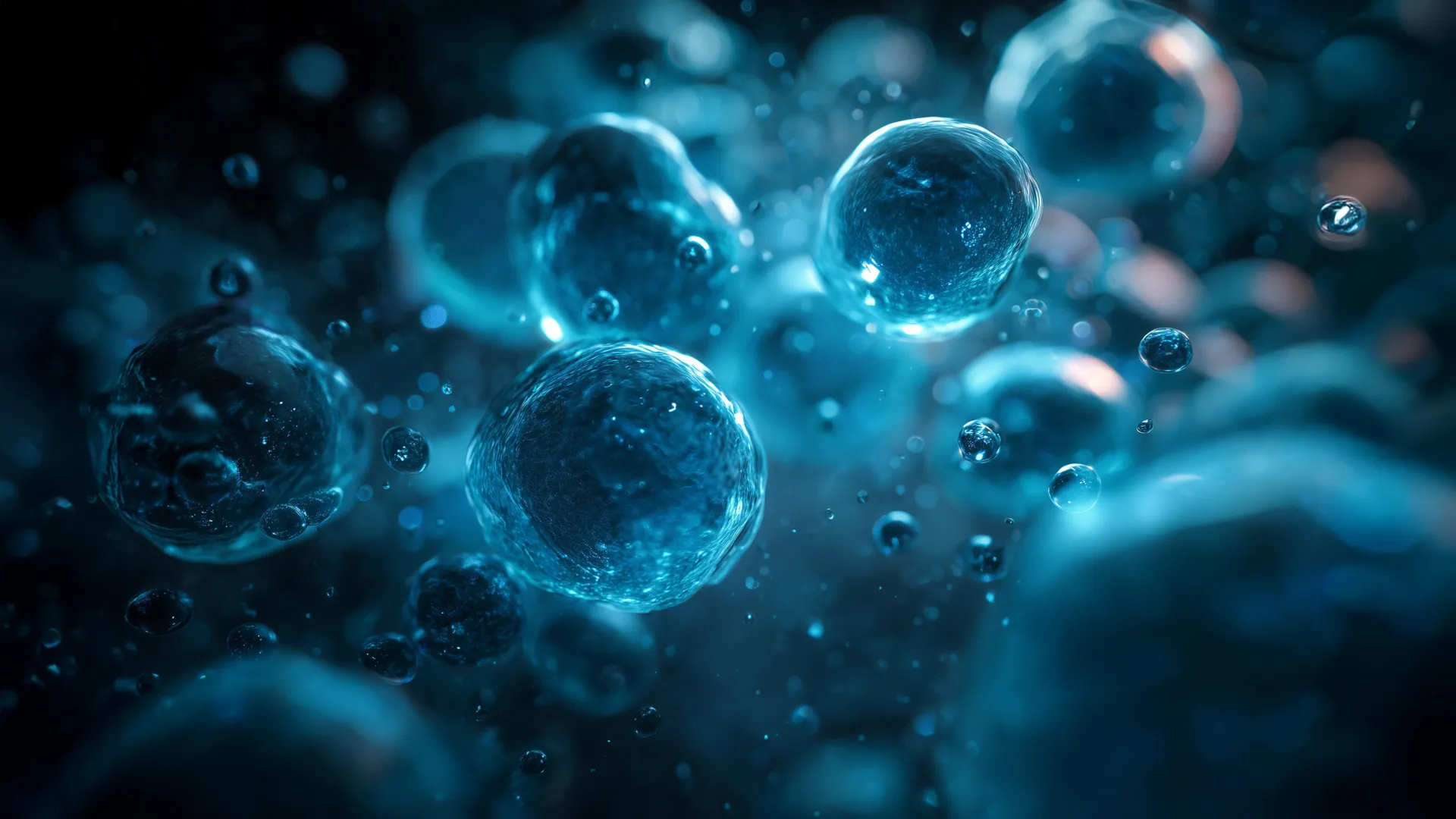
Modern cells are marvels of biological engineering, intricate systems that orchestrate a symphony of internal scaffolding, precisely regulated chemical reactions, and genetic blueprints dictating nearly every aspect of their existence. This remarkable complexity is the bedrock of their ability to thrive in an astonishing array of environments and to compete with unparalleled fitness. Yet, trace their lineage back to the nascent stages of Earth’s history, and the picture shifts dramatically. The earliest precursors to cellular life, known as protocells, were astonishingly simple. These primitive entities were essentially microscopic bubbles, their lipid membranes enclosing a basic soup of organic molecules. The monumental leap from these rudimentary compartments to the sophisticated cellular machinery of today remains one of the most profound and persistent questions in the field of origin-of-life research.
A recent, groundbreaking study spearheaded by researchers at the Earth-Life Science Institute (ELSI) at the Tokyo Institute of Science delves into the potential behaviors of these early structures on ancient Earth. Rather than positing a singular pathway for abiogenesis, this research team adopted a pragmatic approach, meticulously designing experiments that simulate plausible environmental conditions of the primordial planet. Their focus was on understanding how variations in membrane composition influenced critical protocell functions: growth, fusion, and the crucial ability to retain essential internal molecules, particularly under the dynamic stresses of freeze-thaw cycles.
Simulating Protocell Genesis: The Role of Lipid Membranes
To unravel these early cellular dynamics, the ELSI researchers meticulously constructed artificial protocell models. These were small, spherical compartments referred to as large unilamellar vesicles (LUVs). The key to their investigation lay in the specific lipid building blocks they employed. They utilized three distinct types of phospholipids, all belonging to the phosphatidylcholine (PC) family: POPC (1-palmitoyl-2-oleoyl-glycero-3-phosphocholine), PLPC (1-palmitoyl-2-linoleoyl-sn-glycero-3-phosphocholine), and DOPC (1,2-di-oleoyl-sn-glycero-3-phosphocholine).
Dr. Tatsuya Shinoda, a doctoral student at ELSI and the lead author of the study, elaborated on this choice: "We used phosphatidylcholine (PC) as membrane components, owing to their chemical structural continuity with modern cells, potential availability under prebiotic conditions, and retaining ability of essential contents." This selection strategy was deliberate, aiming to bridge the gap between hypothetical early Earth chemistry and the established biochemistry of contemporary life. The PC lipids provided a chemically relevant starting point, offering a degree of plausibility for their presence in early Earth’s organic rich environments and their inherent capacity to encapsulate and protect vital molecules.
While these phospholipids share a common phosphatidylcholine head group, their fatty acid tails exhibit subtle yet significant structural differences. These variations are critical to membrane properties. POPC features one unsaturated acyl chain with a single double bond. PLPC also possesses one unsaturated acyl chain, but this chain contains two double bonds. DOPC, on the other hand, incorporates two unsaturated acyl chains, each with one double bond. These differences in the degree of unsaturation directly impact how tightly the lipid molecules can pack together within the membrane. POPC, with its more saturated chains, tends to form more rigid and ordered membranes. In contrast, PLPC and DOPC, due to the kinks introduced by their double bonds, result in more fluid and less tightly packed membrane structures.
Freeze-Thaw Cycles: A Catalyst for Protocell Evolution
The research team then subjected these carefully constructed vesicles to repeated freeze-thaw cycles, a process designed to mimic the fluctuating temperature regimes that likely characterized early Earth’s climate. These cycles represent a significant environmental stressor that could have profoundly influenced the behavior of nascent protocells.
After just three such cycles, the differences in how the vesicles responded became strikingly apparent. Vesicles predominantly composed of POPC, with their more rigid membranes, tended to aggregate or cluster together. However, they did not readily merge into larger entities. In stark contrast, vesicles incorporating PLPC or DOPC, which possess more fluid membranes, demonstrated a marked propensity for fusion. They coalesced into significantly larger compartments. The study noted a dose-dependent effect: the higher the proportion of PLPC within the membrane, the more likely the vesicles were to fuse and grow.
This observation underscored the critical role of membrane chemistry in dictating protocell behavior. Natsumi Noda, a researcher at ELSI, provided further insight: "Under the stresses of ice crystal formation, membranes can become destabilized or fragmented, requiring structural reorganization upon thawing. The loosely packed lateral organization due to the higher degree of unsaturation may expose more hydrophobic regions during membrane reconstruction, facilitating interactions with adjacent vesicles and making fusion energetically favorable." In essence, the increased fluidity and less ordered packing of membranes rich in unsaturated lipids allowed them to deform and rearrange more easily upon thawing, promoting their coalescence.
Implications of Fusion for Early Life
The ability of protocells to fuse is not merely an interesting physical phenomenon; it carries profound implications for the origin of life. Fusion allows the internal contents of separate compartments to mix. In the context of early Earth, where essential organic molecules were likely dispersed and scarce, this merging of contents would have been a crucial step. It would have brought together disparate chemical ingredients, potentially catalyzing the complex chemical reactions necessary for the emergence of self-replicating systems and ultimately, more sophisticated, cell-like entities. This process of gradual integration and chemical synergy could have been a fundamental driver of increasing molecular complexity.
Molecular Encapsulation: The Challenge of Retention
Beyond growth and fusion, the study also investigated another vital aspect of protocell survival: the ability to capture and retain essential molecules. DNA, the carrier of genetic information in all known life, was a key focus. The researchers compared the performance of vesicles made entirely of POPC with those constructed solely from PLPC.
The results revealed a clear advantage for PLPC-based vesicles. Even before undergoing any freeze-thaw cycles, these more fluid membranes demonstrated a superior capacity for trapping DNA molecules. This initial advantage was further amplified after repeated freeze-thaw cycles. The PLPC vesicles continued to retain significantly more DNA than their POPC counterparts, suggesting that membrane fluidity plays a crucial role in both initial capture and sustained retention of genetic material. This finding is critical, as any protocell capable of originating life would need to reliably hold onto its internal molecular cargo.
Traditional Paradigms and Emerging Hypotheses
Historically, scientific hypotheses regarding the origin of life have often centered on specific terrestrial environments. Prominent among these are scenarios involving shallow, drying pools on land, where repeated wetting and drying cycles could concentrate organic molecules, or deep-sea hydrothermal vents, offering a source of chemical energy and mineral catalysts. However, this ELSI study introduces a compelling new perspective, suggesting that icy environments may have played a far more significant role than previously emphasized.
The researchers posit that the repeated freeze-thaw cycles, a natural consequence of fluctuating temperatures on early Earth, could have served as a powerful engine for protocell development. As water froze, the formation of ice crystals would have acted as a natural concentrating mechanism, pushing dissolved organic molecules into the remaining liquid phases. This localized concentration would have dramatically increased the probability of interactions between molecules and between protocells themselves. Simultaneously, the study’s findings on membrane fusion indicate that more fluid membranes, prevalent in PLPC and DOPC compositions, would have facilitated the merging of these concentrated protocells, thereby promoting the mixing of their contents.
However, the researchers acknowledge a critical trade-off. While fluid membranes are conducive to fusion and molecular mixing, they can also exhibit increased instability and permeability under the mechanical stresses induced by ice crystal formation. This could lead to leakage of vital internal contents. Therefore, for early protocells to succeed, a delicate balance would have been necessary between membrane stability, ensuring the retention of essential molecules, and membrane permeability, allowing for necessary interactions and chemical transformations. The optimal membrane composition, the study suggests, would have been highly dependent on the specific environmental conditions prevalent at the time.
The Path Towards Darwinian Evolution
The journey from simple molecular compartments to self-replicating entities capable of Darwinian evolution is a complex one. Professor Tomoaki Matsuura, the principal investigator behind this pivotal study at ELSI, outlined the potential trajectory: "A recursive selection of F/T-induced grown vesicles across successive generations may be realized by integrating fission mechanisms such as osmotic pressure or mechanical shear. With increasing molecular complexity, the intravesicular system, i.e., gene-encoded function, ultimately may take over the protocellular fitness, consequently leading to the emergence of a primordial cell capable of Darwinian evolution."
This vision suggests a multi-stage process. Initially, physical forces like freeze-thaw cycles drive growth and fusion. As protocells become more complex, internal mechanisms for division, perhaps triggered by osmotic pressure differences or mechanical forces, would emerge. Eventually, the development of gene-encoded functions would grant protocells a degree of autonomy, allowing them to actively control their fitness and paving the way for the grand transition to Darwinian evolution.
Broader Impact and Future Directions
The implications of this research extend beyond academic curiosity. It provides a tangible, experimentally supported model for how life might have originated under conditions that are both plausible for early Earth and distinct from some of the more traditionally explored scenarios. The emphasis on physical processes like freezing and thawing as drivers of protocell evolution offers a new lens through which to view the abiogenesis puzzle.
This work opens up new avenues for future research. Scientists can now explore a wider range of lipid compositions and environmental parameters to further refine our understanding of protocell behavior. Investigating the interplay between membrane properties and the encapsulation of other essential biomolecules, such as amino acids and nucleotides, will be crucial. Furthermore, exploring how protocells might have developed internal mechanisms for replication and division in these icy environments could bridge the gap between simple compartments and the first true living cells.
In conclusion, the findings from ELSI present a compelling case for the significant role of icy environments and the physical processes associated with freezing and thawing in the origin of life. By demonstrating how simple physical forces can influence fundamental protocell behaviors like growth, fusion, and molecular retention, this study offers a vital piece in the intricate puzzle of how life first emerged on our planet. The transition from inert organic molecules to the first evolving cells, a process that has captivated humanity for centuries, may well have been nurtured in the dynamic and often overlooked crucible of ancient ice.











Leave a Reply