

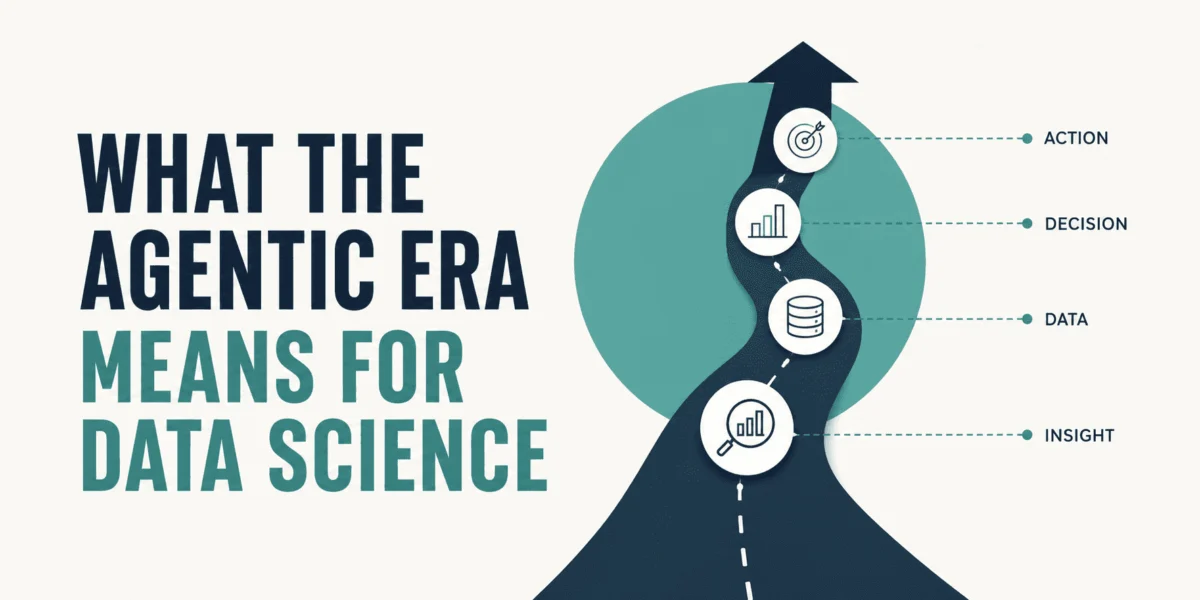
A fundamental shift is underway at the confluence of artificial intelligence and data science, fundamentally altering how practitioners operate. Modern AI systems are no longer confined to generating singular, static responses; instead, they plan, execute multi-step tasks, leverage external tools, critically evaluate their own outputs, and iterate when initial results fall short. This profound transformation signifies not merely the approach of an agentic era, but our active immersion within it. This period is characterized by AI systems demonstrating autonomous, goal-directed behaviors, compelling a significant re-evaluation of the day-to-day responsibilities and requisite skills for data scientists worldwide.
The data science profession has historically demanded a rare synthesis of statistical acumen, programming proficiency, and deep domain expertise. The advent of agentic AI introduces a fourth, now indispensable, dimension: the capability to design, deploy, and rigorously evaluate systems capable of acting independently on behalf of users. To neglect this paradigm shift risks diminished productivity and relevance; conversely, to engage with it proactively promises an exponential enhancement of effectiveness across all facets of data-driven work.
The Genesis of Agentic AI: A Chronological Evolution
The current agentic wave is not an isolated phenomenon but the culmination of decades of AI research, accelerated dramatically by recent breakthroughs in large language models (LLMs). Early AI systems, often rule-based or reliant on expert systems, laid foundational concepts of automated decision-making. The subsequent rise of machine learning, particularly deep learning, ushered in an era of powerful pattern recognition and predictive analytics. However, even advanced neural networks, including early LLMs, primarily functioned as sophisticated pattern matchers, responding to prompts with a single, albeit complex, output.
The critical turning point emerged with the development of LLMs capable of sophisticated reasoning, tool use, and self-correction. Innovations such as Google’s Chain-of-Thought prompting, OpenAI’s Function Calling, and similar advancements from other leading AI labs provided the cognitive architecture necessary for agents. These capabilities allowed LLMs to move beyond mere text generation to reason about and interact with their environment. The past two to three years have seen an explosive growth in frameworks specifically designed to operationalize these advanced LLM capabilities, effectively creating the current agentic ecosystem. This rapid evolution underscores a fundamental reorientation of AI from reactive intelligence to proactive, goal-oriented autonomy.
Redefining the Baseline: The Anatomy of an AI Agent
To grasp the implications of this era, it is essential to understand the operational mechanics of an AI agent in a production environment. At its core, an agent is an autonomous system designed to perceive its environment, reason about the optimal next move, take actions utilizing a suite of available tools, and continuously evaluate the outcomes of those actions.
This operational model stands in stark contrast to traditional LLM interactions. Where a conventional LLM responds to a singular prompt with a static output, an agent operates within continuous, iterative loops. Upon receiving a high-level goal, it intelligently selects the most appropriate tool from its arsenal, executes an action, observes the result, updates its internal reasoning model, and subsequently decides whether to pivot its strategy or press forward. This dynamic cycle can encompass dozens of discrete, interlinked steps, all transpiring autonomously in the background.
The defining characteristic of this paradigm is its native tool integration. In a contemporary data science context, an agent can be tasked with a complex objective such as "analyze customer churn risk." It might then autonomously retrieve relevant customer datasets from a SQL database, perform data scrubbing and preprocessing using a Python library, execute exploratory data analysis (EDA) to identify key features, train a baseline machine learning model, evaluate its performance metrics, and finally generate a structured report detailing its findings and recommendations. Crucially, all these procedural steps are executed without direct human intervention during the task’s execution. This level of autonomy liberates data scientists from the minutiae of execution, allowing them to focus on higher-order problem framing and strategic validation.
The Orchestration Ecosystem: Frameworks Powering Autonomy
The frameworks facilitating this agentic revolution have rapidly matured from nascent experimental libraries into robust, production-grade orchestrators. While they share the fundamental principle of granting an underlying model structured access to tools and a sophisticated reasoning engine to utilize them, they adopt distinct architectural approaches tailored to specific workflows and complexities. The global market for AI software, including these agentic platforms, is projected to reach hundreds of billions of dollars by the mid-2020s, reflecting widespread industry adoption.
-
LangGraph: Developed by the creators of LangChain, LangGraph specializes in graph-based workflow orchestration. Its design philosophy centers on explicit state management and conditional branching, making it ideal for highly complex, multi-stage pipelines where the flow of execution depends on intermediate results. For data science, LangGraph is becoming an industry standard for crafting production-grade workflows, encompassing both single and multi-agent systems, particularly when intricate state tracking and dynamic decision paths are paramount. By 2026, it is anticipated to be a cornerstone for enterprise-level autonomous data pipelines.
-
AutoGen: A Microsoft Research initiative, AutoGen excels in multi-agent conversational patterns. Its strength lies in orchestrating collaborative scenarios where multiple agents, each with a specialized role (e.g., a "coder agent," a "critic agent," a "product manager agent"), interact, debate, and verify each other’s outputs. This framework is an excellent fit for data science tasks requiring built-in review steps, such as when a critic agent scrutinizes a coder agent’s reasoning or a data analyst agent validates a visualization agent’s output. Practitioners must note the significant architectural differences between AutoGen’s v0.2 and v0.4/AG2 versions to ensure compatibility with their documentation and use cases.
-
smolagents: Championed by Hugging Face, smolagents adopts a code-first, minimalist execution philosophy. It is designed for data scientists who are deeply comfortable within pure Python environments and prefer to integrate agentic capabilities directly into their existing scientific stack. This framework is a natural fit for code-heavy tasks that leverage the full spectrum of Python’s data science libraries (e.g., NumPy, Pandas, Scikit-learn, Matplotlib). Its simplicity and direct Pythonic integration make it appealing for rapid prototyping and bespoke agent development without extensive overhead.
Beyond these prominent examples, other frameworks like CrewAI and various proprietary solutions are emerging, each contributing to a rich and diverse ecosystem. The choice of framework increasingly depends on the specific project’s scale, complexity, need for collaboration, and the developer’s preferred coding paradigm.
Shifting the Workflow: From Procedural Execution to Evaluative Oversight
The most immediate and profound impact of agentic AI on the daily work of data scientists is the automation of routine, often tedious, workflows. Consider a standard exploratory data analysis (EDA) pipeline. Traditionally, a data scientist would manually import data, generate summary statistics, visualize distributions, identify missing values, and hunt for outliers. Today, a meticulously designed agent, given a high-level instruction like "perform comprehensive EDA on dataset.csv," can execute every one of these steps autonomously. It can document observations in structured formats, flag anomalies for human review, and even suggest potential next steps for analysis. Industry analysts estimate that such automation can reduce the manual effort in initial data exploration by up to 60-70%, allowing data scientists to reallocate significant portions of their time.
This transformative shift extends deeply into machine learning engineering (MLE) as well. Pipelines that once demanded manual iteration across various preprocessing choices, model selection algorithms, and hyperparameter tuning are now largely managed by sophisticated agentic orchestration. An agent can be tasked with "build the best predictive model for this dataset," and it will autonomously experiment with different feature engineering techniques, evaluate multiple model architectures (e.g., XGBoost, LightGBM, neural networks), tune hyperparameters, and report the optimal model along with its performance metrics. While this dramatically reduces the repetitive burden, it does not eliminate the need for human judgment at key decision points.
This last point is critical: agentic AI does not render the data scientist obsolete; instead, it fundamentally reshapes the role towards higher-order strategic and evaluative decisions. Agents absorb the procedural weight – the "how do I do this again?" repetition that consumes countless hours. The human data scientist retains the evaluative weight – the "is this the right thing to do?" judgment that no model, however advanced, can replicate. This includes interpreting model biases, ensuring ethical deployment, validating business relevance, and navigating ambiguous problem spaces.
The 2026 Skill Stack: Evolving Competencies for the Future
While technical proficiency in Python, statistics, and machine learning remains the irreducible foundation for data professionals, the agentic reality necessitates a new tier of competencies built atop this established base. Data scientists who thrive in this new landscape will cultivate:
- Agent Design and Architecture: Beyond traditional software engineering, this involves understanding prompt engineering specifically for autonomous agents, designing effective tool APIs, orchestrating multi-agent collaboration patterns, and defining robust state management strategies.
- System Evaluation and Monitoring: Developing advanced metrics for assessing agent performance, debugging complex autonomous systems, and implementing sophisticated anomaly detection for agent behavior is paramount. This includes understanding when an agent’s reasoning might be "hallucinating" or deviating from its intended goal.
- Ethical AI and Governance: As agents make more autonomous decisions, the responsibility for their ethical implications grows. Skills in bias detection within agent decisions, ensuring fairness, transparency, and accountability (explainable AI for agents), and navigating regulatory compliance become non-negotiable.
- Enhanced Domain Expertise: Paradoxically, as agents automate more technical steps, deep domain knowledge becomes even more critical. Data scientists must possess profound understanding of the business context to accurately frame agentic problems, interpret agent outputs, validate their relevance, and identify potential pitfalls.
- Human-Agent Collaboration Design: The ability to design intuitive interfaces and seamless workflows that facilitate effective human-agent collaboration is crucial. This includes defining clear handoff points, establishing feedback mechanisms, and optimizing for human oversight and intervention.
- Computational Thinking and Problem Decomposition: Breaking down complex, ill-defined problems into a series of discrete, solvable tasks that can be delegated to specialized agents requires a sophisticated level of computational thinking and strategic problem decomposition.
The Evolution of Roles: New Specializations Emerge
This shift is demonstrably not eliminating data science jobs but rather elevating the ceiling on what an individual practitioner can achieve and ship. The roles emerging from this agentic transformation reflect a clear, albeit sometimes fluid, divide between those who primarily use agents and those who build them.
- Agentic Data Scientists/AI Workflow Specialists: These professionals will leverage pre-built or customized agentic frameworks to accelerate their analytical tasks, model development, and operational workflows. Their focus will be on defining problems for agents, interpreting and validating agent outputs, providing high-level guidance, and ensuring the ethical deployment of autonomous systems within specific business contexts. They become strategic decision-makers and orchestrators of AI-powered solutions.
- Agentic AI Engineers/AI System Architects: These specialists will be at the forefront of designing, developing, and maintaining the underlying agentic frameworks and tools. They will build robust, scalable, and secure multi-agent systems, develop custom tool APIs, optimize agent reasoning capabilities, and ensure the reliability and efficiency of the entire agentic infrastructure. This role merges aspects of traditional software engineering, ML engineering, and advanced AI research.
Furthermore, new hybrid roles such as "AI Governance Specialists" or "Agent Ethics Officers" may emerge, dedicated to ensuring the responsible development and deployment of increasingly autonomous AI systems. The demand for professionals who can bridge the gap between technical AI capabilities and business strategy, with a deep understanding of agentic paradigms, is projected to grow significantly.
Industry Perspectives and Challenges
Experts across the AI landscape echo the sentiment of transformation. Vinod Chugani, an AI and data science educator whose work bridges emerging AI technologies with practical application, emphasizes that "this shift is not about replacing human intellect but augmenting it, allowing practitioners to focus on the ‘is this the right thing to do’ judgment that no model can replicate." This perspective highlights the enduring value of human intuition and strategic thinking.
However, the agentic era is not without its challenges. The increased complexity of managing and debugging multi-agent systems, where interactions can be non-linear and emergent behaviors difficult to predict, poses a significant hurdle. Ensuring trust and explainability in agent decisions – understanding why an agent took a particular action or arrived at a certain conclusion – becomes even more critical as autonomy increases. Security concerns, including the risk of malicious agent manipulation or data breaches through autonomous access, necessitate robust safeguards. Furthermore, the potential for agents to amplify existing biases in data or human instructions requires vigilant ethical oversight and continuous refinement of agent design principles. The computational resource intensiveness of sophisticated, multi-step agentic processes also remains a consideration for widespread adoption.
Keeping Pace: Strategic Adaptation for Practitioners
For data science practitioners still navigating this rapidly evolving landscape, the practical starting point should be deliberately modest. Attempting to automate an entire job function overnight is an ambitious and likely frustrating endeavor.
Instead, begin with a single-agent system. Utilize a framework like smolagents for its Pythonic simplicity or LangGraph for its structured workflow capabilities. Grant this agent access to a limited set of two or three tools highly relevant to a specific, repetitive task that you currently perform manually. Crucially, apply this agent to a problem where you already know the expected outcome. This allows for honest and direct evaluation of its performance.
Once a single agent operates reliably, gradually introduce a second agent, perhaps specializing in a different aspect of the task. Establish clear logging mechanisms, define measurable success criteria, and conduct systematic tests to validate agent performance and identify failure modes. Engage with the vibrant open-source communities surrounding these frameworks, participate in discussions, and experiment with practical examples.
The data scientists who will truly thrive in this agentic era are those who actively build hands-on intuition with these new tools and cultivate the evaluative thinking necessary to deploy and manage autonomous systems responsibly. The only effective way to keep pace with this profound transformation is to actively participate in building and shaping it, one agentic task at a time. This iterative, hands-on approach will not only enhance individual capabilities but also contribute to the collective intelligence required to navigate the complex opportunities and challenges presented by autonomous AI.
Broader Impact and Future Outlook
The implications of the agentic era extend far beyond individual data science roles. For businesses, it promises unprecedented levels of operational efficiency, accelerated innovation, and the democratization of complex analytical capabilities across departments. Companies that effectively integrate agentic systems into their core operations will gain a significant competitive advantage, enabling faster product development, more insightful market analysis, and highly personalized customer experiences.
On a societal level, the rise of autonomous agents will continue to reshape the future of work, demanding a focus on continuous learning, reskilling, and the cultivation of uniquely human skills such as creativity, critical thinking, and empathy. As AI systems become more autonomous, the imperative for robust ethical frameworks, regulatory oversight, and public education will only grow stronger. The agentic era is not merely a technological advancement; it is a fundamental shift in how humans interact with and leverage intelligence, promising a future where data scientists, augmented by powerful AI agents, can tackle problems of unprecedented scale and complexity, driving innovation and insight across every sector.












Leave a Reply