

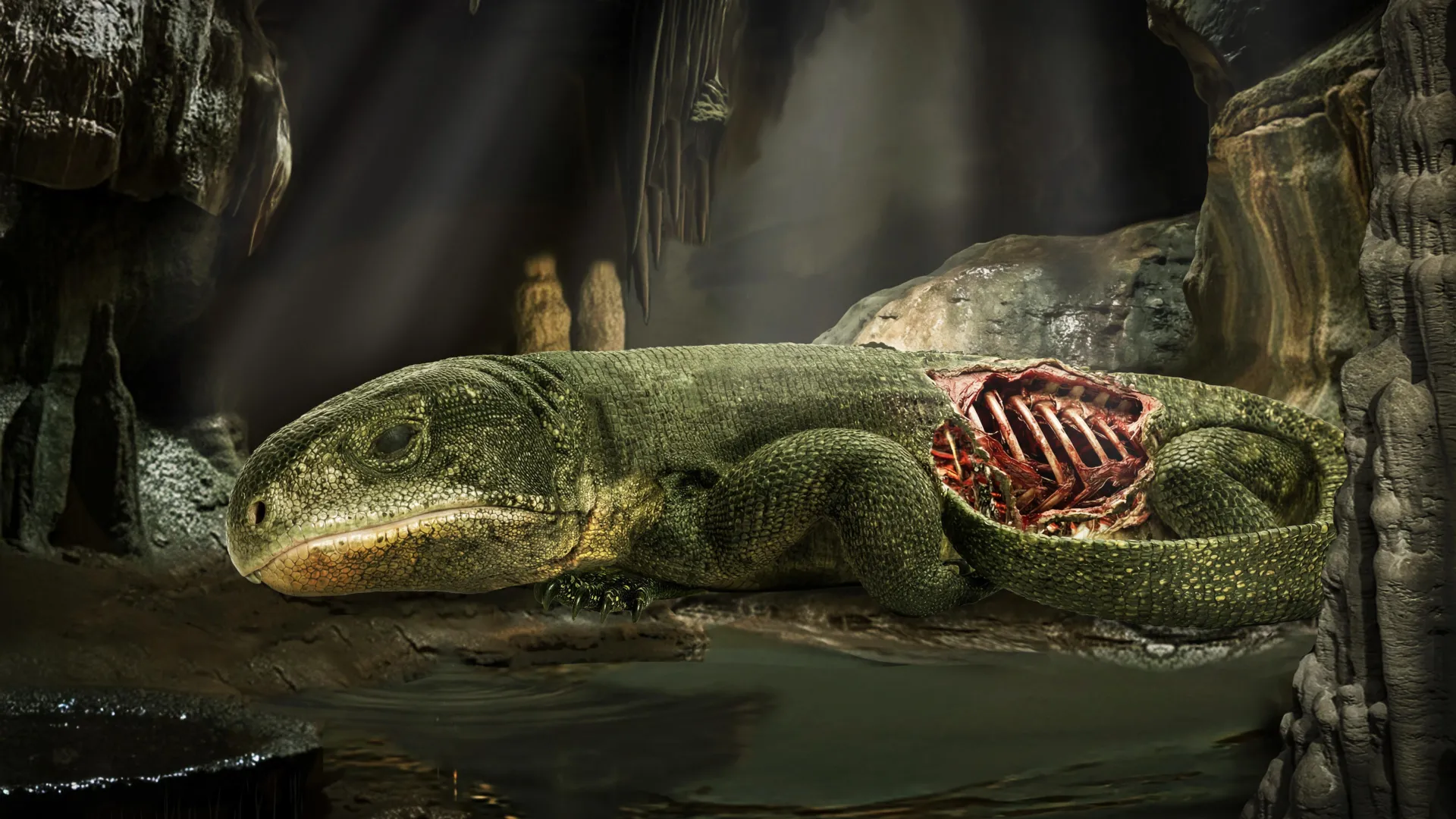
Every breath you take is part of a very ancient story. The steady movement of your chest, the muscles between your ribs pulling outward, and the air filling your lungs feel completely routine. Yet this familiar process traces back hundreds of millions of years. A remarkably preserved reptile that died in an Oklahoma cave about 289 million years ago has now revealed the earliest known example of this breathing system in amniotes—a group that includes reptiles, birds, mammals, and their shared ancestors, among the first animals to fully adapt to life on land. This groundbreaking discovery, detailed in the prestigious journal Nature, not only illuminates the evolutionary origins of terrestrial respiration but also pushes the boundaries of what we thought possible for the preservation of ancient organic material.
A Window into the Permian: The Extraordinary Preservation of Captorhinus aguti
The fossil in question, identified as Captorhinus aguti, a small, lizard-like reptile from the early Permian period (roughly 299 to 252 million years ago), represents a scientific treasure trove. Discovered in the rich fossil beds near Richards Spur, Oklahoma, this specimen has defied the typical limitations of fossilization. While most fossils primarily preserve the hard mineralized remains of bones, this particular Captorhinus specimen exhibits an astonishing level of detail. It has yielded three-dimensional skin impressions, calcified cartilage, and, most remarkably, traces of original proteins. These protein remnants are an astonishing 100 million years older than any previously identified in the fossil record, offering an unprecedented glimpse into the molecular composition of ancient life.
"The exceptional preservation of this Captorhinus specimen is truly remarkable," stated Dr. Ethan Mooney, the lead author of the study, who conducted this research while a student at the University of Toronto under the guidance of Professor Robert R. Reisz, and is now a PhD candidate at Harvard University. "It allows us to move beyond inferring function from skeletal structure and to visualize the actual tissues that facilitated vital biological processes."
Captorhinus aguti itself was a significant creature in its time. Varying in size from a few centimeters to over a meter in length, these early reptiles were among the vanguard of terrestrial vertebrates, successfully colonizing diverse land environments. Their widespread distribution and abundance underscore their evolutionary success and their importance in understanding the early diversification of amniotes.
The Richards Spur Lagerstätte: A Sanctuary of Ancient Life
The unique preservation of the Captorhinus fossil is intrinsically linked to the extraordinary geological conditions of the Richards Spur site. This renowned fossil locality in Oklahoma is celebrated for its exceptional record of late Paleozoic terrestrial life. The cave systems, formed by ancient karst topography, provided a unique microenvironment. Crucially, the presence of oil seeps, which released hydrocarbons, and anoxic (oxygen-free) mud conditions, created a remarkably effective natural preservation system. These elements worked in concert to prevent the rapid decomposition of organic matter, safeguarding not only bones but also soft tissues like skin and cartilage from decay.
The result is a three-dimensional mummified fossil, perfectly preserved in its final moments. The Captorhinus specimen was found with one arm tucked beneath its body, a posture that hints at its final resting place within a crevice or burrow. This level of preservation is exceptionally rare, offering paleontologists a level of anatomical detail that is typically unattainable from skeletal remains alone.
Illuminating Anatomy: High-Tech Scans Reveal Hidden Structures
To unlock the secrets held within the rock, researchers employed cutting-edge non-destructive imaging techniques. Neutron computed tomography (nCT), a highly specialized scanning method, was utilized at a facility in Australia. Neutron beams can penetrate dense materials like rock with ease, allowing for detailed imaging of internal structures without the need for physical excavation, which could damage the delicate fossil.
These high-resolution scans revealed a wealth of anatomical information previously invisible to the naked eye. Dr. Mooney’s detailed analysis of these scans led to a pivotal observation: "I started to see all these structures wrapped around the bones," he recounted. "They were very thin and textured. And lo and behold, there was a nice wrapping of skin around the torso of this animal. The scaly skin has this wonderful accordion-like texture, with these concentric bands covering much of the body from the torso and up to the neck." This scaly texture, with its characteristic banding, bears a striking resemblance to the skin patterns found in modern-day worm lizards (Amphisbaenia), a group of small, burrowing reptiles, providing a direct evolutionary link between ancient and extant species.
Reconstructing the Dawn of Rib-Based Respiration
Beyond the revelation of its skin, the study of multiple Captorhinus specimens from Richards Spur allowed researchers to reconstruct the animal’s entire breathing apparatus. By meticulously examining three distinct fossils, scientists were able to piece together the complex interplay of skeletal elements involved in respiration. One specimen, in particular, displayed a segmented cartilaginous sternum, sternal ribs, intermediate ribs, and the crucial connections linking the ribcage to the shoulder girdle.
This comprehensive examination provided the first direct evidence of costal aspiration breathing in an early amniote. This sophisticated respiratory mechanism relies on the coordinated action of intercostal muscles between the ribs. When these muscles contract, they expand the chest cavity, creating negative pressure that draws air into the lungs. Conversely, relaxation of these muscles allows the chest cavity to contract, expelling air.
A Pivotal Evolutionary Leap: From Amphibian to Terrestrial Mastery
The evolutionary significance of this rib-based breathing system cannot be overstated. Prior to its development, amphibians, the ancestors of amniotes, relied on a less efficient method of respiration. They primarily utilized cutaneous respiration (breathing through their skin) and buccal pumping, a process where they would actively push air into their lungs by raising the floor of their mouth. While effective for the often sedentary lifestyles of many amphibians, these methods inherently limit oxygen intake and, consequently, the potential for sustained, high-energy activity.
The advent of costal aspiration represented a paradigm shift. It allowed for a far more efficient and deeper exchange of gases, enabling amniotes to extract significantly more oxygen from the atmosphere and expel carbon dioxide more effectively. This increased oxygen supply fueled more active lifestyles, a critical advantage for animals venturing into and thriving on the terrestrial landscape.
"We propose that the system found in Captorhinus represents the ancestral condition for the kind of rib assisted respiration present in living reptiles, birds, and mammals," stated Professor Reisz, a co-author of the study. This assertion places the evolution of efficient terrestrial breathing squarely within the lineage leading to all land vertebrates as we know them today.
The "Game Changer" for Terrestrial Colonization
The implications of this discovery extend far beyond the anatomical reconstruction of an ancient reptile. The ability to breathe efficiently on land was a fundamental prerequisite for the successful colonization and diversification of terrestrial ecosystems. Animals equipped with this enhanced respiratory system could pursue prey more vigorously, escape predators more effectively, and explore a wider range of habitats.
"It was a game changer that allowed these animals to adopt a much more active lifestyle," Dr. Mooney emphasized. This newfound dynamism likely played a pivotal role in the evolutionary success of reptiles and their subsequent diversification into numerous ecological niches, eventually leading to the emergence of birds and mammals. The ribcage-based breathing system, therefore, stands as a foundational innovation that paved the way for the terrestrial dominance of amniotes.
Pushing the Boundaries of Paleoproteomics: Ancient Proteins Unearthed
The scientific revelations from the Captorhinus fossil did not end with its respiratory system. In a further testament to its extraordinary preservation, researchers employed synchrotron infrared spectroscopy to detect traces of original proteins within the fossilized bone, cartilage, and skin. The identification of these protein remnants is a monumental achievement, pushing the known limits of biomolecular preservation in fossils by approximately 100 million years.
"The protein remnant finding is exceptional," Dr. Mooney remarked. "It dramatically pushes our understanding of what is possible in terms of soft tissue preservation in the fossil record." Previously, the oldest identified proteins were found in dinosaur fossils, dating back around 65-70 million years. The presence of proteins in a specimen from the early Permian period suggests that under ideal conditions, the building blocks of life can persist for far longer than previously assumed, opening up exciting new avenues for paleoproteomic research. This could potentially allow scientists to investigate molecular details of ancient organisms, offering insights into their physiology, diet, and even evolutionary relationships at a molecular level.
A Legacy of Discovery: Continued Research and Future Potential
The remarkable Captorhinus aguti fossils are now housed at the Royal Ontario Museum in Toronto, where they will continue to be a subject of study for paleontologists worldwide. Dr. Mooney has since transitioned to Harvard University, where his research continues to delve into the evolutionary history of early reptiles, building upon the foundational discoveries made with this exceptional specimen.
This comprehensive investigation into Captorhinus aguti serves as a powerful reminder of how much we can still learn from the fossil record. It provides a vivid illustration of how key evolutionary innovations, such as efficient terrestrial respiration, shaped the trajectory of life on Earth. As scientific techniques advance and our understanding of geological processes deepens, further discoveries like this are likely to emerge, continuously refining our picture of life’s ancient past and the remarkable adaptations that have allowed organisms to thrive in diverse environments. The story of our own breath, it turns out, is inextricably linked to the story of these ancient pioneers of life on land.














Leave a Reply