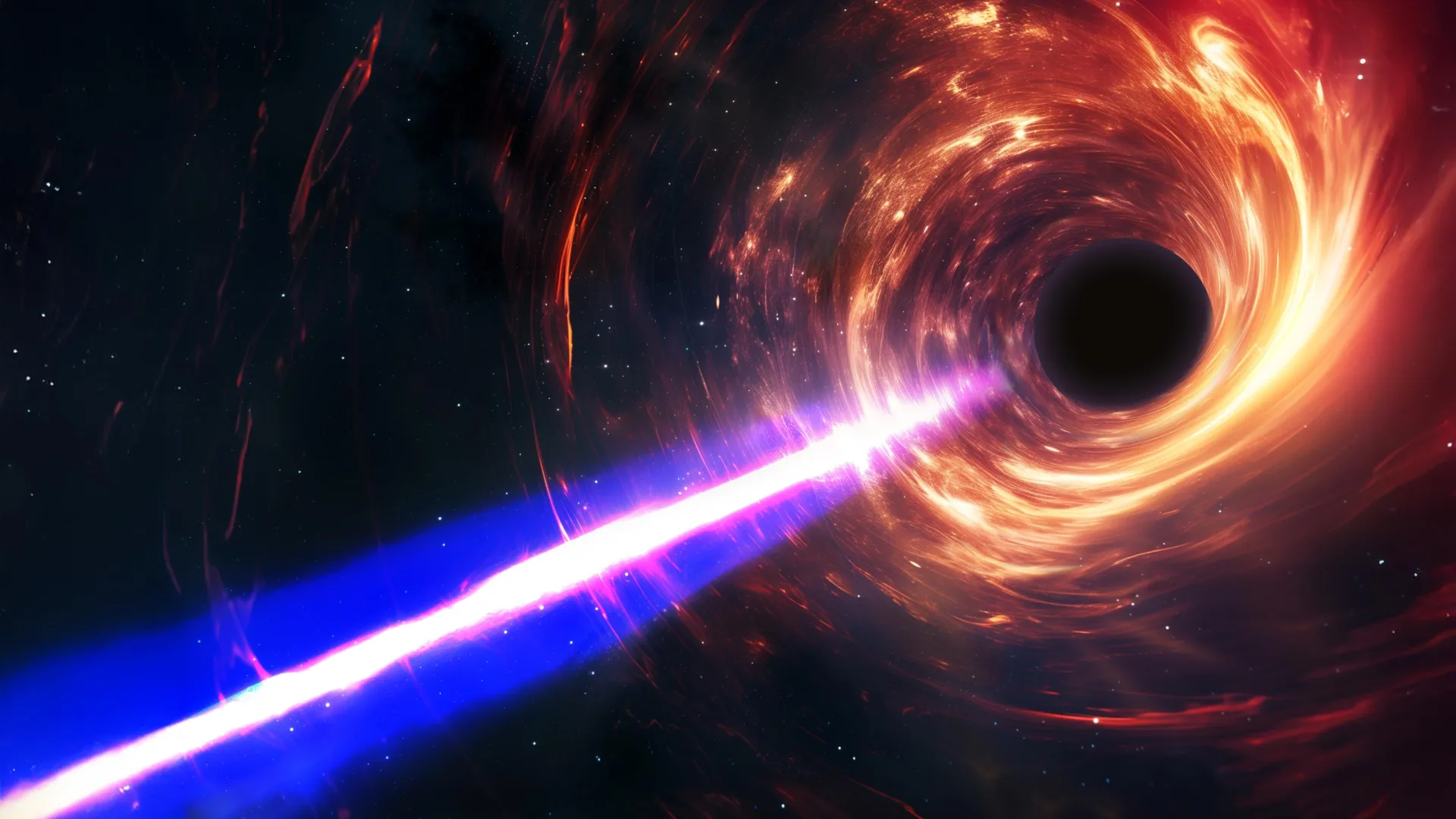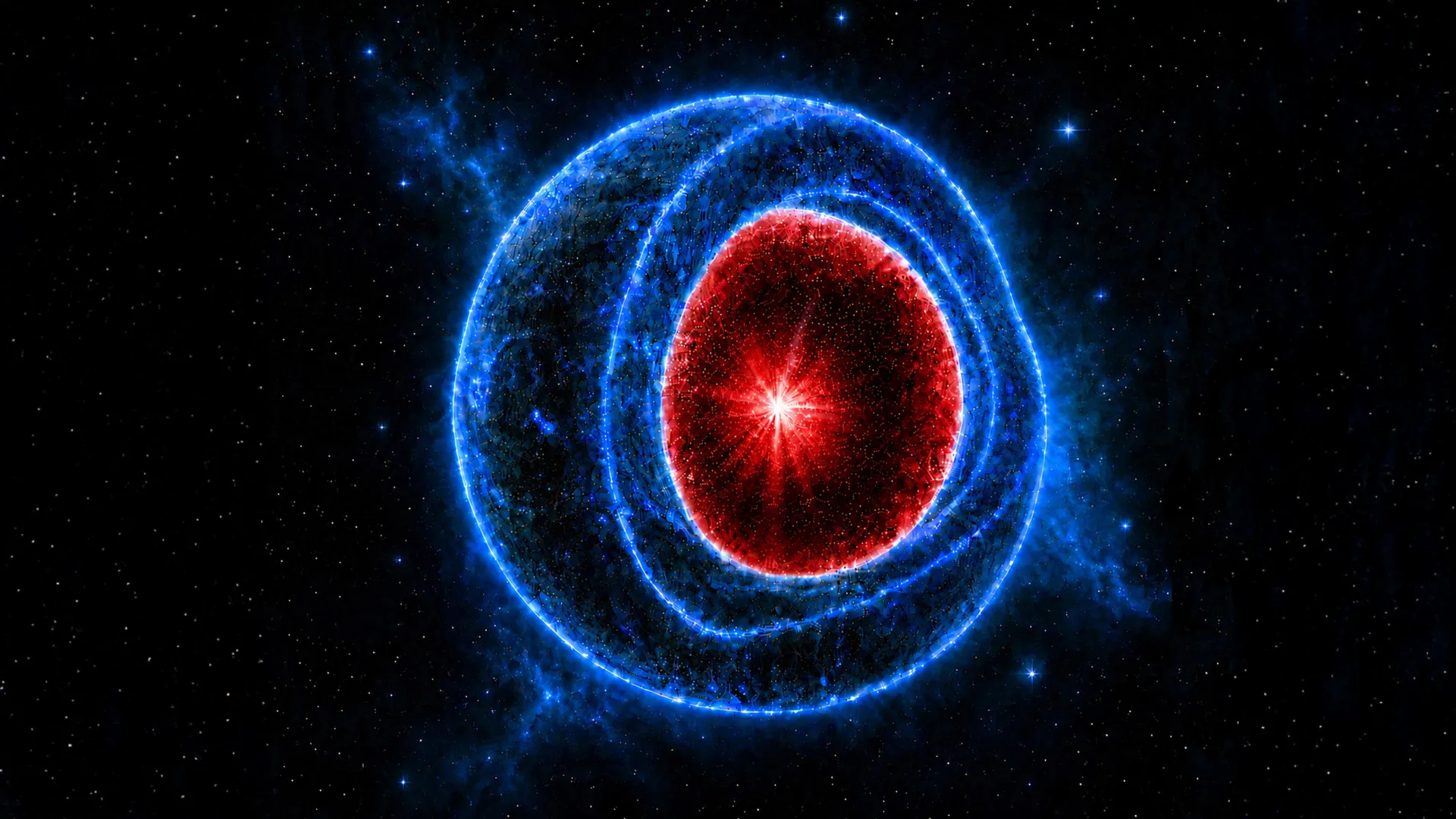
The lifecycle of the most massive stars in the universe concludes not with a quiet fading, but with a cataclysmic transformation that challenges the very foundations of modern physics. For decades, the scientific consensus has held that when a star of sufficient mass exhausts its nuclear fuel, it undergoes an unstoppable gravitational collapse, resulting in a black hole. In this traditional model, matter is crushed into a singularity—a point of infinite density where the laws of spacetime, as described by Albert Einstein’s General Relativity, effectively cease to function. However, a groundbreaking theoretical study by physicists at Goethe University Frankfurt has introduced a compelling alternative to this terminal fate. By proposing a dynamic solution to Einstein’s field equations, researchers Daniel Jampolski and Professor Luciano Rezzolla have suggested that collapsing stars might not become singularities at all, but instead transform into "gravastars"—ultra-compact objects containing an expanding miniature universe driven by dark energy.
The Mathematical Crisis of the Singularity
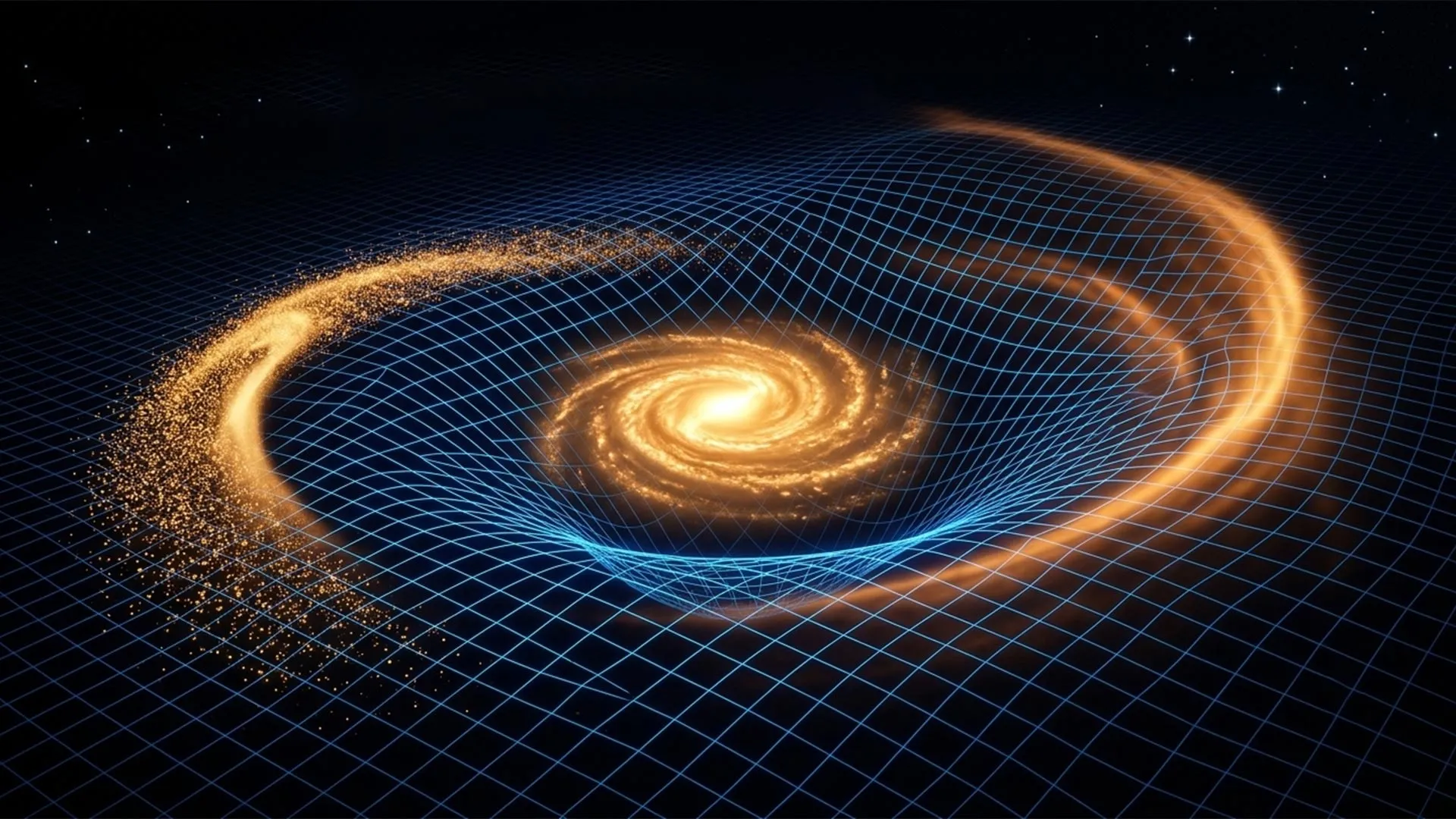
To understand the significance of this new model, one must first examine the inherent contradictions within the standard theory of black holes. According to General Relativity, gravity is the curvature of spacetime caused by mass and energy. In a massive star, the outward pressure generated by nuclear fusion in the core balances the inward pull of gravity. When fusion ceases, gravity wins. If the remaining mass is greater than approximately three times that of the Sun (the Tolman-Oppenheimer-Volkoff limit), no known force can stop the collapse.
The mathematical result of this process is a singularity. At this point, the curvature of spacetime becomes infinite, and the volume becomes zero. For physicists, "infinite" is often a signal that a theory has reached its limit and requires a new framework, likely one that unifies gravity with quantum mechanics. Furthermore, black holes are defined by an event horizon—a boundary from which nothing, not even light, can escape. This leads to the "Information Paradox," where the physical information about the matter that formed the black hole appears to be lost to the universe forever, a concept that violates the principles of quantum physics.
The Emergence of the Gravastar Alternative
Because of these conceptual hurdles, the scientific community has long sought "black hole mimics"—objects that appear and behave like black holes from the outside but lack the problematic singularity and event horizon. In 2001, physicists Pawel Mazur and Emil Mottola proposed the concept of the Gravitational Vacuum Star, or "gravastar."
In the gravastar model, the collapsing matter does not reach a point of infinite density. Instead, as the matter reaches a critical density, it undergoes a phase transition. The interior of the object becomes filled with "vacuum energy" or dark energy, which exerts a powerful negative pressure. This outward pressure counteracts the inward pull of gravity, creating a stable, ultra-compact shell of matter. From an external observer’s perspective, a gravastar would be nearly indistinguishable from a black hole; it would possess immense mass, a strong gravitational pull, and would appear almost entirely dark. However, unlike a black hole, a gravastar would have a physical surface (the thin shell) and no internal singularity.
A New Solution: The Dynamic Birth of an Internal Universe
While the gravastar theory has existed for nearly a quarter of a century, it has faced a significant hurdle: the lack of a "dynamic solution." Previous models could describe what a gravastar looked like once it was already formed, but they could not mathematically demonstrate the process by which a collapsing star transforms into one.
The research conducted by Daniel Jampolski and Luciano Rezzolla, published in a recent study, provides this missing link. Jampolski, who developed the framework during his master’s thesis, and Rezzolla, a renowned expert in theoretical astrophysics, found a way to represent the transition from ordinary matter to a gravastar through a series of complex equations.
Their model suggests that as a star collapses, it reaches a state of extreme compression that triggers a "mini-Big Bang" within the core. This internal explosion is not a traditional blast of matter, but an emergence of dark energy. As this internal universe begins to expand, it pushes against the infalling layers of the star. The result is a delicate but stable equilibrium: the inward gravitational pressure of the stellar shell is perfectly balanced by the outward expansion of the dark energy interior.
"The Big Bang of the emerging universe can unfold once the star has already collapsed almost to the point of becoming a black hole," Jampolski explained. This suggests that the "new physics" required to explain these objects only manifests under the most extreme conditions imaginable, where matter is squeezed to densities that defy current experimental replication.
Comparative Chronology: The Evolution of Gravitational Theory
The journey toward understanding these cosmic giants has spanned over a century of theoretical development:
- 1915: Albert Einstein publishes the General Theory of Relativity, providing the framework for gravity as spacetime curvature.
- 1916: Karl Schwarzschild finds the first exact solution to Einstein’s equations, describing the gravitational field of a point mass, which later defines the "Schwarzschild radius."
- 1939: Robert Oppenheimer and Hartland Snyder model the collapse of a massive star, providing the first theoretical basis for black hole formation.
- 1960s: Roger Penrose and Stephen Hawking develop the Singularity Theorems, proving that under General Relativity, singularities are inevitable in black hole formation.
- 2001: Mazur and Mottola propose the gravastar as a singularity-free alternative.
- 2019: The Event Horizon Telescope (EHT) captures the first image of a "black hole" shadow in the galaxy M87, confirming the existence of ultra-compact objects.
- 2024: Jampolski and Rezzolla propose the dynamic solution, explaining how collapsing matter can theoretically form a gravastar with an expanding interior.
Technical Analysis: Dark Energy as a Structural Support
The core of the Jampolski-Rezzolla model relies on the unique properties of dark energy. In our broader universe, dark energy is the mysterious force driving the accelerated expansion of the cosmos. In the context of a gravastar, this energy acts as a "gravitational repellent."
In the equations of General Relativity, the source of gravity is not just mass, but also pressure. While ordinary pressure (like that in a balloon) adds to the gravitational pull, "negative pressure" (a characteristic of dark energy) creates a repulsive effect. By filling the interior of a collapsing star with this negative pressure, the Jampolski-Rezzolla solution prevents the density from ever reaching infinity.
This "mini-universe" inside the gravastar is mathematically similar to the Friedmann-Lemaître-Robertson-Walker (FLRW) metric, which describes our own expanding universe. The discovery that a collapsing star could contain an expanding FLRW-like interior provides a poetic symmetry to cosmology: the death of a star in one "layer" of reality could theoretically lead to the birth of a new spatial expansion in another.
Scientific Reaction and Observational Challenges
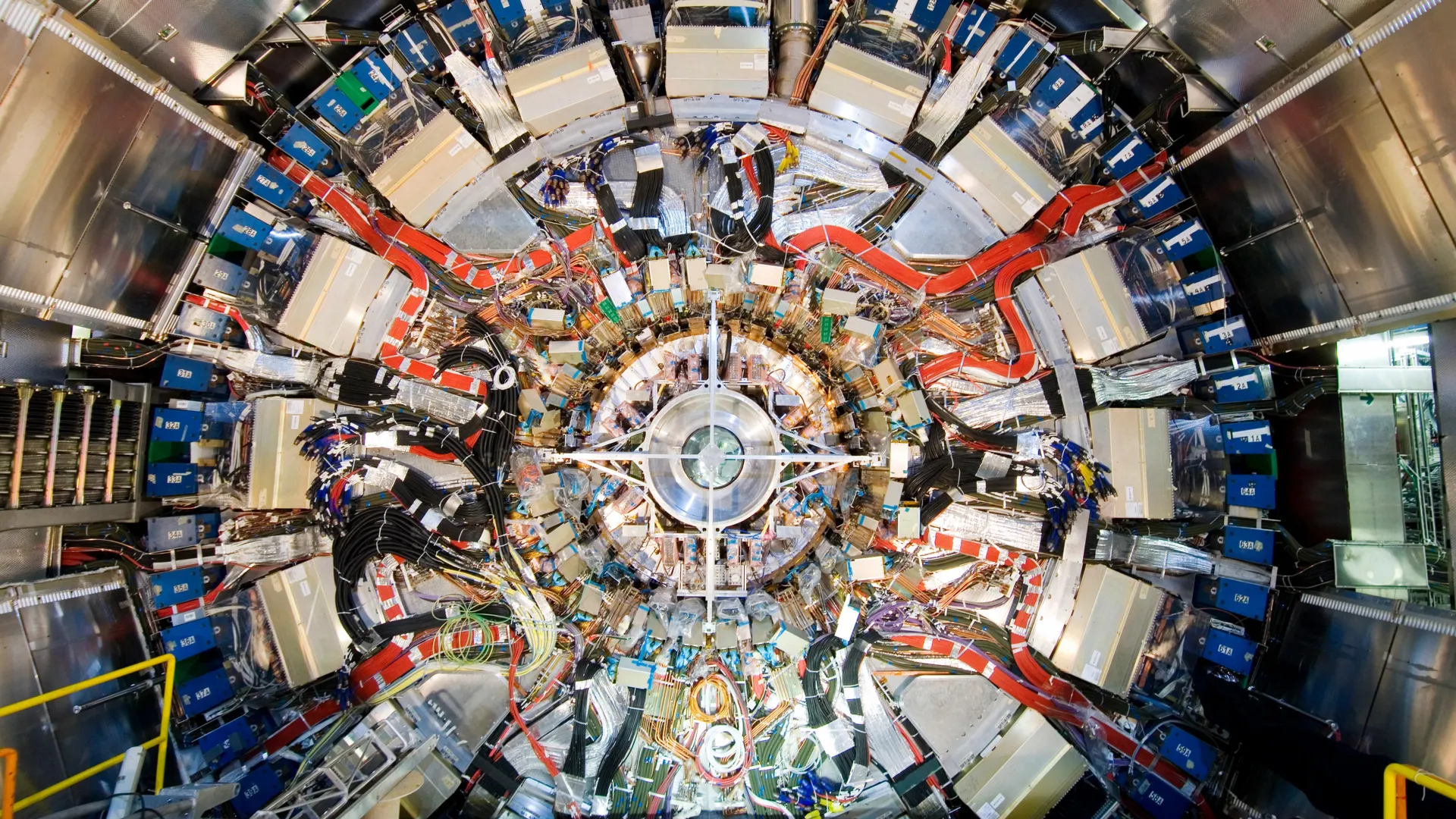
The proposal has sparked significant interest within the theoretical physics community, though it remains a subject of rigorous debate. The primary challenge facing the gravastar theory is observational evidence. Currently, the gravitational waves detected by facilities like LIGO and Virgo, as well as the images produced by the Event Horizon Telescope, are consistent with the mathematical predictions for black holes.
However, as Professor Rezzolla points out, being open to alternatives is a fundamental requirement of the scientific method. "Looking for alternatives to black holes should not suggest a skepticism towards black holes, which still represent the most natural and simplest solution to the fate of gravitational collapse," Rezzolla stated. "However… it is essential to maintain an unbiased approach towards what we do not know and hence explore both the accepted wisdom and the more exotic interpretations."
Critics of the gravastar model often point to the "thin shell" problem. For a gravastar to be stable, the shell of ordinary matter surrounding the dark energy core must be incredibly thin and possess unusual physical properties. Some researchers argue that such shells might be unstable and would eventually collapse into a black hole anyway. The Jampolski-Rezzolla model addresses some of these concerns by providing a dynamic formation path, but it will require further testing through numerical simulations to determine the long-term stability of these objects.
Future Implications: Testing the Theory
The next decade of astrophysics may provide the data needed to distinguish between black holes and gravastars. One potential avenue is the study of "gravitational-wave echoes." When two ultra-compact objects merge, they emit ripples in spacetime. If the objects are black holes with event horizons, the gravitational wave signal should end abruptly. However, if they are gravastars with physical surfaces, the waves might "bounce" or reflect off the surfaces, creating secondary signals or echoes.
Additionally, future iterations of the Event Horizon Telescope will provide higher-resolution images of the "shadows" cast by these objects. A gravastar might cast a slightly different shadow than a black hole, or it might exhibit subtle differences in the way gas and light orbit its surface.
Conclusion: Expanding the Boundaries of Physics
The work of Jampolski and Rezzolla represents a significant step forward in the attempt to resolve the most troubling paradoxes of astrophysics. By showing that a gravastar can form dynamically from the collapse of a star, they have moved the concept from a mathematical curiosity to a viable theoretical contender.
Whether gravastars truly exist or are simply a mathematical "ghost" within Einstein’s equations remains to be seen. Regardless of the outcome, the exploration of these objects forces scientists to confront the limits of their knowledge. If the interior of a collapsed star truly contains an expanding mini-universe, the distinction between the "infinitesimally small" and the "infinitely large" may be far more blurred than we ever imagined. As Rezzolla noted, history is full of exotic interpretations that eventually became the new accepted wisdom, and the gravastar may yet prove to be the key to unlocking a more complete understanding of our universe.