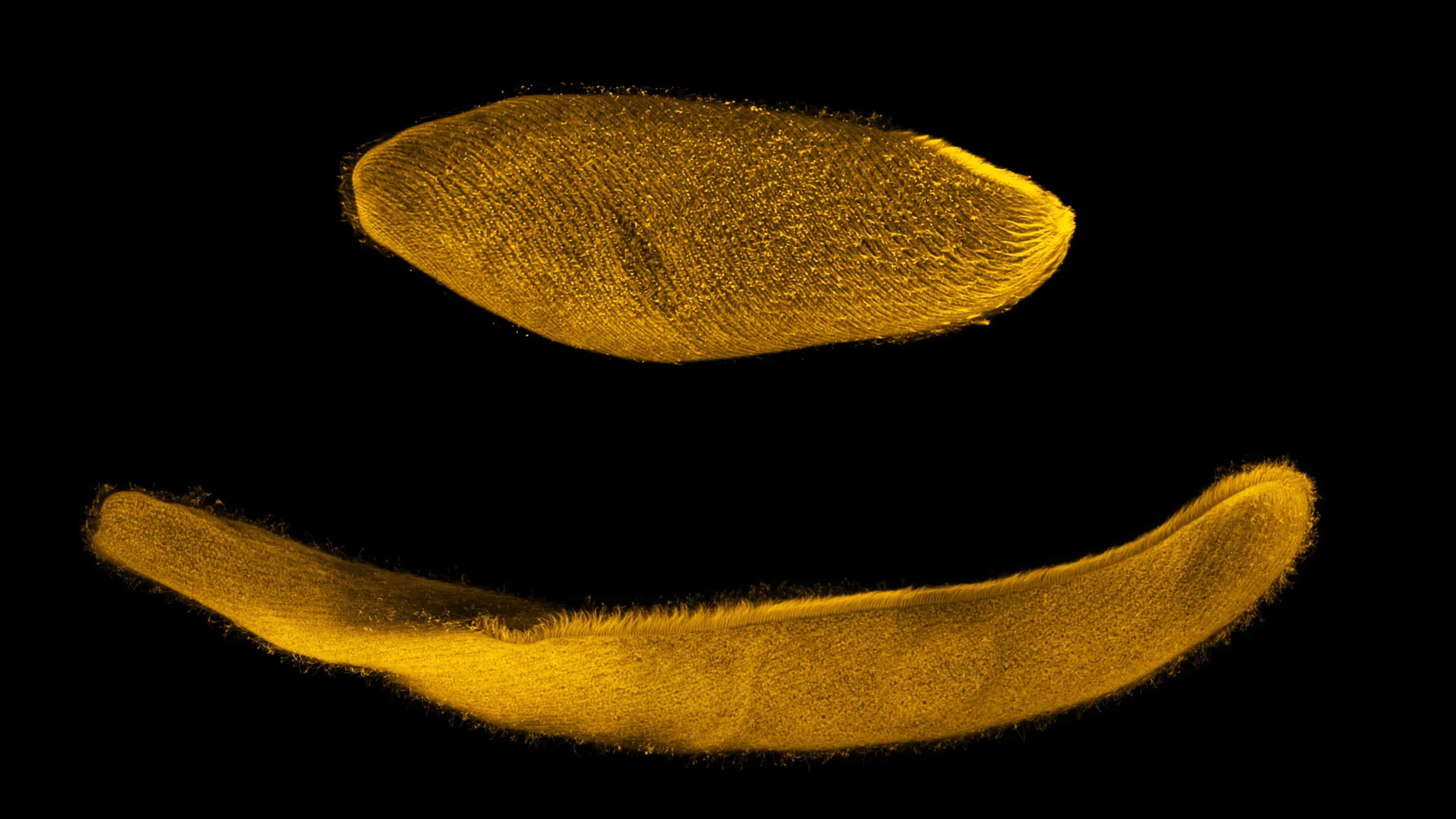
A tiny aquatic organism, barely visible to the naked eye, is currently rewriting the textbooks on biological motion. The single-celled ciliate Spirostomum ambiguum possesses the startling ability to compress its elongated body to one-quarter of its original length in under five milliseconds. This feat of rapid physical transformation occurs hundreds of times faster than a human blink, which typically lasts between 100 and 400 milliseconds. For decades, the sheer velocity of this movement remained a mystery to the biological community, but a new multi-institutional study has finally identified the specialized protein architecture that allows this organism to defy the speed limitations typically associated with cellular machinery.
The Anatomy of an Evolutionary Marvel
Spirostomum ambiguum is a giant among ciliates, reaching lengths of up to four millimeters—an impressive size for a single-celled entity. Its name is derived from the intricate fringe of hairlike cilia that mantle its surface, providing the propulsion necessary to navigate its freshwater habitats. While many organisms utilize cilia for movement, the defining characteristic of Spirostomum is its rapid-fire contraction cycle.
The organism can contract at a rate of roughly 100 body lengths per second. To put this in perspective, if a human were capable of matching this relative speed, they would be moving at thousands of miles per hour. This behavior is theorized by biologists to serve two primary survival functions: rapid escape from predators and a sophisticated form of long-distance communication with other members of its species, potentially through mechanical signaling in the water column.
The research team, led by experts from North Carolina State University, the University of Chicago, Drake University, and the University of Colorado at Boulder, utilized advanced imaging techniques, including electron and immunofluorescence microscopy, to map the organism’s internal structure. Their findings, published in the Proceedings of the National Academy of Sciences, reveal a sophisticated "fishnet" of protein fibers that serves as the biological engine for these lightning-fast movements.
Breaking the ATP Paradigm
For years, the gold standard for biological movement has been the adenosine triphosphate (ATP) cycle. In human muscle cells, myosin and actin filaments interact in a process fueled by the chemical breakdown of ATP. This is a highly efficient but inherently limited system; the chemical conversion process takes time, placing a ceiling on how fast muscles can contract.
Spirostomum, however, has evolved an entirely different approach. "Comparing the way our muscles contract to the way Spirostomum works is like comparing gas to electric power," explains Mary Elting, associate professor of biophysics at North Carolina State University and a co-corresponding author of the study.
The organism’s movement is governed by calcium ions acting as an electrical signal rather than a chemical fuel source. When the organism needs to retract, a calcium-based pulse causes its internal fibrous structures—known as myonemes—to change state. These myonemes are composed of specialized calcium-binding proteins called centrin and Sfi1. When the calcium ions flood the system, the Sfi1 protein undergoes a conformational shift, transitioning from a rigid state to a highly flexible one.
This change causes the protein to "clump up" like a ball of wet spaghetti, pulling the fishnet-like structure tight. Because this does not rely on the complex chemical breakdown of ATP, the organism can bypass the rate-limiting steps that keep animal muscles relatively slow. This allows for near-instantaneous movement, followed by a rapid reset, though the exact mechanics of how the organism "recharges" its calcium potential remains a subject of ongoing research.
Chronology of Discovery and Methodological Rigor
The path to understanding Spirostomum has been a long-standing pursuit in biophysics. While the organism was documented as early as the 19th century, the technical tools required to visualize its sub-microscopic contractions did not exist until recently.
The research project represents a significant collaborative effort across multiple years. Initial observations of the organism’s speed prompted early theories regarding mechanical stress. By 2019, initial funding from the National Science Foundation began to support the sophisticated microscopy work required to see the fishnet structure in situ. Over the subsequent four years, the team integrated data from electron microscopy—which provides high-resolution, static snapshots of the protein network—with live-cell imaging to verify that the fishnet structure indeed serves as the contractile framework.
The study involved a rigorous validation process. By manipulating the concentration of calcium ions in the environment, the team was able to artificially induce contractions, confirming that the calcium pulse is the essential trigger. Further, by using fluorescent markers to track the Sfi1 protein, they observed the transition from stiff to flexible in real-time, matching the speed of the organism’s physical contraction.
Implications for Synthetic Engineering
The discovery of a non-ATP-dependent, calcium-powered movement system carries profound implications for the field of soft robotics and synthetic biology. Engineers have long sought to create artificial muscles that can perform with the power-to-weight ratio of biological systems but often struggle with the limitations of current synthetic materials, which are either too slow, require bulky power supplies, or lack the durability of natural tissue.
By isolating the principles of the "fishnet" geometry, researchers believe they can design synthetic actuators that mimic the movement of Spirostomum. This "geometric" approach to movement is particularly attractive because it allows for uniform contraction, which protects internal components—or in the case of a machine, sensitive internal circuitry—from mechanical stress during high-speed operation.
"If we can understand those processes, it could help us build synthetic systems that mimic the speed and power of this single-celled organism," says Elting. The potential applications range from micro-robotic surgical tools that can navigate delicate tissue with extreme precision, to industrial sensors that react to environmental changes in milliseconds.
The Path Forward: The Reset Problem
Despite the breakthrough in understanding how the organism contracts, the "reset" mechanism remains a significant hurdle. Biological systems are generally expected to follow "one-shot" kinetics when triggered by ion surges, yet Spirostomum displays a remarkable capacity for repeatability.
Scientists are now shifting their focus to the electro-chemical gradient that likely exists across the organism’s cell membrane. The hypothesis is that there is a specialized "reset" phase that restores the calcium balance, but the protein-level machinery responsible for this recharge is currently unknown. Determining how the organism resets its calcium levels without exhausting its energy reserves is considered the next major milestone in the field.
"We would expect calcium-triggered reactions to be ‘one shot,’ but Spirostomum can do it repeatedly," Elting notes. "Understanding those aspects of its motion are the keys to building a fast-moving, ATP-independent artificial muscle."
A Collaborative Scientific Endeavor
The complexity of this research necessitated a cross-disciplinary approach, combining the expertise of chemists, biologists, and engineers. The study was supported by a robust framework of funding from the National Science Foundation (awards 1935260, 2313722, 2313724, 1935262, 1817334, 2313727, and 2313725) and the National Institutes of Health (awards R35GM130327 and R35GM142588).
The team, which included contributors from institutions such as the University of California San Francisco and the Georgia Institute of Technology, represents a new wave of bio-inspired research. By bridging the gap between evolutionary biology and material science, these researchers are not merely documenting the quirks of a single-celled organism; they are identifying fundamental physical principles that have been honed by billions of years of evolution. As the study moves into its next phase, the focus will remain on decoding the electrical reset, a discovery that could ultimately provide the final piece of the puzzle for a new generation of high-speed synthetic machinery.