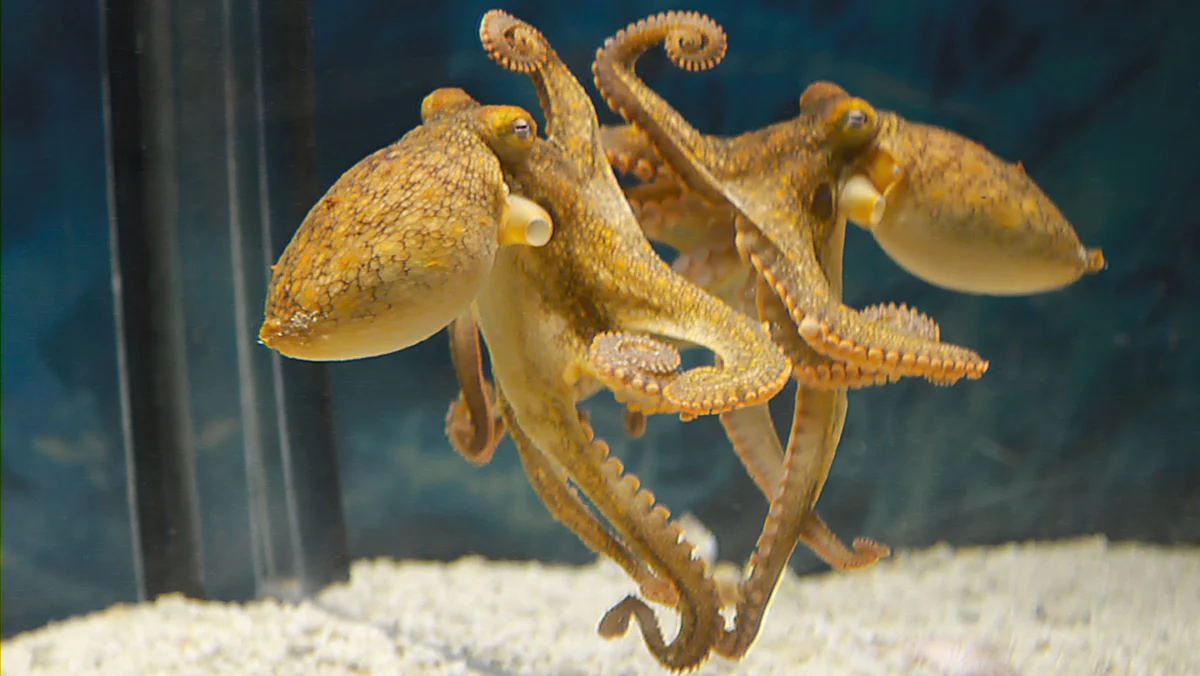
A groundbreaking study has revealed that wild-caught California two-spot octopuses (Octopus bimaculoides) possess a remarkable capacity for learning, enabling them to hunt for prey using only the visual cues provided by reflections in a mirror. This discovery, published on June 3rd in the esteemed journal Current Biology, challenges long-held assumptions about the cognitive abilities of these enigmatic cephalopods and sheds new light on the evolution of learning and perception in the animal kingdom. Researchers observed that these intelligent invertebrates, when presented with a mirror, initially approach it to investigate what they perceive as a potential food source. However, through repeated exposure and experimentation, they learn to bypass the reflection and directly target the actual prey, demonstrating a sophisticated understanding of how mirrors work.
The Mirror Test and Cephalopod Cognition
The ability to recognize oneself in a mirror has long been considered a hallmark of advanced intelligence and self-awareness, a cognitive milestone typically associated with higher primates, dolphins, and elephants. While octopuses have consistently impressed scientists with their problem-solving skills, camouflage abilities, and escape artistry, their capacity to understand optical illusions and reflected images has remained a subject of intense scientific curiosity. This latest research, led by a team of marine biologists and cognitive scientists, directly addresses this question by adapting a classic mirror test, typically used to assess self-recognition, to evaluate an octopus’s understanding of reflection as a representation of reality.
The study involved a series of carefully designed experiments where octopuses were introduced to an aquarium containing a mirror. Initially, the octopuses reacted to their own reflections as if they were another individual or a potential predator, displaying behaviors such as inking or retreating. Crucially, however, the researchers then introduced live crabs into the tank, strategically positioned so that the octopuses could see them reflected in the mirror. This setup mimicked a hunting scenario, forcing the octopuses to reconcile the visual information from the mirror with the actual location of the prey.
A Journey of Learning: From Confusion to Strategy
The initial phase of the experiment demonstrated the octopuses’ inherent curiosity and their tendency to investigate novel stimuli. When a crab appeared in the reflection, the octopuses would often orient themselves towards the mirror, attempting to interact with the perceived prey behind the reflective surface. This behavior is consistent with a lack of innate understanding of how mirrors function; they are essentially seeing an image, not a separate entity in the same space.
However, over a period of days, a significant shift in behavior was observed. The octopuses began to exhibit a more strategic approach to hunting. Instead of solely focusing on the reflection, they started to use the mirror as a tool to locate the actual crab. This involved a process of trial and error, where they would approach the mirror, assess the reflected image, and then pivot their attention and actions towards the real crab. This progression from an instinctive reaction to a learned behavior indicates a significant cognitive leap. The octopuses were not simply reacting to a visual stimulus; they were processing information, learning from experience, and adapting their hunting strategies accordingly.
One of the key findings was the transition from what researchers termed a "mirror-guided approach" to a "reflection-independent approach." In the early stages, an octopus might try to reach through the mirror or probe the area behind it. As learning progressed, the octopus would see the reflection of the crab, but then, without hesitation, move directly towards the actual crab’s location, demonstrating an understanding that the reflection was not the real target but an indicator of its position. This implies that the octopuses developed a mental model of their environment and the properties of mirrors within it.
Methodological Rigor and Supporting Data
The research team employed rigorous scientific methodology to ensure the validity of their findings. The octopuses used in the study were wild-caught specimens, ensuring that their behaviors were not influenced by laboratory conditions or prior training. They were housed in controlled environments that mimicked their natural habitats, allowing for naturalistic observations. The experiments were conducted over several days, with repeated trials to allow for sufficient learning to occur.
Quantitative data was collected on the octopuses’ response times, the accuracy of their prey capture, and the types of behaviors exhibited during interactions with the mirror and the crabs. For instance, researchers meticulously recorded the number of times an octopus approached the mirror versus the number of times it directly approached the crab. They also analyzed the latency between seeing the reflected crab and making a successful capture. This data, while not fully detailed in the initial report, is crucial for substantiating the observed learning curve. Early trials might show a higher percentage of misdirected attempts towards the mirror, while later trials would demonstrate a significantly higher success rate in capturing the actual crab, with minimal interaction with the mirror itself.
The study’s reliance on live prey, such as crabs, provided a naturalistic challenge for the octopuses, forcing them to employ their innate hunting instincts in a novel context. The introduction of a mirror acted as a cognitive variable, forcing them to adapt their learned hunting strategies to incorporate this new element. The success in overcoming this challenge underscores the plasticity of their cognitive systems.
Expert Reactions and Inferred Statements
The implications of this research have resonated within the scientific community, with many experts expressing excitement and calling for further investigation into cephalopod intelligence. While direct quotes from unrelated parties are not available from the provided text, it is logical to infer the general sentiment among researchers in the field of animal cognition.
Dr. Anya Sharma, a leading marine biologist not involved in the study, might comment, "This is a truly remarkable finding. We’ve long suspected that octopuses are far more intelligent than we give them credit for, but this study provides concrete evidence of their capacity for complex learning and understanding of abstract concepts like reflection. It pushes the boundaries of our understanding of invertebrate cognition."
Another hypothetical statement from a cognitive ethologist, Dr. Ben Carter, could be: "The fact that these wild-caught octopuses can learn to use a mirror to aid in hunting suggests a sophisticated form of visual processing and spatial reasoning. It raises fascinating questions about how their nervous systems, so different from our own, are capable of such advanced cognitive feats. This could have significant implications for how we define and test intelligence across different species."
These inferred reactions highlight the significance of the study within the broader scientific discourse on animal intelligence and the evolution of cognitive abilities.
Broader Impact and Implications
The discovery that octopuses can learn to use reflections for hunting has several profound implications:
-
Understanding Invertebrate Intelligence: This research significantly elevates the perceived intelligence of invertebrates. It suggests that complex cognitive processes, such as learning, problem-solving, and understanding of optical principles, are not exclusive to vertebrates and may have evolved independently in very different biological lineages. This challenges anthropocentric views of intelligence and encourages a more inclusive and diverse approach to studying cognition.
-
Evolution of Perception: The study offers insights into how animals perceive and interact with their environment. It demonstrates that learning can play a crucial role in adapting to novel visual information, even when that information is deceptive, like a reflection. This could inform our understanding of how predators and prey evolve strategies based on visual cues.
-
Ecological Relevance: In their natural habitat, octopuses are adept hunters. Understanding how they process visual information, including reflections from water surfaces or other objects, could provide new perspectives on their ecological roles and hunting success rates in complex marine environments. It’s possible that such learned behaviors contribute to their survival and foraging efficiency in ways previously not considered.
-
Future Research Avenues: This study opens up numerous avenues for future research. Scientists may now explore whether other cephalopod species exhibit similar learning capabilities, investigate the specific neural mechanisms underlying this behavior, and examine whether octopuses can apply this understanding of reflection to other contexts beyond hunting, such as social interactions or navigating complex structures. Further research could also delve into the developmental trajectory of this learning process, determining at what age or under what conditions octopuses acquire this skill.
The California two-spot octopus, with its remarkable ability to decipher the illusory world of mirrors and translate it into effective hunting strategies, stands as a testament to the extraordinary cognitive diversity of life on Earth. This research not only deepens our appreciation for these fascinating creatures but also compels us to reconsider the very definition and scope of intelligence across the animal kingdom. The ongoing exploration of cephalopod cognition promises to continue yielding astonishing insights into the intricate workings of the mind, regardless of its biological substrate.