

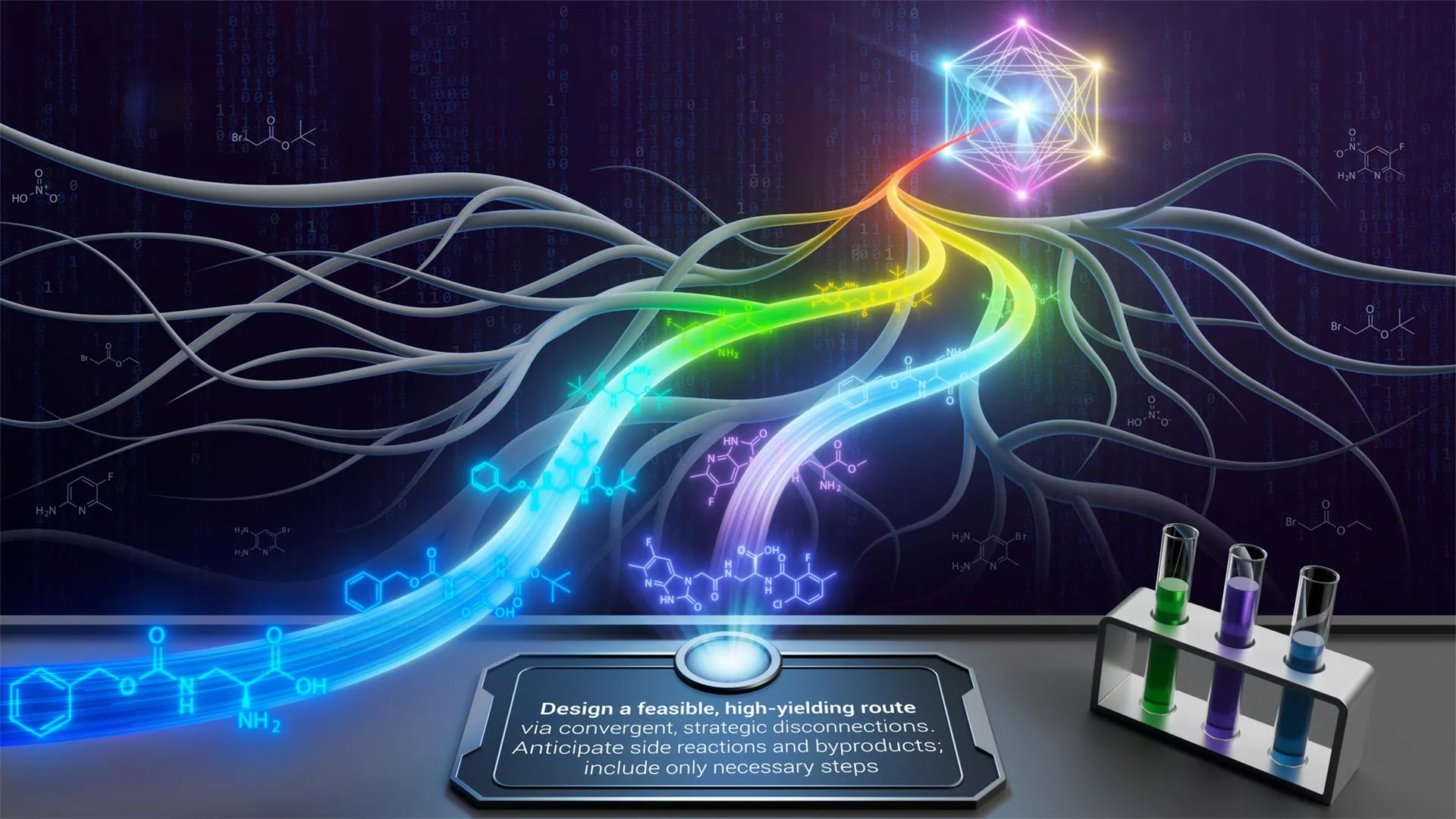
The synthesis of novel molecules represents one of the most formidable intellectual and technical challenges in modern science. Whether the objective is the development of a life-saving pharmaceutical, the engineering of a high-performance polymer, or the creation of sustainable agricultural chemicals, every compound must be meticulously constructed through a sequence of precisely choreographed chemical reactions. This process, known as total synthesis, requires not only a profound understanding of molecular architecture but also a high degree of strategic foresight—a level of expertise that typically takes professional chemists decades to master. However, a groundbreaking development from researchers at the École Polytechnique Fédérale de Lausanne (EPFL) suggests that the gap between human intuition and computational power is narrowing. Led by Professor Philippe Schwaller, the team has introduced Synthegy, a novel framework that leverages the reasoning capabilities of Large Language Models (LLMs) to guide and refine complex chemical synthesis planning and reaction mechanism analysis.
The Evolution and Obstacles of Retrosynthetic Analysis
To appreciate the significance of Synthegy, one must understand the historical context of retrosynthesis. Pioneered in the mid-20th century by Nobel Laureate E.J. Corey, retrosynthesis is a logic-based approach where chemists start with the desired "target" molecule and work backward, mentally breaking it down into simpler, commercially available precursors. This "disconnection approach" requires the chemist to navigate a nearly infinite "chemical space," making critical decisions at every step: which bonds to break, which functional groups to protect, and how to manage stereochemistry.
While computational tools for retrosynthesis have existed since the 1960s—beginning with Corey’s own LHASA (Logic and Heuristics Applied to Synthetic Analysis)—they have historically struggled with the "strategic" element of the process. Traditional software often generates thousands of mathematically possible routes, many of which are chemically impractical, excessively long, or require reagents that are too toxic or expensive. The primary hurdle has always been the lack of "chemical common sense." Experienced chemists use heuristics—mental shortcuts—to prioritize routes that are elegant, efficient, and robust. Replicating this subjective judgment in a digital environment has remained a persistent bottleneck in the digital transformation of chemistry.
Synthegy: A Paradigm Shift in Chemical Reasoning
The research published in the journal Matter by first author Andres M. Bran and his colleagues introduces Synthegy as a solution to this lack of intuition. Unlike previous AI applications in chemistry that attempted to train models to "draw" molecules or predict reaction outcomes directly from scratch, Synthegy utilizes LLMs as high-level reasoning agents. These models do not act as the primary generators of chemical data; instead, they serve as sophisticated evaluators that sit atop existing computational search algorithms.
The Synthegy framework operates by combining traditional tree-search algorithms with the natural language processing power of state-of-the-art LLMs. This allows the system to interpret complex, qualitative instructions provided by a human chemist. "When making tools for chemists, the user interface matters a lot, and previous tools relied on cumbersome filters and rules," explained Andres M. Bran. "With Synthegy, we’re giving chemists the power to just talk, allowing them to iterate much faster and navigate more complex synthetic ideas."
By allowing for natural language input, Synthegy enables a level of "steerability" previously unseen in chemical software. A researcher can instruct the system to "avoid using heavy metals," "prioritize routes that form the piperazine ring in the final step," or "minimize the use of protecting groups to improve atom economy." The LLM then reviews the hundreds of potential pathways generated by the underlying software, scoring and ranking them based on how well they align with these specific strategic goals.
Decoding Reaction Mechanisms through AI Logic
Beyond the macro-level planning of a multi-step synthesis, Synthegy addresses the micro-level complexity of reaction mechanisms. A reaction mechanism is a step-by-step description of how a chemical transformation occurs, detailing the movement of electrons (often visualized as "curly arrows") and the formation of short-lived transition states. Understanding these mechanisms is essential for troubleshooting failed reactions and optimizing yields.
Computational chemistry has long used quantum mechanical simulations to model these steps, but such methods are computationally expensive and require significant manual setup. Synthegy approaches this problem by breaking down reactions into fundamental elementary steps. The LLM then evaluates these steps, assessing whether the proposed electron movements are electronically and sterically plausible. By filtering out "unrealistic" pathways that violate basic chemical principles, Synthegy allows researchers to focus on the most probable mechanisms, effectively acting as a digital sounding board for expert hypotheses.
Empirical Validation and Performance Metrics
To validate the efficacy of Synthegy, the EPFL team conducted an extensive double-blind study involving 36 professional chemists. This rigorous testing phase was designed to determine if the AI’s "judgment" aligned with human expert opinion. The participants were presented with various synthetic routes and mechanism proposals, some generated or ranked by Synthegy and others by traditional methods.
The results were compelling. Across 368 valid evaluations, the chemists agreed with Synthegy’s assessments 71.2% of the time on average. This high rate of concordance suggests that the LLM-based reasoning framework successfully captures the nuances of chemical strategy that previous rule-based systems missed. Furthermore, the study revealed a clear correlation between model scale and performance: larger, more sophisticated LLMs (such as GPT-4) significantly outperformed smaller models, demonstrating an emergent ability to handle complex functional group interconversions and strategic planning.
Specific data points from the study highlighted Synthegy’s ability to:
- Identify and flag redundant protection/deprotection steps that add unnecessary cost and waste.
- Rank pathways based on "step economy," a key metric in green chemistry.
- Provide natural language explanations for its rankings, allowing chemists to understand the "why" behind the AI’s suggestions.
Implications for the Pharmaceutical Industry and Beyond
The introduction of Synthegy comes at a critical time for the global pharmaceutical and materials science industries. The average cost of bringing a new drug to market now exceeds $2.6 billion, with a significant portion of that investment lost during the "valley of death" between initial discovery and successful scale-up. By streamlining the synthesis planning phase, Synthegy has the potential to reduce both the time and the material costs associated with drug development.
Moreover, the framework supports the growing movement toward "Green Chemistry." By guiding chemists toward routes that use fewer reagents, safer solvents, and more efficient pathways, Synthegy contributes to the sustainability of chemical manufacturing. The ability to incorporate expert hypotheses into the search process also means that institutional knowledge—often siloed within the minds of senior researchers—can be digitized and used to augment the work of junior scientists.
"The connection between synthesis planning and mechanisms is very exciting: we usually use mechanisms to discover new reactions that enable us to synthesize new molecules," said Bran. "Our work is bridging that gap computationally through a unified natural language interface."
A Chronology of AI Integration in Chemistry
The development of Synthegy is a milestone in a rapidly accelerating timeline of AI integration in the physical sciences:
- 2010s: The rise of Deep Learning leads to the development of neural networks capable of predicting reaction outcomes with high accuracy (e.g., the work of Segler et al.).
- 2020: Google DeepMind’s AlphaFold 2 revolutionizes structural biology by predicting protein folding, signaling a shift toward AI-driven discovery.
- 2022-2023: The emergence of powerful LLMs prompts researchers to explore their utility in coding and specialized scientific domains.
- 2024: The publication of the Synthegy framework marks the transition from AI as a "prediction engine" to AI as a "reasoning partner," capable of strategic dialogue with human experts.
Analysis of the Broader Impact
The success of Synthegy signals a fundamental shift in the role of the chemist. Rather than spending weeks manually scouring the literature to plan a synthesis, the chemist of the future will likely act as a high-level "architect," providing strategic direction to AI systems that handle the heavy lifting of data processing and route optimization.
However, this transition is not without its challenges. The reliance on LLMs introduces the risk of "hallucinations"—where the model might confidently suggest a chemically impossible step. The EPFL team addressed this by using the LLM as an evaluator of grounded chemical data rather than a primary generator, but the need for human oversight remains paramount. Additionally, the democratization of such powerful synthetic planning tools raises ethical considerations regarding the synthesis of regulated or hazardous substances, necessitating the implementation of robust digital safeguards.
Conclusion
Synthegy represents a significant leap forward in the field of "AI for Science" (AI4Science). By successfully translating the qualitative "gut feeling" of a chemist into a quantitative scoring system, Philippe Schwaller’s team has provided a blueprint for the next generation of laboratory tools. As these models continue to evolve and integrate with automated "cloud labs" and robotic synthesis platforms, the speed of molecular discovery is poised to accelerate exponentially. For the scientific community, Synthegy is more than just a software update; it is a testament to the power of combining human-centric language with the computational rigor of artificial intelligence to solve some of the most complex puzzles in the physical world.















Leave a Reply