

Every breath you take is part of a profoundly ancient narrative, a biological symphony that has resonated through hundreds of millions of years of Earth’s history. The seemingly mundane act of your chest rising and falling, the subtle interplay of intercostal muscles, and the influx of air into your lungs are not merely physiological functions; they are echoes of an evolutionary journey that began long before the age of dinosaurs. Now, a remarkably preserved reptile fossil, unearthed from an Oklahoma cave and dating back approximately 289 million years to the early Permian period, has provided unprecedented insight into the earliest known instance of the breathing system that defines amniotes – the group encompassing reptiles, birds, mammals, and their common terrestrial ancestors. This groundbreaking discovery, detailed in the prestigious journal Nature, illuminates a pivotal evolutionary leap that enabled vertebrates to fully conquer life on land.
A Glimpse into the Permian: Exceptional Preservation in an Oklahoma Cave
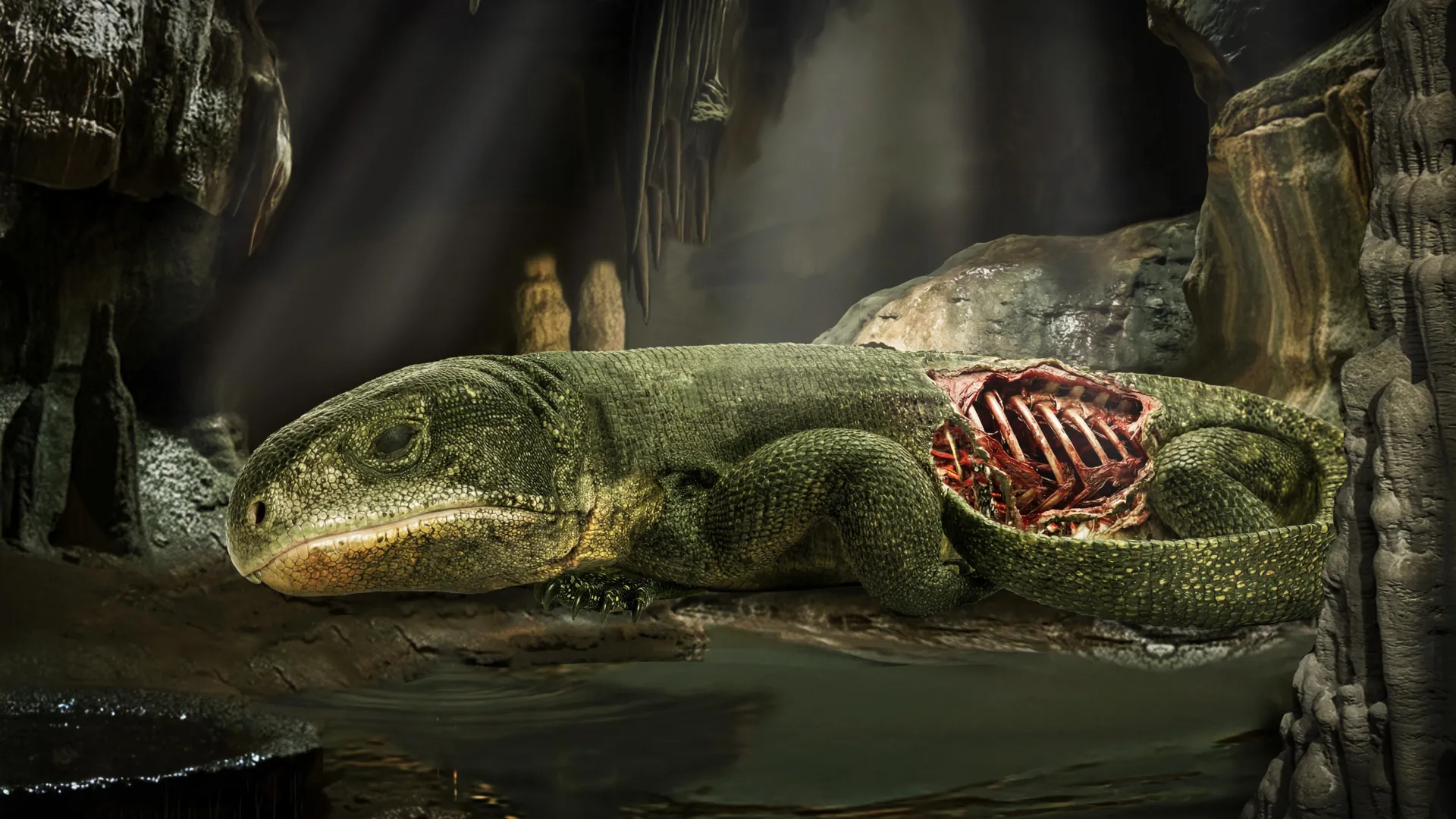
The fossil in question is a small, lizard-like creature named Captorhinus aguti. While only a few inches in length, its preservation is extraordinary, far exceeding the typical skeletal remains found in paleontological digs. This specimen, recovered from the renowned Richards Spur cave systems near Oklahoma, offers a three-dimensional snapshot of ancient anatomy, complete with preserved skin, calcified cartilage, and astonishingly, remnants of original proteins. These protein traces are the oldest ever identified in a fossil, predating previously known examples by a staggering 100 million years.
The Richards Spur site is a geological treasure trove, celebrated for its exceptionally diverse and well-preserved terrestrial vertebrate fossils from the late Paleozoic era. The unique environmental conditions within these ancient cave systems played a crucial role in this exceptional preservation. A confluence of factors, including oil seep hydrocarbons and oxygen-depleted mud, created an anoxic environment that effectively arrested decomposition, safeguarding not only bones but also delicate soft tissues that are almost always lost to time. This protective environment has allowed the Captorhinus aguti fossil to remain virtually mummified, frozen in its final moments with one arm tucked beneath its body, offering an unparalleled, three-dimensional view of its ancient form.
Unraveling the Mechanics of Respiration: The Rib-Based Breathing System
The scientific team, co-led by Ethan Mooney, then a student in Professor Robert R. Reisz’s lab at the University of Toronto and now a PhD candidate at Harvard University, utilized advanced imaging techniques to probe the secrets held within the fossil. Employing neutron computed tomography (nCT) at a specialized facility in Australia, researchers were able to conduct non-destructive scans, peering through the surrounding rock to reveal intricate internal structures.
During the analysis, Mooney observed unexpected details wrapped around the fossilized bones. "I started to see all these structures wrapped around the bones," he recounted, "they were very thin and textured. And lo and behold, there was a nice wrapping of skin around the torso of this animal. The scaly skin has this wonderful accordion-like texture, with these concentric bands covering much of the body from the torso and up to the neck." This intricate scaling pattern bears a striking resemblance to the skin found on modern-day worm lizards, a group of small, burrowing reptiles, underscoring the deep evolutionary lineage of certain anatomical features.
Beyond the skin, the research focused on reconstructing the breathing mechanism. By studying multiple Captorhinus specimens from Richards Spur, scientists were able to piece together the skeletal and cartilaginous elements involved in respiration. One key fossil revealed a segmented cartilaginous sternum, alongside sternal ribs, intermediate ribs, and crucial connections linking the ribcage to the shoulder girdle.
For the first time, these structures could be clearly observed and analyzed in an early reptile, allowing for the reconstruction of a complete breathing system in an early amniote. This provided direct evidence for what is known as costal aspiration breathing – the process where muscles situated between the ribs contract and relax, expanding and compressing the thoracic cavity to draw air into the lungs. This mechanism is fundamental to the respiration of most terrestrial vertebrates today.
The Evolutionary Leap: From Amphibious Lungs to Terrestrial Dominance
The evolution of costal aspiration breathing marked a profound evolutionary shift, distinguishing amniotes from their amphibian ancestors. Prior to this innovation, amphibians relied on a more rudimentary breathing method. They primarily used their skin for gas exchange and employed buccal pumping – a process involving movements of the mouth and throat to force air into their lungs. While this system remains effective for many amphibians in moist environments, it inherently limits their capacity for strenuous activity.
Rib-based breathing, conversely, facilitates deeper and more efficient airflow. This enhanced oxygen intake and carbon dioxide expulsion directly translates to a greater capacity for sustained physical exertion, enabling a more active lifestyle. "We propose that the system found in Captorhinus represents the ancestral condition for the kind of rib assisted respiration present in living reptiles, birds, and mammals," stated Professor Reisz, emphasizing the foundational nature of this discovery.
This newfound efficiency in respiration was a critical catalyst for the success and diversification of early amniotes. It empowered them to explore and exploit terrestrial habitats more effectively, moving away from the water-dependent lifestyles of amphibians. The ability to sustain higher metabolic rates likely contributed to their ability to evade predators, forage more broadly, and compete for resources, ultimately paving the way for the subsequent radiation of reptiles and their descendants, which would come to dominate terrestrial ecosystems for millions of years.
Ethan Mooney further elaborated on the significance, stating, "It was a game changer that allowed these animals to adopt a much more active lifestyle." This single evolutionary innovation had cascading effects, shaping the ecological landscape and setting the stage for the vast array of terrestrial life that followed.
Pushing the Boundaries of Paleontology: Ancient Proteins and Future Research
The discovery of ancient proteins within the Captorhinus aguti fossil represents another significant scientific breakthrough. Using synchrotron infrared spectroscopy, researchers detected traces of original protein molecules embedded within the fossilized bone, cartilage, and skin. These molecular remnants are the oldest of their kind ever identified, pushing the known limits of biomolecular preservation in the fossil record back by nearly 100 million years.
"The protein remnant finding is exceptional," Mooney remarked, highlighting its profound implications for the field. "It dramatically pushes our understanding of what is possible in terms of soft tissue preservation in the fossil record." This finding opens up new avenues for research, potentially allowing scientists to glean even more detailed information about the biology, diet, and physiology of ancient organisms than previously thought possible. It suggests that the potential for recovering molecular data from ancient fossils may be far greater than currently realized.
The precious fossils are now housed at the Royal Ontario Museum in Toronto, a prominent institution dedicated to the preservation and study of natural history. They will remain accessible to the scientific community for further research and analysis, promising continued insights into early vertebrate evolution. Ethan Mooney continues his important work at Harvard, delving deeper into the evolutionary history of early reptiles.
A Window into Evolutionary Adaptation
The findings from Captorhinus aguti offer a vivid and tangible connection to our planet’s deep past. They provide a clearer, more detailed picture of how early vertebrates navigated the challenges of transitioning to a terrestrial existence. The intricate details preserved in this ancient reptile underscore the power of exceptional fossilization events and the critical role of advanced scientific techniques in unlocking their secrets.
This discovery serves as a powerful reminder that even the most fundamental aspects of our own biology, like the simple act of breathing, are the culmination of a long and complex evolutionary journey. It highlights how key innovations, such as efficient rib-based respiration, were not merely incremental changes but transformative leaps that fundamentally altered the trajectory of life on Earth, enabling the conquest of new environments and shaping the diversity of life we see today. The story etched in the bones and tissues of this 289-million-year-old reptile is, indeed, our own ancient story.












Leave a Reply