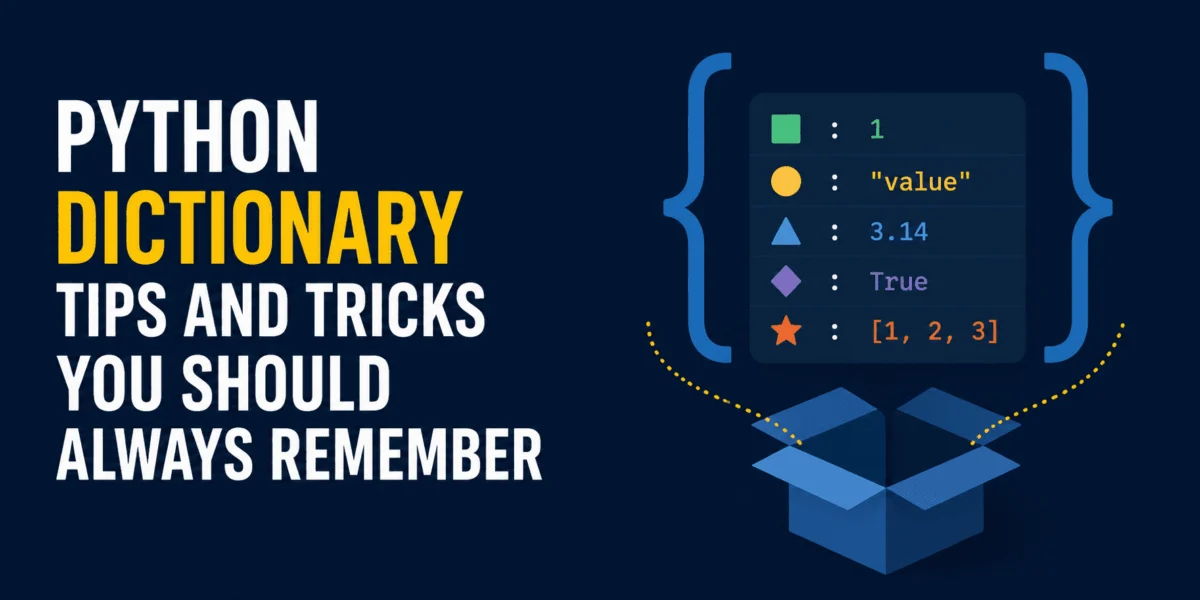
Python dictionaries, fundamental to countless applications from configuration management to sophisticated data structures and API interactions, are far more versatile than their basic operations suggest. While most developers grasp the essentials—creation, key access, and value updates—a deeper dive into advanced techniques is paramount for crafting truly Pythonic, maintainable, and efficient code. This article explores seven pivotal strategies that elevate dictionary usage, ensuring robust and readable solutions in modern Python development.
The Core Techniques for Dictionary Mastery: A Foundational Overview
The ongoing evolution of the Python language continually introduces features designed to streamline common programming patterns and enhance code quality. For dictionaries, these advancements address issues ranging from error handling to data structuring and efficient iteration. The key techniques explored herein represent significant strides in Pythonic development:
- Safe Key Access with
.get(): A method for retrieving values that gracefully handles missing keys, preventing runtime errors. - Streamlined Data Grouping with
collections.defaultdict: An efficient specialized dictionary subclass for aggregating data without explicit key existence checks. - Elegant Dictionary Merging via the
|Operator: A modern, concise syntax for combining dictionaries introduced in Python 3.9. - Efficient Argument Unpacking with ``:** A powerful mechanism to pass dictionary contents as keyword arguments to functions.
- Concise Conditional Assignment using the Walrus Operator (
:=): A Python 3.8 feature that allows assigning values within expressions, simplifying conditional logic. - Enhancing Type Safety with
typing.TypedDict: A static typing construct for defining explicit structures and types for dictionary keys. - Optimized Iteration with
.items(),.keys(),.values(): Best practices for iterating over dictionary components to improve performance and readability.
These techniques, individually and collectively, empower developers to write cleaner, more resilient code, mitigating common pitfalls and embracing Python’s expressive power.
Background and Evolution of Python Dictionaries: A Chronology of Enhancement
The journey of Python dictionaries reflects the language’s continuous commitment to developer experience and performance. From their inception as highly optimized hash maps, dictionaries have remained a cornerstone of Python’s data handling capabilities. Their role expanded significantly with various language enhancements and the introduction of specialized modules.
Early Python Development: Dictionaries were always designed for efficient key-value storage and retrieval, leveraging hash tables for O(1) average-case complexity. This efficiency made them indispensable for mapping, caching, and representing object properties.
The collections Module and defaultdict (Python 2.5 onwards): The collections module, introduced to provide specialized container datatypes, brought defaultdict to the forefront. This subclass of dict simplifies common data aggregation tasks by automatically providing a default value for a key if it does not exist, eliminating the need for boilerplate if key not in dict: checks. This was a significant quality-of-life improvement for tasks like counting frequencies or grouping items, available in Python 2.5 and continuing through Python 3.
Python 3.8: The Walrus Operator and TypedDict: Python 3.8 marked a notable release with two significant additions impacting dictionary usage.
- The Walrus Operator (
:=): Formally known as the assignment expression (PEP 572), this operator allows values to be assigned to variables as part of a larger expression. For dictionaries, this drastically reduces redundancy when a value needs to be retrieved and then evaluated in a conditional statement, particularly with nested structures. Its introduction sparked considerable debate within the community regarding readability, but its utility in specific contexts is undeniable. typing.TypedDict(PEP 589): Introduced as part of thetypingmodule,TypedDictaddressed the growing need for stricter type checking in larger Python projects. While dictionaries are inherently flexible, this flexibility can lead to runtime errors when data structures deviate from expectations.TypedDictallows developers to declare a dictionary’s expected keys and their associated types, enabling static analysis tools like Mypy to catch type mismatches before execution, thereby improving code reliability and maintainability.
Python 3.9: The Dictionary Union Operator (|) (PEP 584): Building on previous methods for merging dictionaries (like dict.update() or ** unpacking), Python 3.9 introduced the | operator for dictionary union and |= for in-place union. This syntax offers a cleaner, more intuitive, and often more performant way to combine dictionaries. It aligns with similar union operations seen in set theory and provides a clear, explicit mechanism for merging, with a defined precedence rule where the right-hand dictionary’s values take precedence in case of key conflicts.
These chronological developments underscore Python’s commitment to providing increasingly robust, expressive, and developer-friendly tools for handling one of its most fundamental data types.
Detailed Exploration of Advanced Dictionary Operations
Secure Access: Leveraging the .get() Method
A common pitfall in Python programming is attempting to access a dictionary key that does not exist, leading to a KeyError and an abrupt program termination. This issue is particularly prevalent when dealing with external data sources like JSON payloads or API responses, where the structure might vary or optional fields might be absent.
Consider a scenario where configuration settings are loaded:
config = "debug": True, "verbose": False
# Attempting to access a non-existent key will raise a KeyError
# print(config["timeout"]) # This line would cause an error
The .get() method offers a robust solution by allowing developers to specify a default value to be returned if the key is not found, preventing errors and providing a graceful fallback.
config = "debug": True, "verbose": False

# Using .get() with a default value
timeout_setting = config.get("timeout", 30)
print(f"Timeout setting: timeout_setting") # Output: Timeout setting: 30

# If the key exists, its value is returned
debug_setting = config.get("debug", False)
print(f"Debug setting: debug_setting") # Output: Debug setting: True
Analysis and Implications: The .get() method is invaluable for handling optional data fields or configurations where a default behavior is acceptable if a specific setting is not provided. It enhances program stability and reduces the need for explicit try-except KeyError blocks, leading to cleaner code. However, it is crucial to understand that if the absence of a key signifies a critical error in application logic, using square bracket access (dict[key]) might be preferable. This allows the KeyError to surface immediately, signaling a fundamental problem that requires resolution rather than silent default substitution.
Streamlining Aggregation: The Power of collections.defaultdict
Aggregating data, such as counting frequencies or grouping items into lists, often involves checking if a key already exists in a dictionary before appending or incrementing its value. This typically results in verbose conditional logic.
Consider counting word frequencies in a list:
words = ["apple", "banana", "apple", "cherry", "banana", "banana"]
counts =

for word in words:
    if word not in counts:
        counts[word] = 0 # Initialize if key doesn't exist
    counts[word] += 1 # Increment
print(counts) # Output: 'apple': 2, 'banana': 3, 'cherry': 1
The collections.defaultdict subclass simplifies this pattern by automatically providing a default value for a key the first time it is accessed. This default value is generated by a "factory function" passed during defaultdict instantiation (e.g., int for 0, list for []).
from collections import defaultdict

words = ["apple", "banana", "apple", "cherry", "banana", "banana"]
counts = defaultdict(int) # int is the factory function, producing 0

for word in words:
    counts[word] += 1 # If 'word' not in counts, counts['word'] becomes 0 before incrementing
print(counts) # Output: defaultdict(<class 'int'>, 'apple': 2, 'banana': 3, 'cherry': 1)

# Example with defaultdict(list) for grouping
data = [('fruit', 'apple'), ('color', 'red'), ('fruit', 'banana'), ('color', 'blue')]
grouped_data = defaultdict(list)
for category, item in data:
    grouped_data[category].append(item)
print(grouped_data) # Output: defaultdict(<class 'list'>, 'fruit': ['apple', 'banana'], 'color': ['red', 'blue'])
Analysis and Implications: defaultdict significantly reduces boilerplate code, making aggregation tasks more concise and readable. It is particularly useful in data processing, log analysis, and any scenario requiring dynamic grouping or counting. Its efficiency stems from avoiding repeated key existence checks, contributing to cleaner and potentially faster code for large datasets.
Elegant Merging: The Dictionary Union Operator (|)
Merging dictionaries was historically achieved through various methods, each with its own quirks or verbosity. Options included dict.update(), using the ** unpacking operator within a new dictionary literal, or manual loops. Python 3.9 introduced the | operator, offering a more intuitive and concise syntax for dictionary union.
defaults = "color": "blue", "size": "medium"
overrides = "size": "large", "weight": "heavy"

# Merging with the | operator creates a new dictionary
merged = defaults | overrides
print(merged) # Output: 'color': 'blue', 'size': 'large', 'weight': 'heavy'

# In-place merging with the |= operator
defaults |= overrides
print(defaults) # Output: 'color': 'blue', 'size': 'large', 'weight': 'heavy'
Analysis and Implications: The | operator provides a clear and idiomatic way to combine dictionaries. A crucial aspect is its precedence rule: when keys overlap, the value from the right-hand dictionary (overrides in the example) takes precedence. This behavior is consistent and predictable, making it ideal for configuration layering or combining datasets where one source’s values should override another’s. The |= operator offers an efficient in-place update when modification of an existing dictionary is desired, avoiding the creation of a new dictionary object. This enhancement simplifies configuration management, data consolidation, and ensures better code readability compared to older methods.
Function Argument Unpacking: The ** Operator
When a function expects several keyword arguments and these arguments are already structured as key-value pairs in a dictionary, manually mapping them can be tedious and error-prone. The ** (double-asterisk) operator provides an elegant solution by unpacking a dictionary’s contents directly into keyword arguments.
Consider a function to create a user profile:
def create_user(name: str, age: int, role: str = "viewer") -> dict:
    return "name": name, "age": age, "role": role

user_data =
    "name": "David",
    "age": 33


# Traditional (and potentially problematic) way
# user = create_user(name=user_data["name"], age=user_data["age"], role=user_data["role"])
# This would raise a KeyError if 'role' is not in user_data

# Using the ** operator for unpacking
user_profile = create_user(**user_data)
print(user_profile) # Output: 'name': 'David', 'age': 33, 'role': 'viewer'
Analysis and Implications: The ** operator dramatically reduces boilerplate code, making function calls cleaner and more expressive. It is particularly useful when passing configuration dictionaries, API payloads, or other structured data to functions. A significant advantage is its graceful handling of default function arguments: if a key present in the dictionary matches a function parameter that also has a default value, the dictionary’s value is used. If the key is not present in the dictionary but the function parameter has a default, the function’s default is automatically applied, enhancing robustness compared to manual indexing which would raise a KeyError. This technique is widely adopted in web frameworks like Django and Flask for handling request parameters.
Concise Conditional Assignment: The Walrus Operator (:=)
Introduced in Python 3.8, the walrus operator (:=) allows assignment of values to variables as part of a larger expression. This feature is particularly useful for dictionaries when a value needs to be retrieved and then evaluated in a conditional statement, avoiding redundant lookups.
Consider retrieving nested user data:
data =
    "user":
        "name": "Bryan",
        "email": "[email protected]"


# Traditional approach (repeats lookup)
if data.get("user") is not None:
    user = data.get("user") # Redundant lookup
    name = user.get("name")
    print(f"User name: name") # Output: User name: Bryan

# Using the walrus operator
if (user := data.get("user")) is not None: # Assigns 'user' and evaluates condition in one step
    name = user.get("name")
    print(f"User name: name") # Output: User name: Bryan

# Example with non-existent user
data_no_user =
if (user := data_no_user.get("user")) is not None:
    print("User found (this won't print)")
else:
    print("No user data found.") # Output: No user data found.
Analysis and Implications: The walrus operator improves code readability and efficiency by eliminating redundant expressions. It shines in scenarios involving conditional logic with dictionary lookups, loop conditions, and list comprehensions where a computed value needs to be used immediately. While powerful, its use should be judicious to maintain code clarity, especially for developers unfamiliar with the syntax. Its formal introduction via PEP 572 highlights the Python core development team’s commitment to enhancing expression capabilities while striving for conciseness.
Structured Data with Type Hints: typing.TypedDict
Python’s dynamic typing offers flexibility, but in larger projects, it can lead to "hidden problems" where dictionaries are expected to conform to a specific structure and type signature, but deviations are only caught at runtime. The typing.TypedDict feature, part of the typing module since Python 3.8, provides a mechanism to declare the expected keys and types for a dictionary.
Consider a simple user profile:
# Without TypedDict, a type mismatch for 'age' might go unnoticed until runtime
def greet(user_dict: dict) -> str:
    # 'age' might be expected as int but could be str
    return f"Hello, user_dict['name']! You are user_dict['age'] years old."

user_data_untyped =
    "name": "Clair",
    "age": "thirty" # This is a string, not an int

print(greet(user_data_untyped)) # Output: Hello, Clair! You are thirty years old. (No error at runtime)
With TypedDict, static type checkers can identify such issues pre-execution:
from typing import TypedDict

class UserProfile(TypedDict):
    name: str
    age: int
    is_active: bool # Can define optional keys using NotRequired from typing_extensions or Optional[type]

def greet_typed(user: UserProfile) -> str:
    return f"Hello, user['name']! You are user['age'] years old."

# This would be flagged by a static type checker like Mypy
user_data_typed: UserProfile =
    "name": "Clair",
    "age": "thirty", # Mypy error: Incompatible types (expression has type "str", TypedDict item "age" has type "int")
    "is_active": True

# print(greet_typed(user_data_typed)) # Would run if Mypy not enforced, but Mypy would warn
Analysis and Implications: TypedDict is a powerful tool for improving the robustness and maintainability of code that deals with structured dictionary data. It acts as a contract for data shapes, making implicit expectations explicit. This significantly enhances code clarity, facilitates collaboration among developers, and boosts the effectiveness of static analysis tools like Mypy. For more complex validation rules, particularly involving nested structures, or when desiring runtime validation, alternative libraries like Pydantic or Python’s dataclasses (potentially with validation hooks) might offer more comprehensive solutions. TypedDict serves as a lightweight yet effective solution for basic structural type checking.
Optimized Iteration: .items(), .keys(), .values()
Iterating over dictionary contents is a frequent operation, but how it’s done can impact both readability and performance. A common, though less efficient, pattern involves iterating over keys and then performing a lookup for each value.
scores =
    "David": 92,
    "Bryan": 87,
    "Clair": 95


# Less efficient iteration (repeated lookup)
print("Scores (less efficient):")
for name in scores:
    print(name, scores[name])
# Output:
# David 92
# Bryan 87
# Clair 95
Python provides specific view objects for iterating over keys, values, or key-value pairs simultaneously, which are more efficient as they avoid redundant dictionary lookups.
# Efficient iteration using .items()
print("nScores (efficient with .items()):")
for name, score in scores.items():
    print(name, score)
# Output:
# David 92
# Bryan 87
# Clair 95

# Iterating only over keys (if values are not needed)
print("nNames (using .keys()):")
for name in scores.keys():
    print(name)
# Output:
# David
# Bryan
# Clair

# Iterating only over values (if keys are not needed)
print("nScores (using .values()):")
for score in scores.values():
    print(score)
# Output:
# 92
# 87
# 95
Analysis and Implications: Using .items(), .keys(), and .values() explicitly improves both code readability and execution efficiency. The .items() method, in particular, is the idiomatic Pythonic way to iterate over both keys and values, preventing the hidden performance cost of repeated dict[key] lookups inside a loop. These methods return dictionary views, which are dynamic: if the dictionary changes, the views reflect those changes. This optimization is crucial in performance-sensitive applications and for processing large dictionaries, reinforcing Python’s emphasis on both clarity and efficiency.
Broader Implications and Best Practices
The mastery of these advanced dictionary techniques extends beyond mere syntax; it fundamentally shapes the quality and efficacy of Python applications.
Enhanced Code Maintainability and Readability: Each of these techniques, from the explicit default handling of .get() to the concise merging with |, contributes to code that is easier to understand, debug, and maintain. Less boilerplate code means less cognitive load for developers.
Increased Robustness and Error Prevention: Features like defaultdict and TypedDict proactively address common error sources. defaultdict prevents KeyError during aggregation, while TypedDict, coupled with static analysis tools like Mypy, catches type mismatches and structural inconsistencies before runtime, significantly reducing the likelihood of production bugs. This shift towards "fail-fast" development through static analysis is a major benefit for complex systems.
Improved Developer Productivity: By offering more concise and expressive ways to handle dictionary operations, these techniques allow developers to focus on core logic rather than boilerplate. The walrus operator, in particular, can streamline conditional assignments, reducing lines of code and making intent clearer in certain contexts.
Ecosystem Impact and Consistency: The widespread adoption of these patterns within Python’s rich ecosystem of libraries and frameworks further solidifies their importance. Understanding them enables developers to work more effectively with popular tools that leverage these idioms. For instance, configuration libraries often utilize merging strategies, and data validation tools build upon the concepts of structured data.
The "Pythonic" Way: Ultimately, these techniques embody the philosophy of writing "Pythonic" code—code that is clear, concise, efficient, and leverages the language’s strengths. While powerful, some features like the walrus operator require careful consideration to ensure they enhance rather than detract from overall readability, especially in team environments where familiarity with newer syntax might vary. The goal is always to strike a balance between conciseness and universal understandability.
Official Endorsement and Community Engagement
The integration of features like the walrus operator, dictionary union, and TypedDict is a testament to the Python community’s vibrant development process, driven by Python Enhancement Proposals (PEPs). These PEPs represent formal design documents outlining new features, their rationale, and technical specifications, serving as the "official statements" from the Python core development team. For instance, PEP 572 (walrus operator), PEP 584 (dictionary union), and PEP 589 (TypedDict) illustrate the rigorous review and consensus-building that precedes language changes.
Furthermore, the enthusiastic adoption of tools like mypy to leverage TypedDict highlights the community’s proactive engagement in improving code quality through static analysis. This collaborative spirit, combining core language evolution with robust tooling, ensures that Python continues to be a leading choice for developers seeking efficient, scalable, and maintainable solutions.
Conclusion
Python dictionaries, seemingly simple, reveal a profound depth through their advanced features. Mastering techniques such as secure key access with .get(), efficient data grouping with defaultdict, the modern | operator for merging, functional unpacking with **, concise assignments via the walrus operator, structural typing with TypedDict, and optimized iteration methods, is not merely about learning new syntax. It is about embracing Python’s design philosophy to write code that is not only functional but also elegant, robust, and highly maintainable. By integrating these practices, developers can significantly elevate the quality and efficiency of their Python projects, ensuring they are well-equipped to tackle the complexities of modern software development.