The rapid ascent of large language models (LLMs) has revolutionized how enterprises interact with vast datasets, with Retrieval-Augmented Generation (RAG) emerging as a cornerstone technology for grounding these models in proprietary and external knowledge. Initially hailed as the standard approach for connecting LLMs with specific documents, RAG’s pattern is elegantly simple: embed a corpus of text, retrieve the most relevant chunks via vector similarity, and inject these into a prompt for the LLM to synthesize an answer. This methodology has proven highly effective in demonstrations and numerous initial production systems, offering a seemingly straightforward path to mitigate LLM hallucinations and provide contextually accurate responses. However, as RAG systems scale and encounter the complexities of real-world enterprise environments, a predictable set of failure modes has begun to surface, prompting a critical re-evaluation of its universal applicability and driving the search for more robust, nuanced alternatives.
The Promise and Pitfalls of Initial RAG Implementations
At its core, RAG was designed to overcome a fundamental limitation of LLMs: their knowledge cutoff and propensity to generate plausible but factually incorrect information (hallucinations). By providing an LLM with external, retrieved information at the time of inference, RAG aimed to ensure that responses were grounded in specific, verifiable data. This hybrid approach—combining the generative power of LLMs with the precision of information retrieval—quickly gained traction across industries, from customer support chatbots to internal knowledge management systems. The early success stories fueled widespread adoption, leading many organizations to invest heavily in building RAG pipelines, often centered around vector databases and embedding models.
However, the simplicity that made RAG appealing also masked inherent complexities that manifest acutely in production environments. The "pattern is simple" — embed, retrieve, inject — belies the nuanced challenges of information relevance, temporal validity, and contextual coherence when dealing with dynamic, heterogeneous, and often contradictory corporate knowledge bases. The initial euphoria surrounding RAG is now giving way to a more pragmatic understanding of its limitations, particularly as enterprises push these systems beyond their proof-of-concept stages into mission-critical operations. This shift in perspective is crucial for understanding why many organizations are now exploring advanced architectural patterns.
Unmasking RAG’s Production Failures: Retrieval Irrelevance and Context Poisoning

The most prevalent failure pattern encountered in production RAG systems is retrieval irrelevance. This occurs when a user’s query, despite sharing vocabulary with multiple documents, fails to retrieve content that is truly relevant to the intent of the question. Consider a user querying a parental leave policy. A standard vector similarity search might retrieve not only the current 2024 policy but also an outdated 2022 version and a cultural blog post discussing work-life balance. Each of these documents might score high on embedding distance due to shared keywords like "parental," "leave," and "policy." Yet, none of them might provide the precise, up-to-date information the user actually needs. The LLM, unaware that the retrieved content is outdated or off-topic, then confidently blends these chunks into a detailed answer that is factually incorrect. This scenario highlights a critical flaw: topical similarity does not automatically equate to factual relevance, a dominant failure mode in many scaled RAG deployments.
A more subtle, yet equally damaging, failure mode is context poisoning. Enterprise knowledge bases frequently contain multiple versions of the same policy document, or even conflicting information across different departmental guidelines. When a retriever, through its vector search, returns chunks from both contradictory sources, the LLM often fails to identify or surface the inherent contradiction. Instead, it might pick one version, blend aspects of both, or synthesize a confident, seemingly coherent answer that is fundamentally flawed. Neither the user nor the model is aware of the underlying factual inconsistency, leading to potentially critical errors in decision-making or information dissemination. This issue underscores the challenge of maintaining data integrity and consistency within a RAG framework.
The root cause of these retrieval challenges often lies in a structural conflict inherent to the chunk-embed-retrieve pipeline: the chunk size dilemma. Effective recall (the ability to retrieve all relevant pieces of information) often necessitates small, focused chunks, typically around 100 to 256 tokens. Smaller chunks are more precise for vector matching. However, good context understanding by the LLM requires larger chunks, often 1,024 tokens or more, to maintain coherence, provide sufficient background, and allow the model to grasp the broader narrative or argument. Every RAG designer faces this trade-off: prioritize granular retrieval at the risk of losing context, or prioritize context at the risk of less precise retrieval. There is no single optimal chunk size that satisfies both requirements across all types of queries and documents, forcing a compromise that inevitably leads to suboptimal performance in specific scenarios.
The Peril of Over-Engineering: Rising Costs and Diminished Returns
When standard RAG systems underperform, a common, yet often counterproductive, response is to introduce greater complexity. This might involve adopting higher-dimensional embeddings, deploying more sophisticated reranking algorithms, or implementing multi-step retrieval processes. While these techniques can offer marginal improvements in specific contexts, they frequently compound the existing problems by increasing computational overhead, escalating costs, and delaying the fundamental architectural re-evaluation that might be truly needed.
The financial and operational ramifications of over-engineered RAG systems are substantial. A recent case study involving a global manufacturing company highlighted this issue starkly: an initial budget of $400,000 for a RAG system ballooned to $1.2 million in the first year alone. Despite this significant investment, the final accuracy on technical documentation queries remained a dismal 23%, ultimately leading to the project’s termination. Similarly, a healthcare enterprise reported vector database costs soaring to $75,000 per month by month six, demonstrating how scaling these systems without addressing core architectural flaws can quickly become economically unsustainable. These individual anecdotes reflect a broader, alarming trend: enterprise RAG implementations reportedly faced a 72% first-year failure rate in 2025. This statistic, if extrapolated, indicates a widespread challenge in deploying RAG effectively at scale, signaling that many organizations are struggling to achieve positive ROI from their investments.

The belief that simply increasing embedding dimensions or employing more sophisticated vector models will automatically resolve performance issues is often misguided. While advanced models can offer finer-grained semantic understanding, their benefits are often outweighed by increased compute costs and latency, particularly if the underlying retrieval architecture remains fundamentally ill-suited for the task. The more critical question, often overlooked amidst the pursuit of marginal gains, is whether the retrieval architecture itself was the appropriate choice for the specific problem domain in the first place. This introspection is vital for avoiding costly, complex solutions that fail to address the root causes of RAG’s limitations.
Emerging Paradigms: Intelligent Alternatives to Traditional RAG
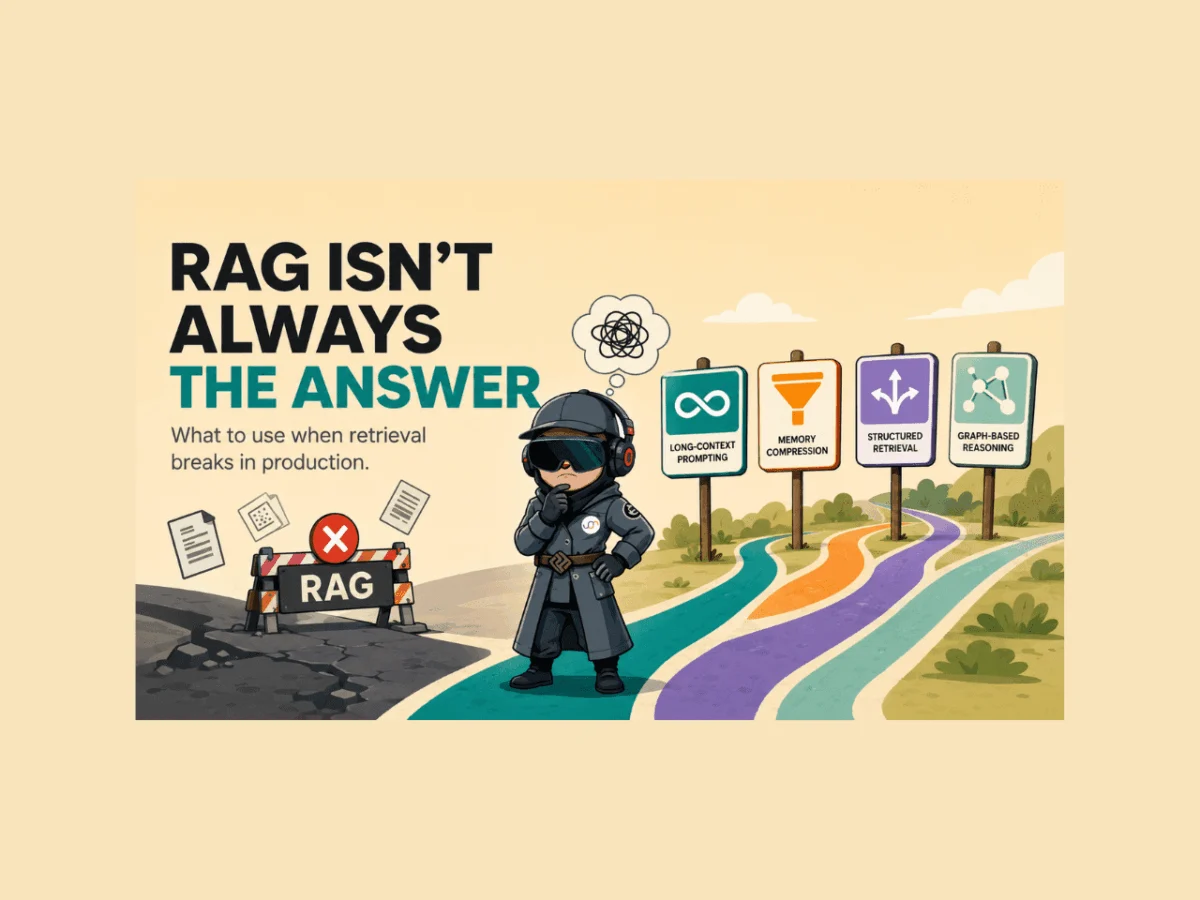
As the limitations of conventional RAG become more apparent, the industry is pivoting towards more intelligent, adaptive, and specialized architectures. These alternatives recognize that a one-size-fits-all approach is insufficient for the diverse demands of enterprise AI.
1. Long-Context Prompting: When Simplicity Prevails
The most direct alternative to an over-engineered RAG pipeline, surprisingly, is to bypass retrieval entirely. For scenarios where the entire corpus of relevant information can fit within the LLM’s extended context window, simply loading the data and allowing the model to "read" it often proves more effective. A benchmark study published in 2025 found that long-context LLMs consistently outperformed RAG on complex Question Answering (QA) tasks when sufficient compute resources were available, with chunk-based retrieval methods lagging significantly.
The primary trade-off with long-context prompting is cost and latency. Processing 1 million tokens, for instance, can incur latencies 30 to 60 times slower than a typical RAG pipeline and cost roughly 1,250 times more per query. However, for high-traffic applications, prompt caching mechanisms can significantly reduce these costs, making long-context solutions more economically competitive. A practical decision rule emerges: if the corpus fits within the context window and the query volume is moderate, long-context prompting offers a cleaner, potentially more accurate starting point. Retrieval is then introduced only when the corpus exceeds the LLM’s context capacity, latency requirements are stringent, or query volume reaches an economic break-even point. This approach emphasizes leveraging the LLM’s inherent capabilities rather than forcing a retrieval layer where it’s not strictly necessary.

2. Memory Compression and Summarization-Based Retrieval: Efficiency Through Condensation
When the corpus is too extensive for a single context window, an intelligent strategy is to summarize documents before retrieval. This summarization-based retrieval compresses the raw information, distilling key points or entire documents into more manageable, coherent summaries, which are then injected into the LLM. Benchmarks indicate that this approach performs comparably to full long-context methods, significantly outperforming traditional chunk-based retrieval.
A concrete example illustrates this efficacy: an order-preserving RAG approach utilizing 48,000 carefully chosen tokens achieved a 13 F1-point improvement over full-context retrieval with 117,000 tokens, all while using one-seventh of the token budget. This highlights a crucial insight: a well-compressed, highly relevant document summary is far more valuable to an LLM than a raw dump of tangentially related, fragmented chunks. Memory compression techniques, therefore, offer a path to both efficiency and accuracy by optimizing the quality and density of information presented to the LLM.
3. Structured and Adaptive Retrieval: Routing by Query Type
When retrieval is undeniably the appropriate architecture, the solution lies not in uniformly applying "better" embeddings, but in intelligently routing queries based on their inherent type and complexity. Research presented at EMNLP 2024 introduced "Self-Route," a system where an LLM first classifies whether a query requires full contextual understanding or a focused factual lookup. Simple factual lookups can then be directed to a lean, efficient RAG system, while complex multi-hop questions requiring global understanding are routed to a long-context model or a more sophisticated retrieval strategy.
This adaptive, hybrid approach has demonstrated significant improvements. Adaptive systems employing hybrid search and reranking have shown 15% to 30% retrieval precision improvements. The core innovation here is making the routing explicit: every query is classified before any retrieval runs, ensuring that the system moves beyond treating all queries as identical embedding problems. This allows for a more tailored and efficient use of resources, combining the strengths of different architectural patterns.

4. Graph-Based Reasoning (GraphRAG): Navigating Complex Relationships
For queries that demand an understanding of relationships and connections across a dataset, rather than merely fetching specific passages, traditional vector retrieval fundamentally fails by design. These are the "multi-hop" questions: "Which decisions did the board reverse in Q3, and what was the stated reason each time?" No single chunk of text will provide this answer; the information resides in the interconnections between various documents, meeting minutes, and policy updates.
To address this, Microsoft Research introduced GraphRAG in 2024. This innovative system constructs a knowledge graph from the entire corpus, then traverses entity relationships to answer queries, rather than relying on vector matching. By representing information as nodes (entities) and edges (relationships), GraphRAG can infer complex answers that require synthesis across multiple documents and relational reasoning. This directly tackles the failure case that standard RAG cannot handle: the need for deep, interconnected understanding.
The trade-off for this advanced capability is increased cost and complexity. Knowledge graph extraction and maintenance can be 3 to 5 times more expensive than baseline RAG and often requires domain-specific tuning to ensure accuracy and completeness. GraphRAG is justified for high-value applications demanding thematic analysis, trend identification, or complex multi-hop reasoning. For simple, single-passage factual lookups, its overhead is unwarranted, underscoring the importance of matching the solution to the problem.
Strategic Implications for Enterprise AI Development
The evolving landscape of RAG and its alternatives offers critical lessons for enterprises building LLM-powered applications. The era of assuming RAG as a universal panacea is drawing to a close, giving way to a more sophisticated understanding of architectural choices.

Firstly, architectural flexibility is paramount. Organizations must cultivate a toolkit of approaches, moving beyond a single, monolithic RAG design. This means evaluating each use case against a spectrum of solutions, from long-context prompting to graph-based reasoning, considering factors like corpus size, query complexity, latency requirements, and cost constraints.
Secondly, data quality and governance become even more critical. The issues of retrieval irrelevance and context poisoning highlight the importance of clean, consistent, and well-structured data. Investing in robust data pipelines, version control for documents, and semantic enrichment can significantly improve the performance of any retrieval system.
Thirdly, cost-benefit analysis must be integrated into every stage of development. The high failure rates and escalating costs associated with over-engineered RAG systems demonstrate that complexity does not automatically equate to efficacy. A clear understanding of the economic break-even points for different architectures is essential for sustainable deployment.
Finally, the focus is shifting towards intelligent query understanding and routing. Treating every query as an identical embedding problem is a limitation. Systems that can dynamically classify query intent and route it to the most appropriate retrieval or generative mechanism will be key to building highly accurate, efficient, and scalable LLM applications.
Conclusion
Retrieval-Augmented Generation remains a reasonable and effective default for many LLM use cases. Its initial success has undeniably pushed the boundaries of what LLMs can achieve in practical applications. However, its predictable failure modes—retrieval irrelevance, context poisoning, and structural limitations inherent in the chunk-size dilemma—demand a more sophisticated approach. Attempting to solve these issues by merely adding complexity to a flawed retrieval design often exacerbates the problems, leading to prohibitive costs and diminishing returns.

The path forward involves a diverse and intelligent architectural toolkit:
- Long-context prompting for smaller, self-contained corpora where raw processing is feasible.
- Memory compression for larger corpora requiring efficient summarization before retrieval.
- Structured and adaptive retrieval through intelligent query routing to match the retrieval mechanism to the query type.
- Graph-based reasoning for complex, multi-hop questions demanding relational understanding.
The fundamental insight is to match the architecture to the query type and data characteristics, rather than imposing a single solution uniformly. By embracing these advanced alternatives and understanding the nuanced strengths and weaknesses of each, enterprises can move beyond the current limitations of RAG, building more resilient, accurate, and cost-effective LLM-powered systems for the future.
Nate Rosidi is a data scientist and in product strategy. He’s also an adjunct professor teaching analytics, and is the founder of StrataScratch, a platform helping data scientists prepare for their interviews with real interview questions from top companies. Nate writes on the latest trends in the career market, gives interview advice, shares data science projects, and covers everything SQL.