

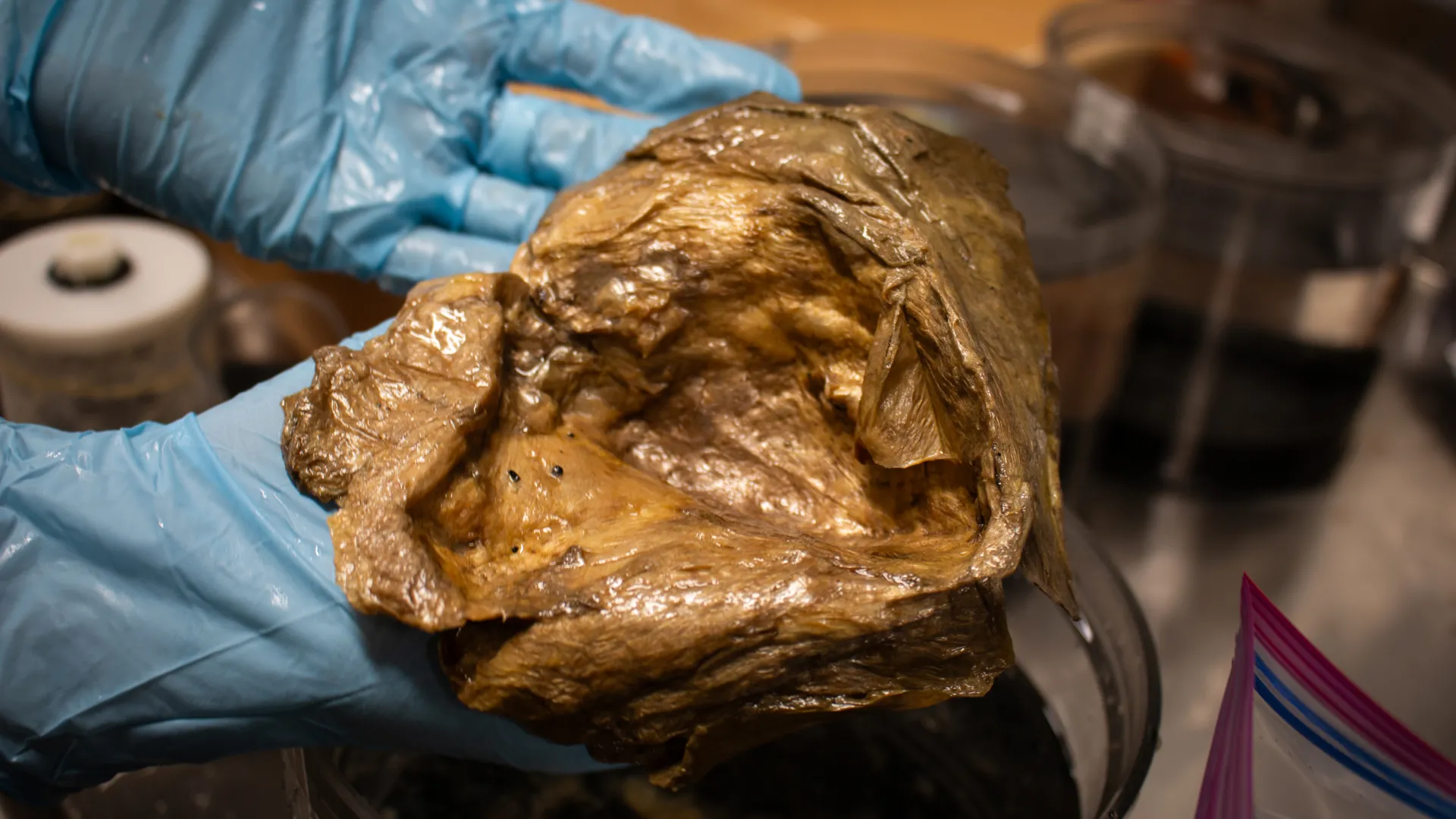
A captivating enigma that emerged from the abyssal depths of the Gulf of Alaska, the so-called "golden orb," has finally surrendered its secrets. Collected during a 2023 NOAA expedition, this peculiar, lustrous object baffled scientists for over two years, sparking widespread public fascination. Now, after a rigorous and multi-faceted investigation, researchers have definitively identified it as the calcified remnants of a colossal deep-sea anemone, specifically a portion of the base from the species Relicanthus daphneae. This revelation not only solves a lingering scientific mystery but also underscores the vast, unexplored biodiversity that lies hidden within Earth’s deepest oceans.
Genesis of a Deep-Sea Mystery: The 2023 NOAA Expedition
The initial encounter with the "golden orb" occurred on a routine deep-sea exploration mission aboard the NOAA Ship Okeanos Explorer in 2023. Utilizing the remotely operated vehicle (ROV) Deep Discoverer, the scientific team was meticulously surveying the seafloor at an astonishing depth of 3,250 meters (approximately 2.1 miles) in a less-charted region of the Gulf of Alaska. It was during this exploration that the ROV’s high-definition cameras captured an image of an unusual, rounded, golden-hued object resting serenely on a rocky outcrop. Its distinct shape, featuring a small, discernible opening, immediately set it apart from known geological formations or biological specimens encountered in such extreme environments.
The appearance of the orb ignited a flurry of hypotheses among the onboard scientists. Initial speculations ranged from the possibility of an exotic egg case laid by an unknown marine creature, to a unique type of sponge, or perhaps an entirely novel organism. The presence of the opening further fueled imaginations, leading to discussions about whether a creature might have inhabited, or recently exited, the structure. This element of the unknown, coupled with its striking visual appearance, quickly propelled the "golden orb" into the public consciousness, becoming a symbol of the enduring mysteries of the deep sea.
To unravel this puzzle, the expedition team employed the ROV’s sophisticated manipulator arm to carefully collect the object using a precision suction sampler. This delicate operation ensured the specimen was preserved as intact as possible for subsequent analysis. The precious cargo was then meticulously transported to the Smithsonian National Museum of Natural History (NMNH) in Washington D.C., a leading institution renowned for its expertise in taxonomic research and the study of biological specimens.
The Long Road to Identification: A Multi-Disciplinary Approach
The journey from discovery to definitive identification was far from instantaneous. Unlike many routine identifications that can be resolved through established protocols and readily available comparative data, the "golden orb" presented a significant challenge, demanding a more protracted and specialized scientific endeavor. This prolonged period of investigation is a testament to the complexity of deep-sea biology and the advanced techniques required to decipher its intricacies.
Dr. Allen Collins, a distinguished zoologist and director of NOAA Fisheries’ National Systematics Laboratory, located within the Smithsonian, recalled the initial stages of the investigation. "We routinely handle hundreds of different samples, and my initial expectation was that our standard analytical processes would swiftly demystify the orb," Dr. Collins stated. "However, this particular specimen proved to be an exceptional case, necessitating a focused and collaborative effort involving individuals with highly specialized skill sets. It evolved into a complex mystery that required the combined expertise of morphological, genetic, deep-sea, and bioinformatics specialists to ultimately unravel."
The scientific team adopted an integrative taxonomic approach, a robust methodology that merges traditional morphological examinations with cutting-edge genetic analysis. This comprehensive strategy is often employed when dealing with poorly understood or unique specimens. Early microscopic examinations revealed that the object lacked the typical anatomical features associated with many common marine invertebrates. Instead, it exhibited a layered structure composed of fibrous material, notably containing numerous cnidocytes – the characteristic stinging cells found in cnidarians, a phylum that includes corals, jellyfish, and anemones. This initial finding strongly suggested a cnidarian origin.
Further in-depth microscopic analysis, spearheaded by Abigail Reft, a scientist at the National Systematics Lab, identified the specific type of stinging cells present as spirocysts. Spirocysts are particularly significant as they are a distinguishing feature of the Hexacorallia subgroup within cnidarians. This finding narrowed the potential identity of the organism considerably. Crucially, during this phase, researchers discovered that a similar, albeit slightly different, object had been collected during a 2021 expedition by the Schmidt Ocean Institute’s Research Vessel Falkor. Comparative studies revealed matching cellular structures between the two specimens, indicating a potential commonality or relatedness.
Unlocking the Genetic Code: Whole-Genome Sequencing as the Key
While morphological clues pointed towards a cnidarian, definitive identification remained elusive. Initial attempts at DNA barcoding, a standard genetic identification technique, proved inconclusive. Scientists theorized that the sample might have been contaminated with genetic material from other microscopic organisms prevalent in the deep-sea environment, or that the DNA itself had degraded over time, hindering effective barcoding.
To overcome these challenges, the research team escalated their efforts to whole-genome sequencing. This advanced technique involves sequencing the entire genetic makeup of an organism, providing a far more comprehensive and robust dataset for identification. The results of this deep-dive genetic analysis were transformative. The sequencing confirmed the presence of animal DNA and, most importantly, revealed a striking genetic affinity to the giant deep-sea anemone species Relicanthus daphneae.
Subsequent sequencing of mitochondrial genomes from both the 2023 "golden orb" specimen and the similar object recovered in 2021 showed them to be nearly identical to a known reference genome for Relicanthus daphneae. This genetic evidence provided the irrefutable confirmation that the mysterious orb was indeed linked to this elusive deep-sea giant.
The True Identity Revealed: More Than Just a ‘Golden Orb’
With the combined weight of morphological and genetic evidence, the scientific community could finally definitively state what the "golden orb" was not: it was not an egg case, not a sponge, and certainly not an unknown, extraterrestrial entity. Instead, the object was identified as a calcified, desiccated remnant of the basal structure of a Relicanthus daphneae anemone. This base is the specialized part of the anemone that anchors the organism to hard substrates on the seafloor, enabling it to maintain its position in the often-turbulent deep-sea environment. The golden hue is likely attributed to mineral deposits and the unique composition of the tissue that has persisted over time in the deep-sea conditions.
The Relicanthus daphneae, commonly known as the giant tube anemone, is a remarkable species. It is characterized by its immense size, with some individuals reaching lengths of up to 2 meters (approximately 6.5 feet), and its distinctive tubular body. These anemones are sessile, meaning they remain fixed in one place, and are typically found attached to rocky outcrops or the remains of sunken whale carcasses, which provide essential nutrients. Their existence in the extreme pressures, perpetual darkness, and frigid temperatures of the deep ocean highlights the incredible adaptability of life on Earth.
Implications and the Unending Frontier of Deep-Sea Exploration
The resolution of the "golden orb" mystery is more than just the solution to a captivating puzzle; it serves as a potent reminder of the immense gaps in our understanding of the deep ocean. This vast realm, covering over 70% of our planet’s surface, remains largely unexplored, with estimates suggesting that less than 5% has been systematically mapped and studied. Each expedition into these abyssal plains and trenches has the potential to reveal new species, novel ecosystems, and previously unimagined biological processes.
CAPT William Mowitt, acting director of NOAA Ocean Exploration, emphasized the significance of such discoveries. "So often in deep ocean exploration, we encounter these captivating mysteries, much like the ‘golden orb’," CAPT Mowitt commented. "With the continuous advancement of sophisticated techniques, such as DNA sequencing, we are increasingly empowered to solve more and more of these enigmas. This is precisely why we persist in our exploration efforts – to unlock the secrets of the deep, to foster a deeper comprehension of how our oceans and their invaluable resources can drive economic growth, bolster our national security, and ultimately, sustain our planet’s delicate ecological balance."
The identification of the "golden orb" also has broader implications for marine biology and conservation. Understanding the distribution, life cycles, and ecological roles of deep-sea organisms like Relicanthus daphneae is crucial for effective management and protection of these vulnerable environments. As human activities, including deep-sea mining and fishing, increasingly encroach upon these previously undisturbed areas, detailed scientific knowledge becomes indispensable for informed decision-making and the prevention of irreversible ecological damage.
The case of the "golden orb" exemplifies the collaborative spirit and scientific rigor that define modern oceanographic research. It highlights the synergy between different scientific disciplines, from ROV operations and specimen collection to advanced genetic analysis and taxonomic expertise. While this particular mystery has been laid to rest, the deep sea continues to be a frontier brimming with untold stories, waiting for the next expedition, the next technological leap, and the next dedicated team of scientists to bring its hidden wonders to light. The ongoing exploration of the deep ocean is not merely an academic pursuit; it is an essential endeavor for understanding our planet, its biodiversity, and its capacity to support life, including our own. The "golden orb," once a symbol of the unknown, now stands as a testament to humanity’s persistent curiosity and our growing ability to decipher the profound mysteries of Earth’s final frontier.















Leave a Reply