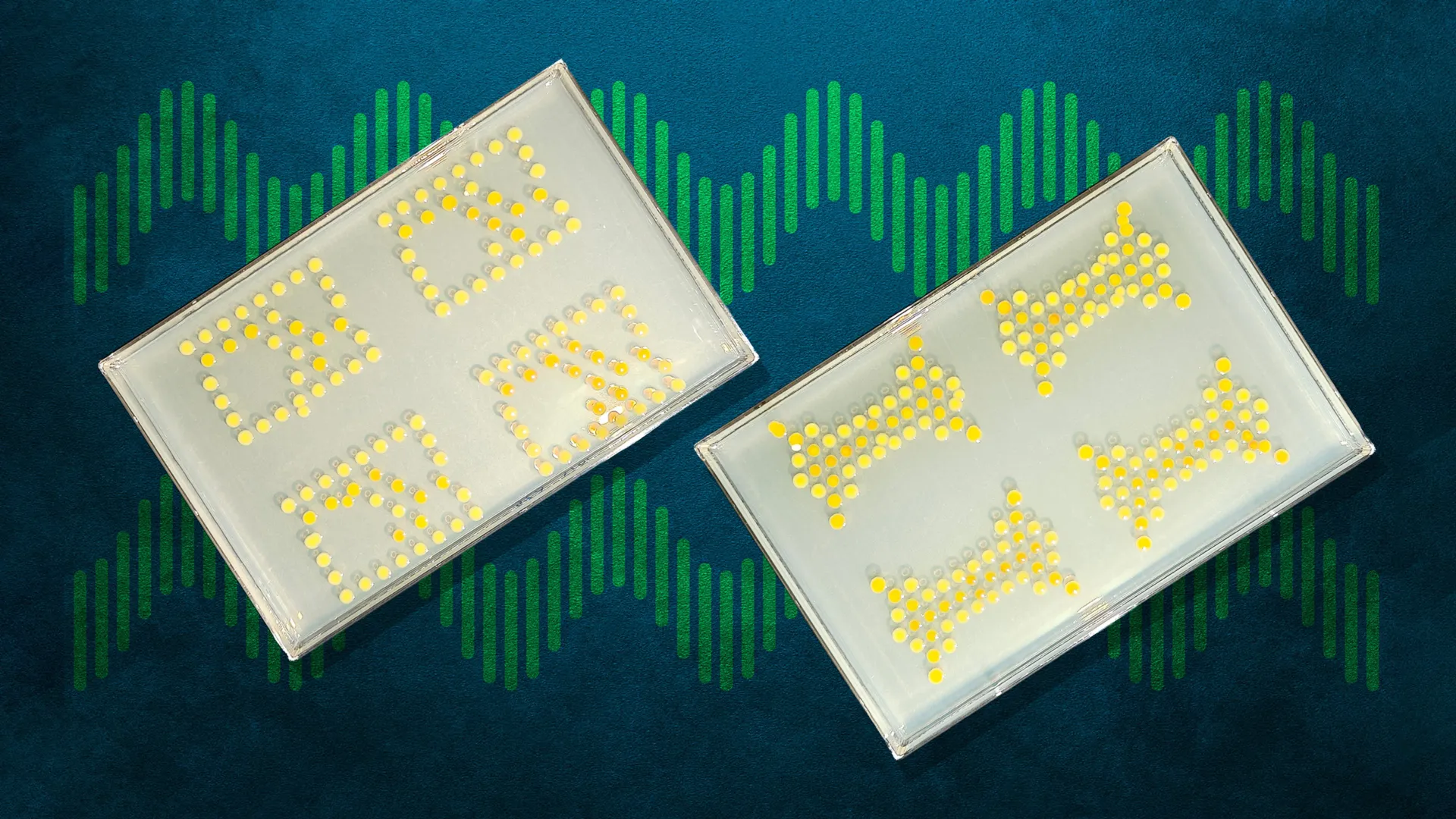
In a landmark development for the field of synthetic biology, researchers at the Massachusetts Institute of Technology (MIT) have successfully engineered bacterial cells to function as biological transistors, effectively transforming Petri dishes into living, programmable circuit boards. By repurposing the natural chemical signaling mechanisms of Pantoea agglomerans, the research team has moved beyond the traditional limitations of single-cell computation, demonstrating that complex logic operations can be achieved by interconnecting distinct bacterial colonies. This breakthrough, published in the journal Nature Chemical Biology, represents a paradigm shift in how scientists approach biological control, moving from internal cellular programming to the construction of modular, multi-cellular systems that mimic the architecture of modern silicon electronics.
The research team, led by Christopher Voigt, head of MIT’s Department of Biological Engineering, along with lead author and postdoc Hamid Doosthosseini and former postdoc Haorong Chen, posits that this modular approach overcomes the "complexity ceiling" that has long plagued synthetic biology. For decades, researchers have attempted to build sophisticated circuits by packing all necessary genetic components into a single cell. However, this strategy is inherently limited by the cell’s internal machinery, which can only support a finite number of transcription factors before protein production becomes overwhelmed, leading to signal cross-talk and system failure.
The Evolution of Biological Computation
The history of synthetic biology is characterized by a gradual move toward higher levels of abstraction. In the early 2000s, scientists focused on creating simple "toggle switches" and "oscillators" within a single bacterial cell. While these early experiments proved that biological systems could be programmed, they lacked the scalability required for meaningful real-world applications. By 2010, the field had advanced to developing logic gates—AND, OR, and NOT gates—using genetic circuits. Yet, these systems remained confined, struggling to process more than a handful of inputs without degrading in performance.
The MIT team’s new architecture represents a departure from this "single-cell" model. By distributing the computational burden across multiple bacterial strains—specifically two versions of transistors and three types of relays—the researchers have created a system that is, in principle, as computationally versatile as a conventional silicon-based processor. The "transistor" strains are engineered to respond to specific signaling molecules, namely OC 6 and OC 12, while the "relay" strains facilitate the transmission of an output molecule, OHC 14, to subsequent components. This design allows for the construction of circuits that can add multiple inputs or direct information toward specific biological "outputs."
Structural Mechanics of the Living Circuit
The construction process for these living circuits is as much a matter of spatial engineering as it is genetic design. The researchers utilize 3D-printing-like techniques to deposit specific bacterial colonies onto agar growth media. By maintaining a precise distance of approximately 5 millimeters between colonies, the team ensures that chemical signals travel in a controlled, directional flow. This spatial layout mimics the physical pathways on a motherboard, where copper traces dictate the movement of electrical current.
In this biological system, the "current" is represented by the diffusion of signaling molecules. When a transistor strain receives an input signal, it either allows the passage of a molecule or blocks it, mirroring the binary switching behavior of an electronic transistor. The inclusion of relay strains provides the necessary "amplification" and signal conversion, allowing the system to maintain signal integrity across a 24-colony array, which remains the largest circuit demonstrated in this study to date.
Comparative Analysis: Biology vs. Silicon
While the computational capacity of these bacterial circuits is theoretically broad, the temporal scale of their operation differs drastically from conventional computing. A modern smartphone processor performs billions of cycles per second, whereas a biological circuit in the MIT study requires approximately eight hours to complete a single logical calculation.
However, experts in the field note that this comparison may be fundamentally flawed due to the different intended environments. Electronic circuits are designed for high-speed, localized processing in controlled, hardware-dense environments. In contrast, biological circuits are designed for decentralized, autonomous operation in dynamic, real-world environments such as soil, plant tissues, or the human microbiome. In these contexts, the "eight-hour cycle" is not a latency issue, but rather an appropriate timeframe for biological processes like plant growth or environmental adaptation.
Agricultural and Environmental Implications
The potential applications for this technology are particularly significant in the agricultural sector. As global food security faces threats from climate change, soil degradation, and pest outbreaks, the ability to deploy "smart" biological systems on crops could provide a new layer of protection.
If these engineered bacterial circuits were successfully integrated into the rhizosphere—the area of soil surrounding a plant’s roots—they could act as a sophisticated diagnostic and response system. For instance, a circuit could be programmed to monitor moisture levels (drought stress) or detect chemical signatures of specific pathogens. Once the circuit processes this information, it could trigger the bacteria to produce a protective fungicide or a growth-promoting hormone, effectively allowing the plant to self-medicate in response to its environment.
Beyond agriculture, the broader implications include the development of "sentinel" bacteria capable of monitoring water quality in real-time, or therapeutic bacteria that could be deployed within the human gut to identify and respond to inflammatory markers, potentially revolutionizing the treatment of chronic autoimmune conditions.
Strategic Funding and Future Trajectory
The research has received substantial backing from the U.S. government, with funding provided by the Defense Advanced Research Projects Agency (DARPA) and the Intelligence Advanced Research Projects Activity (IARPA). This interest underscores the strategic importance of biological computing for national security, ranging from environmental monitoring to advanced material manufacturing.
The next phase of the research, according to the team, will involve scaling the number of interconnected colonies and refining the signal-to-noise ratio within the circuits. Furthermore, the team aims to transition these circuits from the controlled environment of a Petri dish to more complex, multi-species environments. This will require overcoming the challenge of "genetic stability"—ensuring that the engineered strains can persist in a competitive, non-sterile environment without being outcompeted by wild-type bacteria.
Expert Perspective on the Breakthrough
While the academic community has largely praised the study, independent researchers emphasize the challenge of long-term persistence. Dr. Elena Rodriguez, a systems biologist not involved in the study, notes that "the MIT team has provided the ‘architecture’ for biological computing, but the ‘operating system’—the ability for these circuits to run reliably in the wild over months or years—remains the next great frontier. The hurdle is not just building the logic, but maintaining the genetic integrity of the circuits against evolutionary pressure."
Despite these challenges, the MIT study serves as a proof-of-concept that the fundamental principles of computing are not restricted to silicon. By leveraging the inherent complexity of life, researchers are successfully bridging the gap between biological systems and engineering. As the precision of CRISPR and other gene-editing tools continues to improve, the ability to "wire" these living components will likely become a standard tool in the biotechnological toolkit, potentially ushering in an era where the boundary between organic matter and digital logic is effectively erased.
As the paper concludes, the team remains optimistic about the pace of progress. By linking simpler, robust functions into more complex networks, the researchers believe they have established a scalable foundation. Whether these systems will eventually perform complex calculations on a scale comparable to traditional computers is perhaps less important than their ability to bring sophisticated, automated decision-making to the biological world. For a farmer observing a field of crops, the "overnight" computation of a bacterial circuit might be the difference between a successful harvest and a total crop failure, proving that in the right context, biological time is not just sufficient—it is ideal.