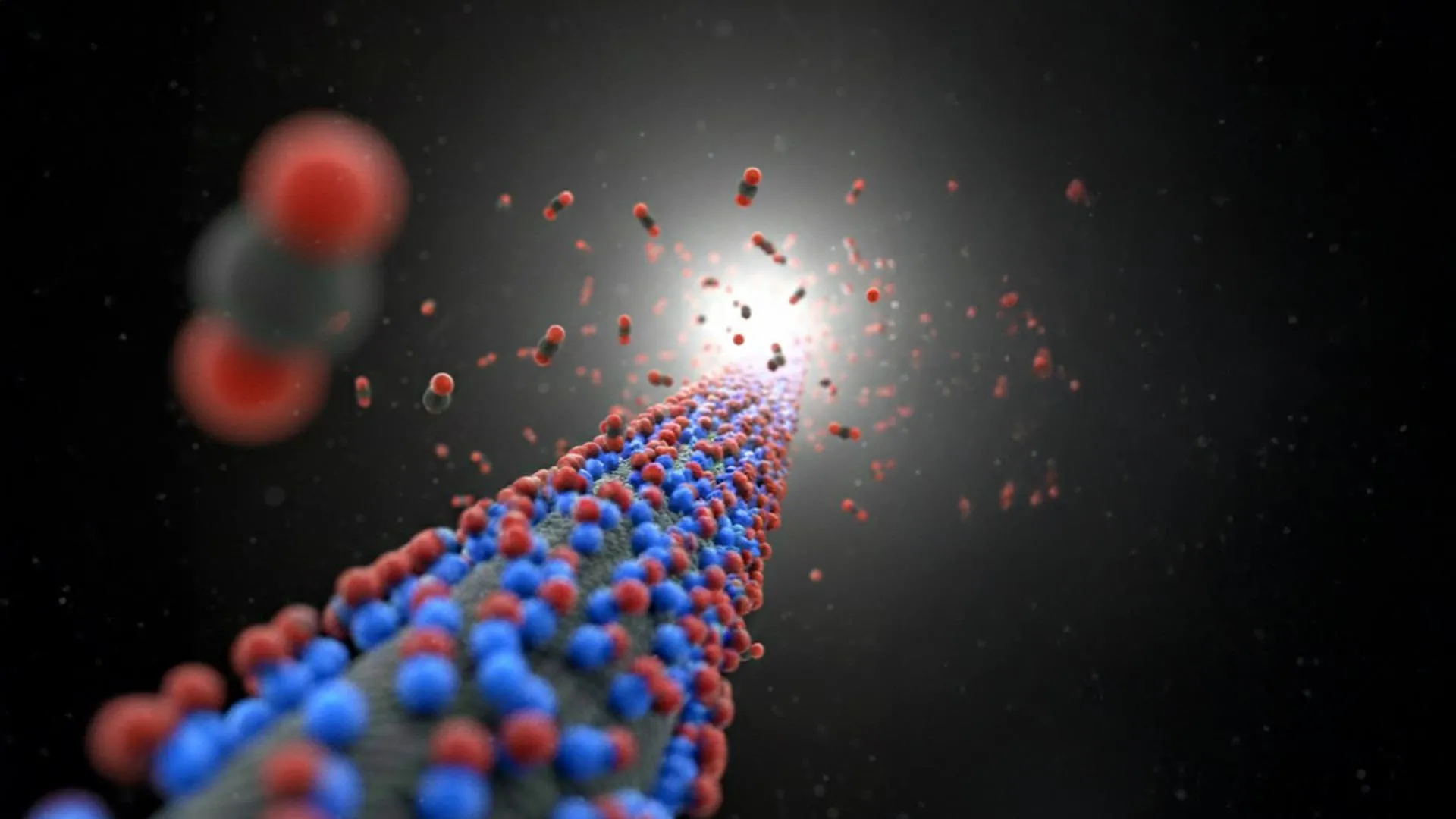
The global effort to mitigate the escalating effects of climate change has reached a critical juncture, with carbon capture and storage (CCS) emerging as a cornerstone of international environmental policy. While the theoretical framework for capturing carbon dioxide (CO2) before it enters the atmosphere has existed for decades, the practical application of these technologies has been hampered by significant economic and energetic hurdles. In a transformative development published in the journal Carbon, a research team at Chiba University in Japan has unveiled a new class of carbon materials dubbed "viciazites." These materials, engineered with molecular-level precision, represent a potential paradigm shift in how industrial facilities might soon strip greenhouse gases from their emissions at a fraction of the current energy cost.
The project, spearheaded by Associate Professor Yasuhiro Yamada from the Graduate School of Engineering and Associate Professor Tomonori Ohba from the Graduate School of Science, addresses the primary bottleneck of carbon capture: the "energy penalty." By designing carbon structures where nitrogen-based functional groups are positioned in specific, adjacent pairings, the team has created a material that can capture CO2 efficiently and, more importantly, release it for storage at temperatures as low as 60°C.
The Industrial Challenge: Beyond Aqueous Amine Scrubbing
For years, the gold standard for industrial carbon capture has been aqueous amine scrubbing. This process involves passing flue gas through a liquid solution containing amines—organic compounds derived from ammonia. While effective at binding with CO2, the process is notoriously energy-intensive. To "regenerate" the solution—releasing the captured CO2 so the liquid can be reused—the entire volume must be heated to temperatures exceeding 100°C.
In the context of a large-scale power plant or manufacturing facility, the energy required to maintain these temperatures represents a massive operational expense. This "parasitic load" can consume up to 30% of a power plant’s total energy output, significantly reducing efficiency and driving up the cost of electricity. Furthermore, amine solutions are often corrosive to equipment and can degrade over time into toxic byproducts, necessitating careful handling and frequent replacement.
As the Intergovernmental Panel on Climate Change (IPCC) emphasizes the need for rapid decarbonization to limit global warming to 1.5°C, the search for solid-state alternatives has intensified. Solid carbon materials, such as activated carbon or biochar, offer a more sustainable path. They are generally cheaper to produce, more chemically stable, and possess immense surface areas—often exceeding 1,000 square meters per gram—providing ample space for CO2 molecules to adhere.
The Science of Nitrogen Doping and the Viciazite Breakthrough
The effectiveness of carbon-based sorbents is largely determined by "doping"—the process of introducing other elements, like nitrogen, into the carbon lattice to create active sites for CO2 adsorption. Nitrogen groups are particularly effective because they are basic, and CO2 is slightly acidic, creating a natural chemical affinity.
However, traditional manufacturing techniques for nitrogen-doped carbons have lacked precision. Most methods result in a random distribution of nitrogen atoms across the carbon surface. This randomness makes it impossible for scientists to determine which specific atomic arrangements are responsible for high performance. It also limits the "cooperative effect," where two adjacent nitrogen atoms might work together to hold a CO2 molecule more effectively or release it more easily.
The Chiba University team overcame this limitation by developing a controlled synthesis method to create "viciazites." The name is derived from the structural similarity to certain natural nitrogen-containing compounds. Unlike traditional doped carbons, viciazites are "designer" materials where the nitrogen groups are placed side-by-side in a deliberate, reproducible architecture.
A Chronology of Controlled Synthesis
The development of viciazites followed a rigorous multi-step chemical engineering process designed to ensure high selectivity—the ability to place nitrogen atoms exactly where intended.
- Selection of Precursors: The researchers began with coronene, a polycyclic aromatic hydrocarbon consisting of seven hexagonal rings. Coronene serves as a stable, flat molecular template.
- Thermal Treatment and Bromination: The coronene was heated and subsequently treated with bromine. This step was crucial as it created specific "docking sites" on the edges of the carbon rings.
- Amination via Ammonia Gas: In the final step, the brominated material was exposed to ammonia gas. The ammonia molecules replaced the bromine atoms, resulting in the formation of primary amine groups (-NH2).
Through this three-step sequence, the team achieved a remarkable 76% selectivity for adjacent primary amine groups. To broaden the scope of the study, the researchers produced two additional variations of viciazites using different starting compounds: one featuring adjacent pyrrolic nitrogen (achieving 82% selectivity) and another with adjacent pyridinic nitrogen (achieving 60% selectivity).
Performance Metrics and Data Validation
To verify that the nitrogen atoms were indeed adjacent, the researchers employed a suite of advanced analytical techniques. Nuclear Magnetic Resonance (NMR) spectroscopy allowed the team to observe the local magnetic environment of the atoms, while X-ray Photoelectron Spectroscopy (XPS) provided data on the elemental composition and chemical states of the surface. These empirical results were further supported by computational modeling, which simulated the molecular interactions and confirmed that the adjacent configuration was energetically stable.
The performance testing yielded clear winners in the quest for efficiency. The samples were applied to activated carbon fibers—a common substrate in industrial filtration—and exposed to CO2.
- Primary Amine Viciazites (-NH2): This configuration showed the highest affinity for CO2. Most significantly, the researchers found that the captured gas could be desorbed (released) at temperatures below 60°C.
- Pyrrolic Nitrogen Viciazites: While these materials captured CO2 effectively, they required higher temperatures for release. However, their structural rigidity suggests they may offer superior durability in harsh industrial environments.
- Pyridinic Nitrogen Viciazites: This configuration showed the least improvement over standard untreated carbon, suggesting that the specific geometry of the nitrogen pairing is the decisive factor in performance.
The Economic Implications: Utilizing Industrial Waste Heat
The ability to release CO2 at 60°C is more than just a scientific curiosity; it is an economic game-changer. Most industrial processes, from steel manufacturing to cement production, generate vast amounts of "low-grade" waste heat. This heat, often ranging between 50°C and 90°C, is usually vented into the atmosphere because it is not hot enough to drive traditional steam turbines or chemical processes.
"Performance evaluation revealed that in carbon materials where NH2 groups are introduced adjacently, most of the adsorbed CO2 desorbs at temperatures below 60°C," explained Dr. Yamada. "By combining this property with industrial waste heat, it may be possible to achieve efficient CO2 capture processes with substantially reduced operating costs."
By utilizing waste heat that is already being produced, facilities could potentially eliminate the largest portion of the carbon capture energy penalty. This would lower the "cost per ton" of CO2 captured, making it more feasible for companies to meet carbon taxes or participate in carbon credit markets.
Broader Impact and Future Applications
The research at Chiba University, co-authored by Mr. Kota Kondo, does not stop at climate mitigation. The "designer" nature of viciazites means their surface properties can be tuned for various chemical interactions.
In the field of water treatment, these materials could be used to remove heavy metal ions from industrial runoff. The adjacent nitrogen groups act as "chelating agents," essentially grabbing metal ions out of the water and holding them securely. Additionally, viciazites show promise as advanced catalysts for chemical synthesis, where the precise placement of active sites can speed up reactions and reduce the need for expensive precious metals like platinum or palladium.
The study received significant support from the Japanese government and scientific foundations, including the Mukai Science and Technology Foundation and the Japan Society for the Promotion of Science (JSPS). It also utilized the "Advanced Research Infrastructure for Materials and Nanotechnology in Japan (ARIM)," a national initiative by the Ministry of Education, Culture, Sports, Science and Technology (MEXT). This level of support underscores the strategic importance Japan places on developing "Green Transformation" (GX) technologies.
Conclusion: A Validated Pathway for Next-Generation Sorbents
As the world transitions away from fossil fuels, the role of CCS remains vital for "hard-to-abate" sectors like heavy industry. The work of Dr. Yamada, Dr. Ohba, and their team provides a blueprint for the next generation of carbon capture materials. By moving from random doping to molecular-level architecture, the Chiba University researchers have proven that it is possible to create high-performance, cost-effective solutions for the world’s most pressing environmental challenge.
"Our motivation is to contribute to the future society and to utilize our recently developed carbon materials with controlled structures," Dr. Yamada concluded. The validated pathways established in this study offer the molecular-level control essential for developing technologies that are not only scientifically sound but also economically viable on a global scale. As these materials move from the laboratory toward pilot-scale industrial trials, they represent a significant step toward a sustainable, low-carbon future.